That difference shapes everything downstream — weld speed, distortion, equipment cost, and how much rework your crew handles by the end of a shift.
For shops supplying trailer OEMs, structural steel fabricators, or power and transformer manufacturers, picking the wrong process isn't just inconvenient. It shows up as blown budgets, missed delivery windows, and warped parts headed for the scrap bin.
Laser welding adoption keeps climbing across manufacturing. The global laser welding equipment market is projected to grow from $2.9 billion in 2025 to $4.2 billion by 2035, a 3.7% CAGR driven largely by automotive, EV battery, and robotic welding-cell demand.
This guide breaks down where each process wins, where it falls short, and how to decide which one — or both — belongs on your shop floor.
Key Takeaways
- Arc welding uses an electric current for affordable, portable welds on thick structural sections.
- Laser welding uses a focused beam for fast, low-distortion welds on thin-to-medium metal.
- Let material thickness, production volume, and budget guide your decision, not trends.
- Hybrid laser-arc welding blends deep penetration with laser speed for mid-thickness joints.
- Many shops run both processes side by side instead of choosing just one.
Arc Welding vs Laser Welding: Quick Comparison
Here's the side-by-side breakdown fabricators actually need before making a purchasing decision:
| Factor | Arc Welding | Laser Welding |
|---|---|---|
| Cost | Low equipment and consumable cost, quick ROI | High upfront investment, offset by speed and reduced rework |
| Heat Source | Electric arc (SMAW, GMAW, GTAW, FCAW) | Focused beam of light (fiber, CO2, or Nd:YAG) |
| Penetration | Deep, excellent on thick structural sections | Strong on thin-to-medium stock; thick sections often need multiple passes |
| Speed | Slower deposition, especially manual TIG/Stick | Much faster on thin-gauge work |
| Precision/HAZ | Wider heat-affected zone, higher distortion risk | Narrow, controlled HAZ, minimal warping |
Speed: Where Laser Pulls Ahead
Speed is the biggest operational gap between the two processes, but the size of that gap depends entirely on the job. Dynamic Metal Innovations, a job shop working thin-gauge steel and stainless cabinets, found that handheld laser welding ran 4 to 5 times faster than TIG on comparable work.
That advantage narrows fast on thick material, tight fit-up, or intricate corners — situations where a skilled TIG welder's manual puddle control still wins out.
Cost: Upfront Price Tag vs. Long-Term Payback
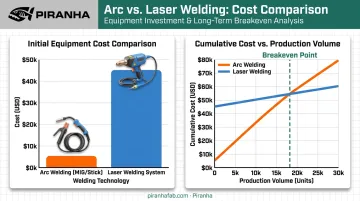
Arc welding keeps capital costs low. A MIG or Stick setup costs a fraction of a laser system, and consumables (wire, tungsten, flux) are cheap and available everywhere.
Laser systems demand a much bigger check upfront, plus tighter fixturing and part fit-up. The payback comes later, through faster cycle times and less post-weld cleanup, but only if your production volume justifies the investment.
What is Arc Welding?
Arc welding covers a family of processes, all built around the same principle: an electric arc melts base and filler metal to form a joint. The variant you choose depends on material, joint access, and required finish:
- MIG/GMAW: Continuously fed wire electrode; fast and forgiving, making it the default choice for general fabrication
- TIG/GTAW: Nonconsumable tungsten electrode with tight control, favored on stainless and aluminum
- Stick/SMAW: Flux-coated consumable rod that's rugged, portable, and a field-repair staple
- FCAW: Continuously fed flux-cored wire delivering strong penetration on thick sections, common in structural and shipbuilding work
Arc welding has stayed the backbone of heavy fabrication for one simple reason: it's affordable and it travels. A generator and a Stick welder can work almost anywhere, with no clean room or fixed cell required. Multi-position capability (flat, vertical, overhead) means the same operator can move from a shop floor weld to an overhead field repair without switching equipment.
Where Arc Welding Earns Its Keep
Arc processes dominate wherever material runs thick and joints carry structural load:
- Structural steel assembly and building frames
- Trailer chassis and frame welding
- Heavy equipment fabrication
- Pipeline and tank construction
Construction, shipbuilding, and trailer or truck-body manufacturing all lean on GMAW and FCAW specifically because these processes handle thick steel sections in a single pass, without the fixturing precision laser welding demands. For shops running high consumable volume, welding cost is driven far more by labor and overhead than by materials. Fit-up quality and operator efficiency matter more than which arc process you pick.
What is Laser Welding?
Laser beam welding swaps the electric arc for a focused beam of light, delivering heat with far more precision than any arc process can match. That precision translates into real operational advantages:
- Narrow HAZ reduces rework and warping on heat-sensitive parts
- Non-contact process cuts down on electrode wear and contamination
- Automation-ready design supports scaling production without swapping equipment
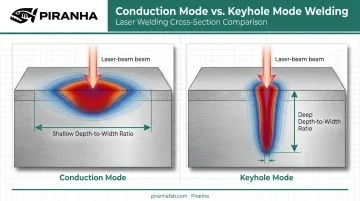
Laser welding runs in two distinct modes. Conduction mode absorbs energy at the surface, producing a wide, shallow weld. Keyhole mode forms a vapor cavity that drives a deep, narrow weld with a high depth-to-width ratio, closer to what arc welding produces but with a fraction of the heat input.
Systems range from fully automated robotic cells down to handheld units that operators run manually, similar in feel to a MIG gun.
Where Laser Welding Fits in Production
Laser welding dominates high-volume, precision-driven work where thermal distortion isn't an option:
- Automotive body panels
- Aerospace components
- EV battery enclosures
- Electronics and medical device assemblies
Piranha's MA1 Series handheld laser welders, for example, run up to 4 times faster than traditional MIG/TIG welding on mild steel. That kind of gain compounds fast across a full production shift in a high-mix fabrication shop.
That speed, paired with a narrower HAZ, is exactly why shops moving thin-gauge sheet metal keep gravitating toward laser.
Arc vs Laser Welding: Which Is Better for Your Shop?
There's no universal winner here. The right call comes down to five factors:
- Material thickness — thick structural sections favor arc; thin-to-medium gauge favors laser
- Production volume — high-volume runs justify laser's upfront cost; low-volume work rarely does
- Budget for equipment and training — arc has a lower entry point and shorter learning curve
- Required weld aesthetics — laser's narrow HAZ wins where cosmetic finish matters
- Floor space and automation goals — laser cells scale into lights-out production more easily
Choose arc welding for thick or structural work, field repairs, or tighter budgets. Choose laser welding for thin materials, high-precision runs, or high-volume production where distortion control matters.
For shops caught in the middle, hybrid laser-arc welding combines a keyhole laser with a MAG arc in one weld pool. Testing on 4mm, 6mm, and 8mm steel plate showed better gap tolerance than laser alone, with deeper penetration than typical arc processes. It's a real option for thicker sections that still need speed.
Upstream Prep Matters More Than the Welding Method
Regardless of which process ends up on your floor, weld quality starts before the torch or laser head ever fires. Kris Boles, President of Wilco Machine & Fab., explains how upstream tolerances changed his shop's output:
"Probably the one thing that's been as satisfying to us as anything is the tolerances we've been able to hold. It has saved us a tremendous amount of time."
Accurate cutting, repeatable hole positioning, and clean edges produced by fiber laser cutters and ironworkers improve joint fit-up before welding even starts. Poor fit-up creates gaps, which lead to rework no matter how good your welding process is.
Real-World Example: Titan Trailers
Titan Trailers manually welded steel and aluminum couplers for years. The process was slow and physically exhausting for operators, and it capped how much volume the shop could push through.
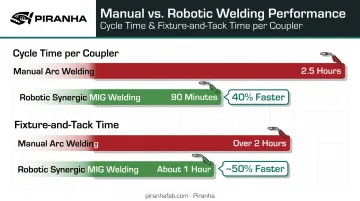
The fix was automating the existing arc process rather than switching to laser welding. Titan Trailers moved to robotic gas-metal-arc (synergic MIG) welding for its high-volume coupler line. The results were significant: cycle time on steel couplers dropped from 2.5 hours to 90 minutes, and fixture-and-tack time fell from over two hours to about one hour.
The takeaway: applying the right process more consistently often beats chasing new welding technology. Reliable, precise upstream equipment, the kind Piranha supplies as a single-source manufacturer, sets up any shop for that consistency, whether the downstream process is arc, laser, or both.
Conclusion
There's no single "winner" between arc and laser welding. The right choice depends on material thickness, production volume, budget, and how much precision your parts demand. Plenty of shops end up running both, using each where it fits best.
What ties every outcome together: lower operating costs, less rework, faster turnaround, consistent weld quality. It traces back to more than the welding torch itself.
Pairing the right welding process with precise, repeatable part preparation is what sets a shop up for long-term production efficiency. Piranha's cutting systems help deliver that same upstream precision, keeping parts weld-ready regardless of process.
Frequently Asked Questions
Is laser welding as strong as arc welding?
Laser welding can match or exceed arc weld strength on thin-to-medium sections and precision applications. Proper joint prep, material selection, and process control matter just as much as the welding method itself.
Do laser welders need gas?
Most laser welding processes use shielding gas, commonly argon or nitrogen, to protect the weld pool from oxidation. This serves the same purpose as shielding gas in MIG or TIG welding.
Can laser welding replace MIG welding?
Laser welding can replace MIG in thin-material, high-precision, or automated production settings. MIG remains the better choice for thicker materials, field repairs, and lower-volume or budget-constrained shops.
Is laser welding more expensive than arc welding?
Laser welding equipment carries a much higher upfront cost than arc equipment. Faster speeds and reduced rework can offset that investment over time in high-volume operations.
What is the maximum material thickness laser welding can handle?
Laser welding works best on thin-to-medium thickness material, with high-power systems capable of deeper single-pass welds depending on the material and beam quality. Very thick sections still typically favor arc welding.
Can arc and laser welding be used together?
Yes — hybrid laser-arc welding combines the deep penetration of an arc with the speed and precision of a laser beam. It's a practical middle ground for thicker or less precisely fit joints.