Introduction
Walk onto a trailer OEM's production floor in Indiana or a switchgear enclosure shop in Ohio, and you'll see it: raw coil moving into a laser tower, cut blanks routing to a robotic press brake, finished parts stacking for weld-out.
No hand touches the metal until final assembly. Fully automated sheet metal fabrication has moved from trade-show demo to standard production floor across North America.
Labor shortages are pushing the shift. U.S. manufacturers may need as many as 3.8 million new workers by 2033, with roughly 1.9 million of those jobs at risk of going unfilled, according to a Deloitte and Manufacturing Institute study. Shops can't hire their way into 24/7 capacity anymore.
But "automation" gets thrown around loosely. Buying one robotic cell isn't the same as running an integrated, end-to-end line, and confusing the two leads to blown budgets and ROI math that never pencils out.
This guide goes inside the actual mechanics of a fully automated line, stage by stage, not the sales pitch.
Key Takeaways
- Fully automated fabrication links loading, cutting, forming, and handling into one software-directed sequence
- Four stages drive it: initiation, core operation, regulation, and output
- High-mix and high-volume shops benefit most under NEMA/UL tolerances and multi-shift demands
- Automation-ready equipment lets shops add load/unload systems in phases instead of replacing machines outright
What Is Fully Automated Sheet Metal Fabrication?
Fully automated sheet metal fabrication is a production model where material loading, cutting or punching, forming, and part transfer between stations run through CNC-controlled machines, robotics, and material handling systems. Software (CAM, MES, or ERP) coordinates the whole sequence with little to no manual intervention at each station.
That's the technical definition. Here's the practical one: automation decouples output from headcount.
Manual, station-by-station handling creates problems that compound as volume grows:
- Fatigue-driven errors on late shifts
- Inconsistent tolerances between operators
- Capacity limits tied directly to how many trained hands you can staff
What it is not: owning a single automated laser doesn't make a shop fully automated. If bending and material handling still run manually, you've automated one station, not the line.
A partially automated line still carries most of the labor cost of a fully manual one, which throws off ROI projections built on "we bought an automated machine."
Hard, Programmable, and Adaptive Automation
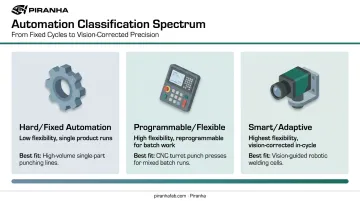
Three classifications cover most of what's running on shop floors today:
| Type | Flexibility | Best fit |
|---|---|---|
| Hard/fixed | Low, built for one product | Long, stable production runs |
| Programmable/flexible | High, reprogrammable via CNC | Batch work, mixed part families |
| Smart/adaptive | Highest, sensor and vision-corrected | Variable material, in-cycle correction |
The process sequence barely changes between types. What changes is flexibility and setup time at each stage.
Despite the buzz around AI-driven "smart" systems, programmable fixed-sequence automation remains the backbone of most fabrication shops. It delivers repeatable output at lower complexity than adaptive systems that lean on vision and machine learning to self-correct.
For a shop cutting NEMA enclosure panels or trailer subframes, a programmable CNC laser paired with a robotic press brake often gets the job done without the added cost of adaptive sensing layers.
How Does Fully Automated Sheet Metal Fabrication Work?
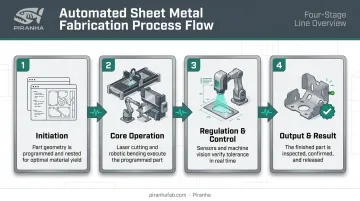
A fully automated line moves a part through four connected stages: initiation, core operation, regulation, and output. Each stage hands off digitally to the next, with software carrying the part's data forward instead of a person carrying a traveler sheet.
Initiation
The process starts before any metal moves. A CAD/CAM file and a production schedule pulled from ERP or MES software trigger nesting software, which generates a cutting plan and machine program automatically.
This stage is automated once engineering work is done, but someone still has to do that engineering work. Program setup, tooling selection, and nesting logic require human input upfront. Automated doesn't mean unattended from the design phase forward.
Common bottleneck: unstandardized part designs or inconsistent material specs at this stage force reprogramming or manual correction, and that friction cascades downstream. A nesting file built on the wrong material gauge doesn't just slow down cutting. It throws off bend allowances and tooling selection at every station that follows.
Core Operation
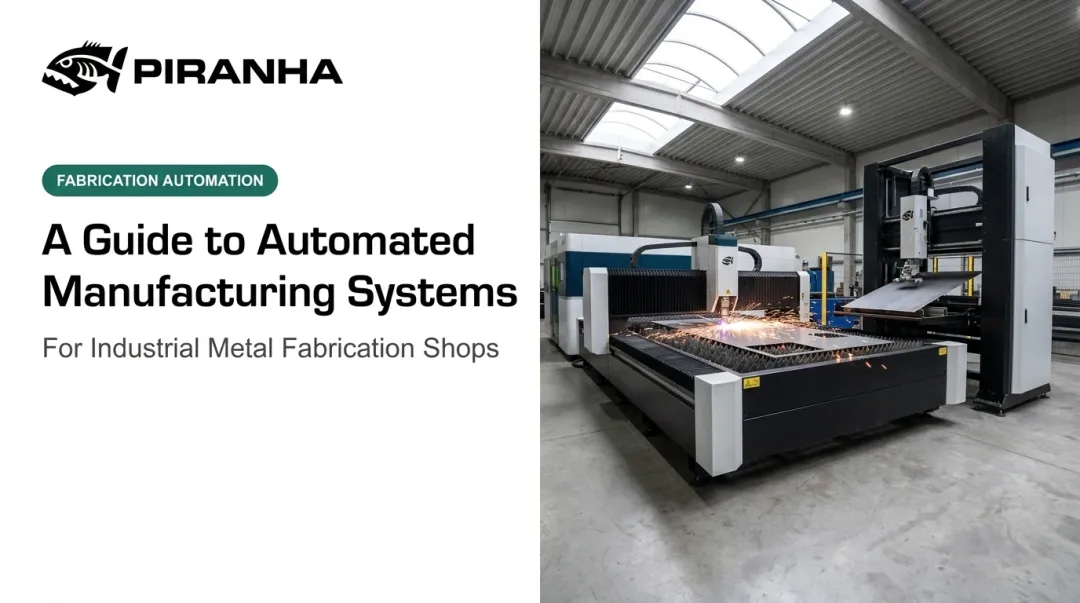
This is where metal actually moves. Automated loaders or towers feed raw sheet onto a laser, plasma, or turret punch, which cuts blanks without an operator physically placing material on the table.
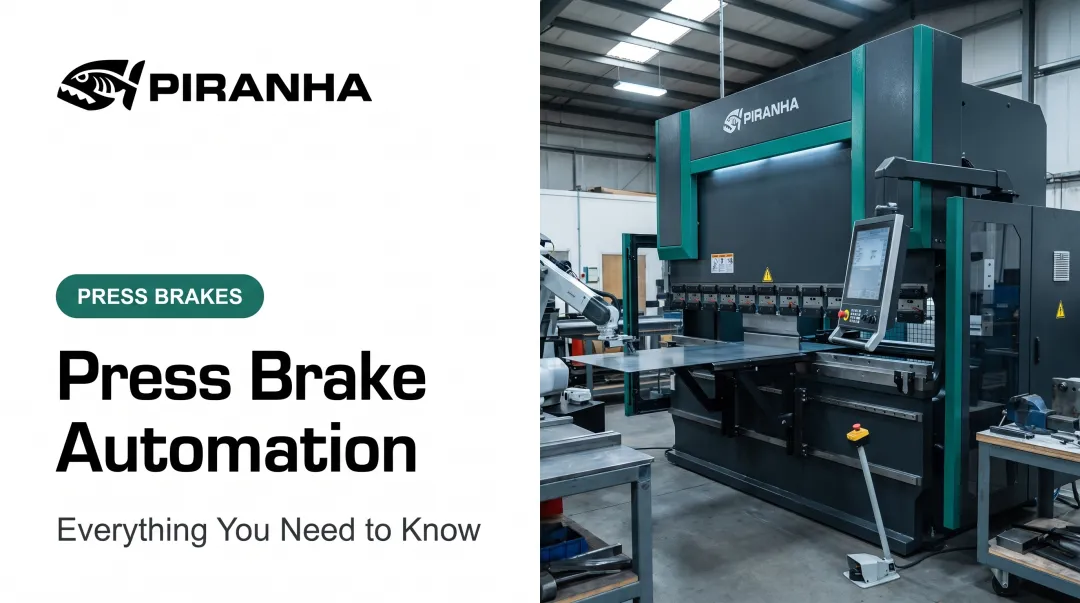
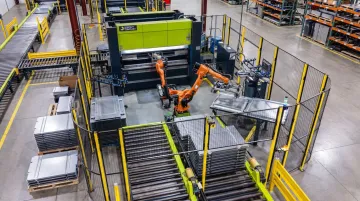
From there, automated unloaders or robotic arms transfer cut parts to a robotic press brake or panel bender. Tool changeovers and bend sequences run on program, without a person adjusting bend angles by hand.
Equipment purchased with automation-ready design matters most at this stage. A fiber laser built to integrate with load/unload systems, now or later, lets a shop add automation in phases as volume grows rather than replacing the machine entirely.
Piranha's fiber laser lineup follows this design philosophy: the base machine ships ready to connect to a lift-assist arm, a load/unload gantry, or a full tower system without structural modification.
Three variables define performance at this stage:
- Cycle time consistency across shifts
- Cut and bend accuracy against tolerance
- Ability to run unattended through nights and weekends
Regulation and Control
An automated line doesn't run blind. Vision systems and force sensors monitor cut quality, bend angle, and material variation in real time, catching drift before it turns into scrap.
IoT-connected sensors also track machine vibration, temperature, and cycle data, flagging maintenance needs before a failure stops the line. That's predictive maintenance instead of reactive repair.
This stage exists because automation amplifies mistakes as much as it amplifies output. Without real-time correction, an automated line simply reproduces errors faster and at higher volume than a manual process ever could.
A bend angle off by half a degree on one manually formed part is a nuisance. That same error programmed into a robotic press brake running unattended for eight hours is a pallet of scrap.
Output and Result
The end result is a dimensionally consistent, quality-verified part ready for welding, assembly, or finishing, with production data logged automatically for traceability. No paper travelers, no guessing which shift ran a given part.
That consistency feeds directly into downstream operations. Welding cells, powder coating lines, and final assembly all run with less rework when parts arriving from cutting and forming already meet tolerance.
Real installations back this up. At Thunder Creek Equipment's Pella, Iowa, plant, a robot now loads, positions, forms, and unloads steel at a 135-ton press brake. The reported result includes more repeatable bend accuracy, higher downstream welding accuracy, and less scrap, tied directly to removing manual handling from the forming step.
That's the practical payoff of the regulation stage doing its job upstream. Output only stays consistent if the control layer catches problems before they reach the next station.
Where Fully Automated Sheet Metal Fabrication Is Used
Automation typically clusters around four workflow points: blanking and cutting, forming and bending, material handling between stations, and, on more integrated lines, robotic welding or assembly hand-off.
It performs best under specific conditions:
- High part-volume runs where changeover cost amortizes fast
- Precision-driven specs, like NEMA or UL-rated enclosure work, where tolerance can't drift shift to shift
- Multi-shift or unmanned production windows where headcount can't scale with demand
Industry patterns vary, even though the underlying mechanics stay similar:
- Trailer and truck body OEMs run automated cutting-to-bending lines for subframes, panels, and body components. Stoughton Trailers, for example, runs in-house subassembly using automated lasers for cutting, shearing, punching, and bending.
- Power, transformer, and switchgear enclosure fabricators apply automated lines to tank plates, breaker housings, bus compartments, and NEMA-rated cabinets — components with tight tolerance requirements and long production runs.
- Structural steel shops use CNC robotic plasma processing for beams, channel, and angle, though that falls under structural fabrication rather than thin-gauge sheet work.
These three segments, trailer OEMs, enclosure fabricators, and structural shops, make up a large share of the North American shops evaluating automation right now. They're also where Piranha sees the heaviest demand for automation-ready laser and press brake equipment.
Conclusion
Fully automated sheet metal fabrication runs as a coordinated sequence, not a single machine humming away in the corner: initiation sets the program, core operation cuts and forms the metal, regulation catches errors in real time, and output delivers a traceable, ready-to-weld part.
Shops evaluating automation should weigh that full sequence before writing a purchase order. A robotic cell bolted onto an otherwise manual line won't deliver the ROI the sales brochure promised.
The smarter move is prioritizing equipment designed for phased, automation-ready integration. Piranha builds its fiber laser and press brake lines for that kind of scalability, so shops can add automation now or later without replacing the machine when volume grows.
Frequently Asked Questions
Are there fully automated fabrication factories in the US?
Yes, fully automated lines run across the U.S., particularly among trailer, power equipment, and enclosure OEMs. Most facilities operate a hybrid mix of automated and manual stations rather than a fully unmanned factory floor.
What are two common types of fabrication?
Structural fabrication covers heavy steel, beams, frames, and channel, for load-bearing construction. Sheet metal fabrication cuts, bends, and forms thinner-gauge metal into enclosures, panels, and components.
What are some examples of automated fabrication?
Common examples include automated laser or plasma cutting with load/unload towers, robotic press brakes and panel benders, and material handling systems that move blanks between stations without manual lifting.
What equipment is used in fully automated sheet metal fabrication?
Core equipment includes fiber laser cutters, combination punch/plasma machines, robotic press brakes, ironworkers, and automated material handling systems, often built with automation-ready mounting points and controls from the factory.
How much does it cost to automate a sheet metal fabrication line?
Cost varies widely, from a single robotic cell to a full cut-to-bend line. ROI depends on production volume, local labor rates, and whether equipment was purchased automation-ready for phased scaling rather than a full rebuild.
Can automation handle custom or low-volume sheet metal parts?
Modern programmable automation handles custom and low-volume work efficiently through fast program changeovers and flexible tooling. One automated panel bender, for example, runs up to 80% faster than a manual press brake on comparable parts.