
Introduction
Search "Buffalo ironworker for sale" and you won't land on a shiny new-equipment page. You'll land in the used market.
Buffalo Forge built its reputation over a century ago. Most units circulating today are secondhand, reconditioned, or sitting in a liquidation lot.
That creates real risk. Buyers face uncertain machine condition, spotty parts availability, and hidden costs that can turn a bargain into a budget disaster.
This guide covers where these machines actually get sold, what to inspect before you sign anything, and what fair pricing looks like. It also explains why a new ironworker sometimes pencils out cheaper than a decades-old used one.
Key Takeaways
- Buffalo ironworkers carry a 120+ year legacy built on punching, shearing, notching, and bending
- Nearly every unit for sale today is used, making inspection and documentation essential
- Pricing swings widely based on tonnage, age, condition, and included tooling
- Parts scarcity and zero warranty coverage are the biggest risks with legacy machines
- Total cost of ownership, not sticker price, decides whether used or new actually wins
Understanding Buffalo Ironworkers: A Quick Overview
Buffalo Forge Company got its start in 1878, making portable blacksmith forges. Over the decades, the lineup grew into punches, shears, and bar cutters that fabrication shops leaned on for generations.
American Punch Co., an industrial punch-and-die manufacturer, credits Buffalo as the originator of the multi-station ironworker concept. Machines were historically offered in sizes ranging from 1/2 through 3-1/2.
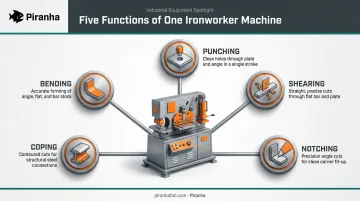
A single Buffalo ironworker typically handles:
- Punching — clean holes through plate and structural shapes
- Shearing — flat bar and plate cutting
- Notching — angle and channel prep
- Coping — structural steel fit-up
- Bending — light-gauge forming on some models
That versatility is exactly why demand for used units stays steady. Structural steel fabricators, general manufacturing shops, construction outfits, and trailer or truck body builders all want one machine that replaces four or five single-purpose tools. Fewer machines, less floor space, one operator running multiple operations. That steady demand raises a practical question: what should you check before buying a used unit?
Where to Buy a Buffalo Ironworker for Sale
Used Buffalo units show up across a handful of channels, each with different tradeoffs.
Industrial Equipment Dealers and Marketplaces
Specialized used-machinery marketplaces list model numbers, tonnage, hours, photos, and sometimes service history. Surplus Record, a marketplace operating since 1924, showed over 191,000 machinery and electrical-equipment listings in a recent snapshot. That scale is useful, but field completeness varies listing to listing. Some sellers post full specs and photos; others post a price and little else.
Auctions and Plant Liquidations
Bankruptcy sales and plant liquidations can produce lower prices, but the equipment is almost always sold as-is, where-is. No guarantees on description accuracy, no warranty, and inspection is entirely on you. If the auction house doesn't allow a pre-sale walkthrough, that's a red flag worth weighing against the discount.
Other Channels Worth Checking
A few additional channels round out the search, each suited to a different comfort level with risk:
- Online industrial classifieds: Search by tonnage and size first, then filter by seller rating - verification matters most here since private sellers mix with dealers.
- Regional machinery dealers and brokers: These often carry multiple trade-in units at once, letting you compare condition side by side instead of relying on memory.
- Dealers who sell both used and new: A few specialists carry legacy used brands alongside new-production ironworkers, letting you compare a reconditioned Buffalo against a new machine under one quote and delivery timeline.
Buying Checklist: What to Inspect Before You Purchase
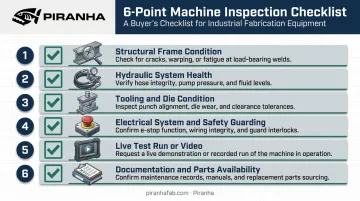
Skipping inspection on a machine this old is how a "good deal" becomes a shop liability. Work through this checklist before any money changes hands.
- Structural frame condition — Look for cracks, weld repairs, or excessive wear on the housing. Repeated punching shock can stretch a frame over decades, and that shows up as fatigue you won't catch from photos alone.
- Hydraulic system health — Check hoses, cylinders, and the pump for leaks or weeping seals. Request maintenance and service records. Machines without documented history carry hidden risk that a visual inspection alone won't reveal.
- Tooling and die condition — Confirm exactly which punches, dies, and shear blades are included. Worn or mismatched tooling adds cost the moment you take delivery.
- Electrical system and safety guarding — Verify e-stops function and guards are intact. Older units frequently fall short of current safety expectations, and retrofitting guarding isn't free.
- Request a live test run or video — Watch the machine cycle under load, checking for clean punched holes and shear cuts without excessive burr. A live demonstration predicts near-term reliability more accurately than any spec sheet.
- Verify documentation and parts availability — Ask for manuals and parts lists. Confirm whether replacement parts are still being produced for that exact model and size before you commit.
That last point deserves extra weight. Buffalo publishes separate parts breakdowns for machines built before and after 1963, which is helpful for identification. It doesn't mean every part on that breakdown is still stocked or affordably priced today.
Pricing Guide: What Affects the Cost
Buffalo ironworker pricing swings more than most buyers expect, and tonnage alone doesn't explain it.
Recent asking-price snapshots from used equipment marketplaces showed:
| Listing | Stated Capacity | Asking Price |
|---|---|---|
| Buffalo Model 1/2, mechanical, condition "Good" | 50 ton | $4,250 |
| Buffalo Model 1/2, mechanical UIW | 50 ton | $7,500 |
| Buffalo Model 1/2 listing | 58 ton | $4,444 |
| Universal ironworker, seller-labeled | 106 ton | $9,500 |
Two 50-ton machines, over $3,000 apart. Why? Because price depends on more than the tonnage stamped on the label:
- Age and model year: Earlier machines may lack updated safety features
- Condition and refurbishment level: A fully reconditioned unit with new seals and hydraulics costs more than an as-is machine sold straight off a shop floor
- Included tooling: A machine with a full set of punches, dies, and shear blades is worth meaningfully more than a bare frame
- Documentation: Service records and manuals add buyer confidence, which shows up in the price
Keep in mind these are asking prices, not confirmed sale results, so treat any single listing as a data point, not a benchmark. And remember: the number on the invoice is only part of what you'll actually spend. That's where things get more complicated.
The Hidden Costs of Buying Used—and Why a New Ironworker May Pay Off Faster
The sticker price on a used Buffalo ironworker is rarely the full story. Four cost categories tend to surface after the sale, not before.
Parts Obsolescence
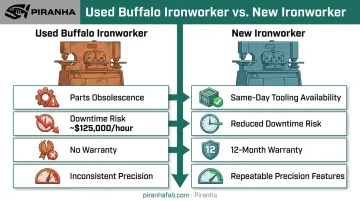
Older legacy machines run into discontinued production runs. When a critical part isn't stocked anywhere, shops end up waiting on long lead times or paying for custom-fabricated replacements. Neither cost shows up in the purchase price.
Piranha addresses this differently on its own equipment line. Standard tooling sizes ship same-day from its Belvidere, Illinois facility, and its die catalog cross-references Buffalo, Cleveland, and American Punch Co. specs. Shops running an older Buffalo machine can often source compatible replacement punches and dies through Piranha's tooling catalog instead of chasing down obsolete OEM parts.
Downtime Risk
This is the cost buyers underestimate most. An ABB survey of over 3,200 plant-maintenance decision-makers found the typical unplanned outage costs close to $125,000 per hour, and more than two-thirds of respondents said outages happen at least monthly. A machine with no warranty and uncertain parts sourcing carries that risk every single day it's on your floor.
Warranty and Support Gaps
Used equipment purchases almost never include a warranty. Piranha backs new ironworkers with a 12-month warranty on materials and workmanship from the date of shipment, plus U.S.-based phone support. No overseas call queue, no guessing whether a distributor still exists.
Precision for Spec-Driven Work
Older machines can also fall short on repeatability. Fabricators building to NEMA or UL-relevant drawings need consistent hole positioning and clean cut edges every cycle, something a worn 50-year-old frame may no longer deliver reliably. New Piranha ironworkers are built with features like automatic urethane hold-downs and low rake angle shears specifically to hold that consistency across enclosure and switchgear work.
Weigh all four factors together, and a used Buffalo at $7,500 with unknown parts sourcing and zero warranty can end up costing more than a new machine with support built in.
Frequently Asked Questions
How much does a used Buffalo ironworker cost?
Pricing depends on size, age, condition, and included tooling, with recent asking prices ranging roughly from $4,250 to $9,500. Compare several listings and normalize for tooling and documentation before committing.
What sizes do Buffalo ironworkers come in?
Buffalo's lineup historically spans 1/2 through 3-1/2 size designations. Match your shop's material thickness and workload to the exact model's capacity table rather than the size label alone.
Can I still get parts for an old Buffalo ironworker?
Parts availability varies by model and age, and it's not guaranteed. Confirm sourcing before purchasing, since suppliers like Piranha maintain cross-referenced die catalogs covering legacy Buffalo punches and dies.
What's the difference between buying new vs. used ironworker equipment?
New equipment from manufacturers like Piranha comes with a warranty, U.S.-based support, and modern safety features that used machines typically lack. Total cost of ownership, including downtime risk, often favors new once you run the full comparison.
How long do ironworker machines typically last?
With proper maintenance, ironworkers can run for decades. Wear parts like tooling, seals, and hydraulic components still need periodic replacement regardless of the machine's age.
Are Buffalo ironworkers still manufactured today?
Buffalo's legacy brand status means most units for sale are secondhand or reconditioned rather than fresh off a production line. Buyers should treat any purchase as used equipment, or consider new ironworkers from manufacturers like Piranha for factory warranty coverage.