That reality is fading fast. Fabrication shops today face a different problem entirely: finding and keeping skilled labor. The Manufacturing Institute projects US manufacturers will need 3.8 million new workers between 2024 and 2033, with as many as 1.9 million positions going unfilled if the skills gap doesn't close.
That's why "easy to run" isn't a marketing line anymore. It's a competitive edge. Modern CNC plasma systems, from automated torch height control to smarter cutting tables, have stripped away most of the old complexity. Here's what changed, and what to look for when you're shopping for a system.
Key Takeaways
- CNC (Computer Numerical Control) automates torch movement, replacing hand-guided cutting.
- Automatic torch height control and nesting software eliminate the guesswork that once intimidated new hires.
- A poorly built cutting bed can undermine even the best torch automation.
- Ease of use doesn't have to come at the cost of precision or future scalability.
- Vendor support and service response deserve as much weight as the machine's spec sheet.
What Is CNC Plasma Cutting?
Plasma cutting works by forcing an electric arc through a gas, ionizing it into superheated plasma that can exceed 20,000 degrees Celsius (roughly 36,000 degrees Fahrenheit, depending on the system). That jet melts electrically conductive metal and blasts it out of the kerf, leaving a clean cut behind.
It handles carbon steel, stainless steel, and aluminum without breaking a sweat. That versatility is why it's become a staple across trailer manufacturing, structural steel, and enclosure fabrication.
What Does CNC Stand For?
CNC stands for Computer Numerical Control. Instead of a person gripping a torch and following a chalk line, a computer reads programmed code (G-code) and drives the torch along an exact, repeatable path.
The difference shows up immediately:
| Cutting Method | Accuracy |
|---|---|
| Handheld plasma cutting | Depends entirely on the operator's hand and eye |
| CNC-guided cutting | Motion is computer-controlled, so part five looks exactly like part one |
Why It Matters for Fabrication Shops
Consistency is the real win here. A skilled operator hand-cutting to a marked line can typically hold about 1.6 mm (1/16 in.). CNC changes that math entirely.
Hypertherm reports that entry-level mechanized systems hold roughly +/-0.76 mm, while high-definition CNC plasma systems tighten that to 0.25-0.51 mm depending on material and thickness.
That precision translates directly into OEM-spec work: trailer brackets that bolt together without grinding, structural steel profiles that hold tolerance across a production run, and electrical enclosures that meet UL and NEMA requirements without rework.
Why CNC Plasma Cutting Used to Feel Complicated
Older CNC plasma systems demanded real expertise just to keep running. A few reasons shops hesitated to adopt them:
- Constant height resets. Without automatic height control, operators had to manually set pierce height before every cut and adjust again for warped or uneven plate.
- CAM-heavy programming. Getting parts nested efficiently on a sheet required dedicated CAD/CAM knowledge, which meant a steep learning curve for anyone new to the machine.
- Layered maintenance headaches. Fume management, consumable upkeep, and machine calibration piled on extra complexity that discouraged smaller shops from ever giving CNC plasma a shot.
Plasma cutting still delivered strong results in the right hands, but it stayed a specialist's tool, one that required years on the machine before an operator felt confident.
The Technology That Made CNC Plasma Cutting So Much Easier
Most of that old complexity has been automated away. Here's what's doing the heavy lifting:
- Automatic torch height control (THC): Real-time arc-voltage feedback adjusts the Z-axis instantly, keeping the correct standoff distance on warped plate without manual height resets.
- Anti-dive and collision protection: Locks torch height on slow corner moves to protect consumables and tighten accuracy on tight curves. Magnetic breakaway assemblies release the torch on impact, stopping damage before it happens.
- Touchscreen, conversational controllers: Plain-language interfaces let operators without a CAD/CAM background load a design and start cutting fast, cutting the old learning curve down dramatically.
- Automated nesting software: Arranges parts on a sheet automatically to cut scrap and maximize yield. In one documented case using Hypertherm PlateSaver, material utilization improved 3.2% over conventional nesting.
- Automation-ready platforms: Today's systems connect with material loading, unloading, and robotic handling as production scales, so shops won't need to replace the machine. Piranha's ArcMax X CNC Plasma Tables, built on Hypertherm XPR technology, reflect this design philosophy.
- Preventive maintenance and remote diagnostics: Built-in monitoring catches problems early, and manufacturer-backed service programs reduce the troubleshooting burden on shop floor staff.
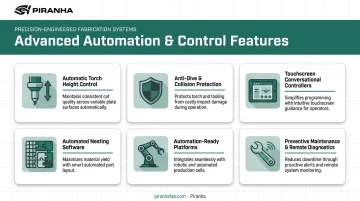
Together, these features have turned a machine that once demanded a seasoned specialist into one a new hire can run productively within days.
What Is a CNC Bed? The Foundation of Precision Cutting
The CNC bed, also called the cutting table, is the flat, slatted surface integrated with the machine's X/Y motion rails that supports your workpiece during a cut. It sounds simple. It isn't optional.
The slats are designed to let molten metal and dross fall away from the cut while keeping the plate supported and level. Worn or dross-covered slats create uneven support, which throws off cut angle and drives up scrap.
Water Tables vs. Downdraft Tables
Fume management comes down to two approaches:
| Feature | Water Table | Downdraft Table |
|---|---|---|
| Mechanism | Traps sparks and dross in water | Blower pulls smoke through ducting to a filtration system |
| Best fit | Smaller shops, lower-volume cutting | High-volume industrial operations |
| Relative cost | Lower upfront cost | Typically 40-60% more expensive to install on large machines |
| Maintenance | Sludge removal, freeze/corrosion management | Filter and ductwork upkeep |
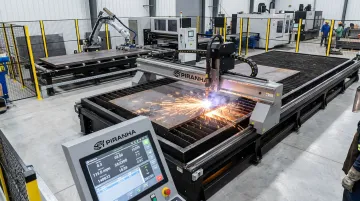
Bed size and structural rigidity matter just as much as the fume system. Industrial-grade beds need to handle heavier plate, common in trailer and structural steel work, without flexing or warping under load. Piranha builds its plasma and laser tables with reinforced beds for exactly that kind of heavy-plate production. No amount of THC, anti-dive protection, or nesting software makes up for a table that isn't built to stay flat.
Choosing the Right CNC Plasma System for Your Shop
A few things to weigh before you commit:
- Table size and amperage. Match the bed to your typical material dimensions and choose an amperage range that covers your usual plate thickness, not just today's jobs.
- Automation-readiness. Confirm the system connects to material handling or robotic integration later. Piranha's 4400 MAX at Degelman Industries cuts accurately enough that 80% of robotically welded parts skip secondary operations entirely.
- Vendor support. Installation help, hands-on training, same-day parts shipping, and US-based phone support all cut downtime. Piranha ships parts same-day from Belvidere, Illinois, and covers plasma tables, punch/plasma combos, and fiber lasers under one roof.
Weigh these factors together rather than shopping on sticker price alone. Factor in labor savings, reduced rework, and shorter operator ramp-up time. A machine that costs more upfront but trains a new hire in days instead of months often wins out on total cost of ownership over its lifetime.
Frequently Asked Questions
What does CNC stand for?
CNC stands for Computer Numerical Control. It's the automated system that drives torch movement using programmed code rather than a hand-guided torch.
What is a CNC bed?
The CNC bed is the slatted support table integrated with the machine's motion system. It holds the workpiece during cutting while letting dross and molten metal fall through.
Is CNC plasma cutting difficult to learn for new operators?
Not anymore. Touchscreen controllers and automated features like torch height control have shortened the learning curve compared to older manual-height systems.
What's the difference between handheld and CNC plasma cutting?
Handheld cutting relies on the operator's steadiness and eye for a line. CNC cutting uses computer-controlled motion, which delivers repeatable accuracy from the first part to the last.
How much does a CNC plasma cutting system cost?
Pricing varies widely based on table size, amperage, and automation features, ranging from around $60,000 for mid-industrial systems to $200,000 or more for high-production configurations. Request a tailored quote for accurate figures.
Can CNC plasma cutters handle thick industrial plate?
Yes. Higher-amperage CNC plasma systems are built for the thick plate common in structural and heavy fabrication work, well beyond what lighter hobbyist machines can manage.