That gap between speed and repeatability is where a lot of shops bleed money. Manual marking, re-measuring, and operator-dependent positioning create inconsistent hole placement, scrapped parts, and slower cycle times. Metal fabricators report scrap and rework averaging 1.4% of sales, according to The Fabricator's 2024 financial survey — and positioning errors are a common contributor to that number.
This guide breaks down how pneumatic punch machines actually work, what a display controller adds, and how to spec the right setup for production that has to hit tolerance every single time.
Key Takeaways
- Compressed air powers the punch stroke, while the display controller delivers precise positioning.
- Programmable positioning removes manual marking and re-measuring from the workflow entirely.
- These machines are workhorses for NEMA/UL enclosure work, trailer manufacturing, and structural steel.
- Match tonnage, stroke, and controller sophistication to your production volume, not the reverse.
- Piranha's punch and ironworker platforms pair rugged air/hydraulic power with repeatable, precise controls.
How Does a Pneumatic Punch Machine Work?
The mechanics are refreshingly straightforward. An air compressor feeds compressed air into a pneumatic cylinder. That air pushes a piston, and the piston drives the punch straight through the material and into a matched die below it. No exotic engineering — just pressure and geometry doing the work.
Core components involved in the system:
- Air compressor (the power source)
- Pressure regulator (controls force output)
- Directional and flow control valves (control timing and speed)
- Pneumatic cylinder with piston
- Punch and die assembly
- Mounting table or bed
The Punch Cycle, Step by Step
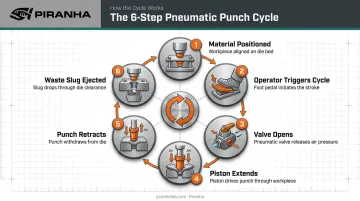
- Material is positioned on the die, either manually or via a positioning table.
- Operator triggers the cycle using a foot pedal or button.
- The valve opens, directing compressed air into the cylinder.
- The piston extends, driving the punch through the material and into the die.
- The punch retracts as air redirects to the return side of the cylinder.
- Waste slug is ejected or retained, depending on the die style, and the part moves to the next hole location.
Stroke length, air pressure, and punching speed are all adjustable to match material thickness and hole geometry. A thicker plate or a larger hole diameter needs more force; a thin enclosure panel needs speed more than brute tonnage.
Cylinder force is a function of pressure and piston area. Speed depends mainly on airflow through the valves, so shops tune both independently depending on the job.
Safety hasn't stood still either. Modern machines commonly incorporate presence-sensing guards and interlocked sensors that stop the cycle if a hand strays into the point of operation.
OSHA's machine guarding standards make clear that presence-sensing devices must be interlocked with the control circuit. A display controller doesn't replace that guarding, but it works alongside it to keep high-speed cycles safer.
The Role of a Display Controller in Modern Punch Machines
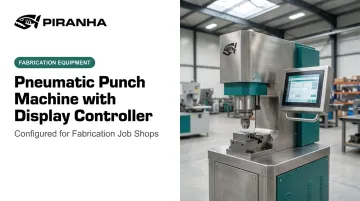
A display controller is the digital interface (touchscreen, LCD, or LED panel) that lets an operator set, save, and recall punch positions, stroke depth, and pressure settings instead of re-measuring every single part.
Here's the practical difference it makes:
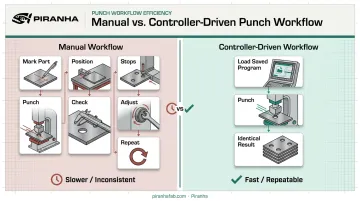
Manual workflow: Mark the part, position it, punch it, check it, adjust, repeat for every hole and every part in the run.
Controller-driven workflow: Load a saved program once. Every subsequent part gets identical hole placement because the coordinates are already stored, with no marking and no guesswork required.
Repeatability That Compounds Across a Production Run
The advantage compounds across hundreds of parts, not just one. Once a hole pattern is programmed, the controller repeats it exactly, run after run. That consistency matters when parts feed into NEMA or UL-rated enclosure assemblies, where opening placement affects gasket seating and overall enclosure performance.
Many controllers also integrate with backgauges or positioning tables to execute multi-hole patterns automatically, which is critical when a single enclosure panel needs a dozen precisely spaced holes and zero tolerance for drift between them.
Diagnostics That Prevent Downtime Surprises
Beyond positioning, display controllers typically track:
- Cycle counts for maintenance scheduling
- Fault codes that flag issues before they cause a breakdown
- Program libraries that store dozens of part configurations for instant recall
This is the philosophy behind Piranha's approach to punch and ironworker equipment: controls designed for repeatable hole positioning and clean, spec-compliant cuts, not just raw punching force. The real payoff is fewer scrapped parts and less time spent setting up between jobs.
Key Benefits of Pneumatic Punch Machines with Display Controllers
Pairing pneumatic actuation with a digital controller solves several problems at once.
Speed. Air actuation is inherently fast, and pre-programmed positioning eliminates the dead time spent marking and measuring between parts. The cycle itself takes seconds; it's the setup time between cycles that a controller compresses.
Precision and consistency. Digital control removes the variability of human eyeballing on spec-driven parts like structural connections and electrical enclosures. The tenth part matches the first.
Lower operating costs. A single air compressor can often power multiple stations, and pneumatic systems generally involve simpler mechanics than full hydraulic setups. That said, air isn't free to move around a shop:
Leaks can waste 20% to 30% of total compressor output in poorly maintained compressed-air systems, according to the U.S. Department of Energy.
Tight air lines and regular leak checks show up directly in your operating costs, making them a maintenance priority rather than an afterthought.
Improved safety. Programmed strokes combined with presence-sensing guarding reduce operator exposure at the point of operation. According to OSHA's mechanical power press safety data, 49% of injuries involving mechanical power presses resulted in amputation. Guarding and programmed cycles both earn their place on the shop floor for that reason.
Scalability. Shops can start with basic digital controls and layer in automation (backgauges, multi-station feeds, robotic loading) later, without replacing the core machine. Piranha designs its equipment around that same principle: machines built to scale with your production growth instead of forcing a full replacement every time volume jumps.
Industries and Applications
Pneumatic punch machines with display controllers show up wherever repeatable holes at volume matter more than one-off custom work.
- Structural steel and construction: Punching aluminum window and door frames or steel framing members where consistent hole spacing speeds up downstream assembly and reduces field fit-up problems.
- Trailer and truck body manufacturing: Repeatable hole patterns across cross-members, brackets, and mounting points matter when one trailer design requires thousands of identical parts each production year.
- Electrical enclosure and switchgear fabrication: Tight-tolerance, NEMA/UL-relevant hole punching affects gasket seating, device mounting, and the enclosure's tested construction. Display controllers hold that precision on part two hundred, not just part one.
Each of these applications shares the same underlying requirement: hole placement that doesn't degrade as fatigue, shift changes, or operator turnover enter the picture.
Choosing the Right Pneumatic Punch Machine for Your Shop
Specs matter, but only in the context of what you're actually producing. Before comparing machines, nail down these four factors:
| Factor | What to Evaluate |
|---|---|
| Tonnage capacity | Calculated force needed based on material thickness, hole perimeter, and material strength, then checked against both machine and tooling limits |
| Punch stroke length | Usable stroke, shut height, and whether full rated force is available at the point in the stroke you need it |
| Material thickness range | Confirm capacity for your actual gauge range, not just a general "mild steel" claim |
| Controller sophistication | Basic digital readout versus full CNC-style positioning with backgauge integration |
Total Cost of Ownership Beats Sticker Price
A cheaper machine that breaks down twice a year costs more than a slightly pricier one that doesn't. Factor in:
- Durability of the core mechanics
- Parts availability and lead time
- Service response time when something does go wrong
This is where single-vendor simplicity pays off. Piranha ships parts same-day from its Belvidere, Illinois facility and backs machines with U.S.-based service. That means one quote, one install team, and one parts catalog, instead of chasing down three different vendors when a seal kit or die needs replacing.
Build in Room to Grow
Beyond parts and service, plan for how your needs will change. Choose a controller platform that supports future upgrades, such as added backgauges, expanded program storage, or integration with automated feeding. Avoid one that locks you into replacing the entire machine when production volume climbs. A machine you buy today should still make sense in five years, not force a rebuy the moment your order volume doubles.
Frequently Asked Questions
How does a pneumatic punching machine work?
Compressed air drives a piston inside a cylinder, which forces the punch through the material and into a matched die. The cycle repeats each time the operator triggers it via a foot pedal or button.
Do pneumatic punching machines work?
Yes, they're widely used across fabrication because of their simple, reliable mechanics. Fewer moving parts and failure points mean less downtime compared to more complex systems.
What is the difference between a pneumatic and hydraulic punch machine?
Pneumatic machines rely on air pressure, giving fast, simple operation ideal for lighter-gauge work. Hydraulic machines generate far higher tonnage, making them better suited to thicker materials and heavier-duty punching.
What materials can a pneumatic punch machine punch through?
Common materials include mild steel, aluminum, stainless steel, and select non-metal sheet materials. Actual capacity depends on tonnage, punch and die selection, and material thickness.
What does a display controller add to a punch machine?
It adds saved punch programs, precise repeatable positioning, and diagnostic feedback like cycle counts and fault alerts. These are capabilities a purely manual machine simply doesn't have.
How much maintenance do pneumatic punch machines require?
Regular tasks include lubricating seals, inspecting air lines for leaks or damage, and periodically checking punch and die wear. Staying on schedule with these keeps downtime minimal and cycle quality consistent.