Introduction
Walk onto almost any modern fabrication floor and you'll notice something missing: the constant flicker and hiss of TIG torches. Laser welding has become the fastest-growing joining technology in U.S. manufacturing, pushing into automotive, aerospace, and heavy fabrication shops that once ran exclusively on MIG and TIG.
Part of the reason is workforce math. The American Welding Society projects the U.S. will need 320,500 new welding professionals by 2029, and manufacturers are turning to automation to close that gap, according to recent workforce trend data. Laser welding manufacturers are answering with faster cycle times, cleaner welds, less rework, and lower labor overhead per part.
This guide ranks the top 10 laser welding machine manufacturers to watch in 2026 and breaks down how to evaluate them for a real, working production floor — not a spec sheet in a vacuum.
Key Takeaways
- Welder shortages and automation demand are driving faster laser welding adoption across U.S. fabrication
- Top picks span fiber laser pioneers (IPG, Coherent), legacy brands (Lincoln Electric), and portable specialists (DenaliWeld)
- Laser power, automation readiness, and U.S.-based service matter more than brand recognition
- One manufacturer for welding, cutting, and bending equipment simplifies service and scales with growth
Overview of Laser Welding Manufacturers in the Metal Fabrication Industry
A laser welding machine manufacturer designs and builds the laser source, the welding head, and (increasingly) the automation that moves the part through the weld. Get that sourcing decision wrong, and you're stuck with slow support, mismatched power output, or a machine that can't grow with your shop.
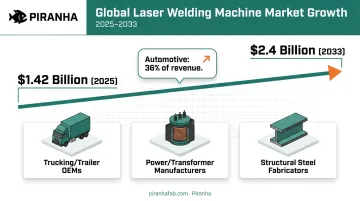
That risk is growing as the market itself expands. The global laser welding machine market was valued at $1.42 billion in 2025 and is projected to reach $2.4 billion by 2033, with automotive applications alone accounting for nearly 36% of that revenue. That growth is showing up on real shop floors:
- Trucking and trailer OEMs are swapping manual MIG stations for handheld and robotic fiber laser cells
- Power and transformer manufacturers use laser welding for cleaner, faster enclosure seams
- Structural steel fabricators are adopting it to cut rework on thick-plate joints
These are sectors Piranha has served for decades through its cutting, bending, and punching equipment — which makes the shift toward laser welding directly relevant to how a fabrication line gets built. Below, we evaluate manufacturers on technology, reliability, U.S. support, and total value.
Top 10 Laser Welding Machine Manufacturers in 2026
Before ranking anyone, it's worth being clear about the criteria. This list weighs:
- Fiber laser technology leadership: source quality and beam consistency
- Automation capability: handheld, cobot, and full robotic integration paths
- Industrial reliability: documented uptime and service track record
- U.S. service and support network: actual response times, not marketing promises
- Application versatility: proven performance across metals and part geometries
IPG Photonics
IPG is the name behind a lot of other companies' welding systems. Founded in 1990 and headquartered in Oxford, Massachusetts, IPG pioneered commercial fiber laser technology and still manufactures its own components in-house rather than sourcing them out.
That vertical integration shows up in beam quality and long-term reliability. Its LightWELD handheld line, which includes wobble welding for aluminum and copper, claims weld speeds up to 4x faster than TIG.
| Detail | Info |
|---|---|
| Headquarters/Founded | Oxford, MA / 1990 |
| Core Product | Fiber laser sources, LightWELD handheld systems |
| Best For | Large-scale industrial automation requiring premium reliability |
Coherent Corp.
Coherent's roots trace to 1971, with its current identity formed when II-VI acquired Coherent, Inc. and rebranded in 2022. Headquartered in Saxonburg, Pennsylvania, the company pours serious money into R&D: $582 million, or 10% of revenue, in FY2025.
This R&D investment funds precision fiber laser systems like ExactWeld, built for high-repeatability welding on small metal and plastic components used in medical and automotive electronics.
| Detail | Info |
|---|---|
| Headquarters/Founded | Saxonburg, PA / 1971 origins |
| Core Product | Precision fiber laser welding systems (ExactWeld) |
| Best For | Medical device, electronics, high-tolerance manufacturing |
Trumpf
Germany's Trumpf has built its reputation on high-precision industrial laser engineering, and its VisionLine OCT Check system is a genuine standout. It uses optical coherence tomography to measure keyhole depth in real time during deep welds, then logs the data for traceability.
For aerospace and automotive shops where a single bad weld can fail inspection, that kind of quality-critical monitoring is a real differentiator, not just a spec-sheet feature.
| Detail | Info |
|---|---|
| Headquarters/Founded | Ditzingen, Germany / global leader |
| Core Product | High-power fiber laser welders with OCT weld monitoring |
| Best For | Aerospace and automotive precision welding |
Lincoln Electric
Lincoln Electric has been a household name in American welding since 1895, and it now runs 71 manufacturing and automation-integration locations across 20 countries out of its Cleveland, Ohio headquarters. Few competitors can match that kind of footprint.
Its Laser-Pak robotic systems and Flex Lase handheld units (including cobot models) bring laser welding into shops that already trust Lincoln for metallurgy and service.
| Detail | Info |
|---|---|
| Headquarters/Founded | Cleveland, OH / 1895 |
| Core Product | Robotic laser welding cells (Laser-Pak), Flex Lase handheld |
| Best For | High-volume automotive and structural steel automation |
LaserStar Technologies
LaserStar has been manufacturing in the U.S. since 1957, out of Orlando, Florida. The company built its reputation on manual and semi-automated systems with strong ergonomics and hands-on operator training.
The FiberStar line targets integrators who need a reliable fiber laser source for custom automation builds, particularly in jewelry and medical device manufacturing.
| Detail | Info |
|---|---|
| Headquarters/Founded | Orlando, FL / 1957 |
| Core Product | Manual and semi-automated fiber laser welders (FiberStar) |
| Best For | Jewelry and medical device precision welding |
Amada Weld Tech
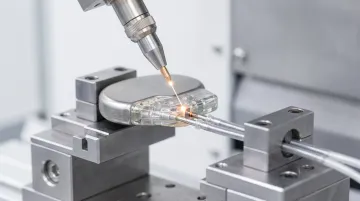
Amada Weld Tech's lineage runs through its predecessor Unitek (1948) and parent company Amada (1946). Based in Monrovia, California, the company specializes in application-engineered joining for medical devices, electronics, and automotive components.
What sets them apart is the full-stack approach: laser source, weld head, motion control, and quality monitoring, all configured as one turnkey system rather than assembled from separate vendors.
| Detail | Info |
|---|---|
| Headquarters/Founded | Monrovia, CA / 1946 (parent co.) |
| Core Product | Multi-axis fiber laser welding systems |
| Best For | Micro-welding and hermetic sealing applications |
Han's Laser
Han's Laser is one of Asia's largest laser equipment manufacturers, headquartered in Shenzhen, China. Its U.S. product lineup includes fiber laser welders for EV battery packs and precision parts, built with CCD camera vision systems to catch defects during the weld itself.
For manufacturers scaling battery or consumer electronics production, that vision-assisted automation is the main draw.
| Detail | Info |
|---|---|
| Headquarters/Founded | Shenzhen, China |
| Core Product | Handheld and robotic laser welders, battery welding lines |
| Best For | EV battery and consumer electronics manufacturing |
Alpha Laser
Alpha Laser, founded in 1994 near Munich, Germany, built its business around mobility. Rather than moving a workpiece to a fixed laser station, its ALM systems bring the laser head to the part, which is critical for repairing large injection molds and dies that can't be relocated.
The company maintains a U.S. presence in Meadville, Pennsylvania, for domestic service and support.
| Detail | Info |
|---|---|
| Headquarters/Founded | Puchheim, Germany / U.S. base in Meadville, PA / 1994 |
| Core Product | Mobile laser welding systems (ALM) |
| Best For | Mold/die repair and on-site industrial welding |
DenaliWeld
DenaliWeld is a newer, employee-owned American company based in Chicago, built entirely around portable equipment. The JET Series air-cooled welders weigh around 90 pounds, making them genuinely field-portable rather than "portable" in the loose industrial sense.
The company's robotic and cobot-compatible product lines give shops a growth path once handheld welding outpaces demand.
| Detail | Info |
|---|---|
| Headquarters/Founded | Chicago, IL |
| Core Product | Air-cooled portable JET Series welders |
| Best For | Small-to-mid fabrication shops needing portability |
Laser Photonics
Laser Photonics designs and builds its handheld and automated welders in Orlando, Florida, aiming squarely at shops transitioning off traditional TIG/MIG. The WeldTech line supports multiple weld-weave patterns and optional filler wire, with compact units built for transport between job sites or warehouse stations.
The company expanded its Orlando facility in 2024 to add a dedicated customer training center, a signal of how seriously it takes onboarding new laser welding operators.
| Detail | Info |
|---|---|
| Headquarters/Founded | Orlando, FL |
| Core Product | WeldTech handheld and robotic units |
| Best For | Shops seeking fast U.S.-based turnkey setup |
How We Chose the Best Laser Welding Machine Manufacturers
The most common buyer mistake is judging manufacturers by the wrong criteria. Shops chase a familiar brand name or the lowest quoted price, then discover months later that the laser source underperforms, service tickets sit unanswered, or there's no path to add automation later.
We built this list around factors that actually predict production ROI:
- Fiber laser technology leadership: who builds their own core components versus who resells someone else's laser
- Industrial reliability and uptime data: documented performance, not marketing claims
- U.S.-based support: response times when a machine goes down mid-shift
- Automation compatibility: whether the machine can grow from handheld to robotic without a full replacement
- Application breadth: proven results across the materials and joint types you actually run
None of these factors matter in isolation. A manufacturer with the best fiber laser source in the world is still a liability if support takes three weeks to answer the phone.
Beyond the Weld: Building a Complete Fabrication Line
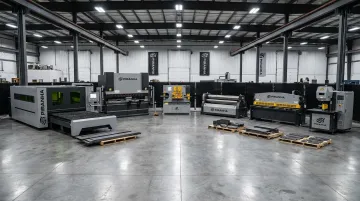
A laser welder is one station on a fabrication floor. The parts feeding into it (cut, punched, and bent) determine how clean and consistent that weld can actually be. Sloppy edges from an underpowered cutter create gaps a laser can't compensate for.
That's where Piranha comes in. With more than 140 years of combined heritage through its W.A. Whitney and Bertsch brands, Piranha builds fiber laser cutters, press brakes, ironworkers, plate rolls, and shears alongside its own laser welders. Every one of those machines comes from a single manufacturer.
For trailer OEMs, structural steel fabricators, and electrical enclosure builders, that single-vendor setup solves a real headache:
- A single quote instead of juggling five vendor proposals
- One install team replaces scheduling conflicts across multiple service windows
- No hunting down obsolete SKUs across three different parts catalogs
Piranha's fiber lasers, for instance, ship automation-ready from the factory: a dual pallet shuttle system, automatic focus cutting head, and retrofit-ready gantry options.
These features let a shop start manual and scale to lights-out production without replacing the machine. Pair that with U.S.-based service and stocked parts, and the case for a domestic, full-line manufacturer is hard to ignore.
Conclusion
Choosing a laser welding manufacturer comes down to technology fit, automation roadmap, and service reliability — not which name is most recognizable at a trade show. Before signing a purchase order, weigh total cost of ownership against actual uptime history, then confirm the machine can scale with your production plans.
If you're rounding out a fabrication line rather than buying a welder in isolation, Piranha's team can walk you through laser cutting, punching, and bending equipment that complements your welding investment. Support and parts ship from the same U.S.-based team behind your welding purchase.
Frequently Asked Questions
What is the difference between handheld and automated laser welding machines?
Handheld units are lower-cost, portable, and suited to small-batch or repair work where an operator guides the weld manually. Automated or robotic systems suit high-volume production where consistency and repeatability matter more than flexibility.
How much does an industrial laser welding machine cost in 2026?
Pricing varies widely based on laser power, cooling method, and automation level, with most manufacturers requiring a custom quote rather than publishing fixed prices. Research current quotes for the specific machine class your production volume actually needs.
Which industries benefit most from laser welding technology?
Automotive and EV manufacturing lead adoption, representing the largest share of global market revenue, followed by aerospace, medical devices, electronics, and general metal fabrication. Structural steel and trailer manufacturing are catching up fast.
Can laser welding machines weld aluminum and other reflective metals?
Reflective metals like aluminum and copper were historically difficult to weld with lasers. Modern beam-shaping techniques, including wobble welding and adjustable ring mode fiber lasers, have made these materials practical for production use.
How long does it take to train an operator on a laser welding machine?
Most manufacturers run one-day operator training courses, and operators typically produce quality welds within hours rather than the weeks required for traditional TIG/MIG certification. Exact timelines vary by machine and prior welding experience.
Do laser welding manufacturers also offer laser cutting or other fabrication equipment?
Most welding-focused brands specialize narrowly in laser sources and weld heads. Manufacturers like Piranha offer a broader fabrication line spanning cutting, punching, and bending equipment for shops that want a single vendor for the whole floor.