Introduction
Trucking, power, and structural fabrication shops are all fighting the same battle: shorter cycle times, tighter tolerances, and less rework. Customers expect faster turnarounds without a drop in quality.
Laser welding gets tossed around as a "future of welding" buzzword. But its real value isn't theoretical. It shows up in the numbers shops already track daily: cycle time, scrap rate, and labor hours per part.
This article breaks down what laser welding delivers on the shop floor, which KPIs it moves, and when it pays off for a fabrication operation.
Key Takeaways
- Laser welding slashes cycle times versus MIG/TIG on sheet metal seams
- Minimal heat distortion cuts warping and grinding, boosting first-pass yield
- Automation-ready laser cells scale production without adding headcount
- High upfront cost and strict fit-up requirements are the main tradeoffs to plan around
- Pairing laser cutting with laser welding builds a unified precision workflow
What Is Laser Welding (Brief Context)
Laser welding is a fusion process that uses a focused, high-energy beam of light to melt and join metal at the seam. At sufficient power density, the beam creates a "keyhole," a narrow vapor channel that lets the weld penetrate deep into the joint in a single pass.
You'll find it running production lines in:
- Automotive body panels and EV battery packs
- Aerospace components
- Medical devices and electronics
- Structural steel and sheet metal fabrication
Across these applications, laser welding earns its place through results: faster, cleaner, more repeatable joints that hold up under inspection and stress. Those throughput and quality numbers are why shops adopt it, numbers arc welding can't match at scale.
Key Advantages of Laser Welding
The advantages below aren't organized by technical specification. They're grouped by what actually shows up on a production report: speed and quality.
Each one ties directly to metrics fabrication managers already watch, including throughput, scrap and rework rate, and labor cost.
Speed and Productivity Gains
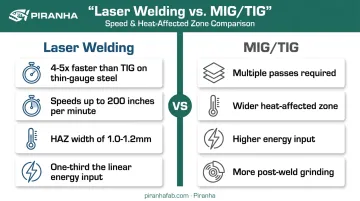
A laser weld uses a concentrated, high-power beam that completes deep joints in a single pass. MIG and TIG often need multiple passes to finish the same seam, while a laser weld gets there in one shot.
In automated cells, robotic beam delivery keeps the process running continuously, cutting manual handling time out of the equation entirely.
The numbers back this up. One thin-gauge cabinet fabricator reported laser welding ran 4-5x faster than TIG on 14-18 gauge steel and stainless parts, according to The Fabricator's 2024 coverage of laser and TIG welding in job shops. A separate contract fabricator hit speeds up to 200 inches per minute on straight sheet-metal seams.
Faster welds mean shorter cycle times and more parts per hour, without adding a single body to the floor. This speed advantage matters most for OEMs like trailer and truck body manufacturers running against tight delivery windows.
KPIs impacted:
- Cycle time
- Units per hour
- Labor cost per weld
- On-time delivery rate
This advantage compounds in high-volume runs, multi-shift operations, or any shop trying to scale output without expanding floor space or headcount.
Precision, Weld Quality, and Minimal Heat-Affected Zone
A laser's concentrated power density puts heat exactly where the seam is, nowhere else. That produces a much smaller heat-affected zone (HAZ) than arc-based processes spread across a wider band of material.
In practice, that means:
- Little to no post-weld grinding
- Less warping and distortion in finished parts
- Joint integrity that holds up better under stress
A 2024 study in Materials measured one-pass laser welds in 6.0-6.7 mm low-carbon steel with HAZ widths of just 1.0-1.2 mm, using roughly a third of the linear energy TIG required for a comparable joint (Materials, 2024). Less heat input, less distortion, fewer parts kicked back at inspection.
That reduction in downstream rework matters most in compliance-driven work, where dimensional accuracy isn't negotiable, think structural steel and NEMA/UL-compliant electrical enclosures.
KPIs impacted:
- Scrap and rework rate
- First-pass yield
- Dimensional tolerance compliance
- Post-processing labor hours
This advantage is most valuable on thin or delicate materials, dissimilar metal joints, and anything with strict cosmetic or structural specs.
Versatility and Automation-Readiness
Laser welding runs across steel, stainless, aluminum, titanium, and even dissimilar metal combinations, at a wide range of thicknesses. It integrates cleanly with robotic and CNC systems, which is exactly why more shops are building laser welding cells as automation-first from day one.
Fiber-delivered beams let robotic arms follow complex geometries that would slow a manual welder down. TRUMPF's entry-level automated cell, for example, uses a cobot-style robot that can be taught a new seam in minutes and targets electrical cabinets and sheet-metal enclosures without post-processing (TRUMPF's 2021 announcement of its entry-level automated laser welding cell).
That kind of flexibility pays off in a few concrete ways:
- One laser welding investment supports multiple product lines instead of separate setups per material or thickness
- Automation-ready systems let a shop scale into new capacity without swapping out core equipment
- The same logic drives Piranha's fiber laser cutting systems, built from the start for future automation
KPIs impacted:
- Equipment utilization rate
- Changeover time
- Capacity for new part types
- Automation ROI timeline
This matters most for shops running mixed production, planning future automation, or serving OEMs across trucking, power, and structural steel, where flexible material handling isn't optional.
What Happens When Laser Welding Advantages Are Ignored
Sticking with legacy MIG/TIG processes after volume or precision demands outgrow them has a cost. It just shows up gradually instead of all at once.
- Inconsistent weld quality drives up inspection time and rework hours
- Slower cycle times create bottlenecks that ripple into downstream production stages
- Heavier reliance on skilled manual welders raises costs as experienced welders grow scarce and expensive to hire
- Scaling costs climb because output can't grow without proportionally adding labor
None of these show up as a single dramatic failure. They show up as margin erosion, one job at a time.
How to Get the Most Value from Laser Welding
Laser welding delivers its strongest ROI when three factors line up:
- Controlled joint fit-up
- Consistent material handling
- Realistic volume expectations
Skip any one of those, and the technology underperforms what it's capable of.
Evaluate laser welding as part of a broader workflow, not as a standalone process. Shops get more value by looking at laser welding alongside processes they may already run, like fiber laser cutting, to build one unified precision workflow from cutting through joining.
That's the model manufacturers like Piranha point to. Piranha builds automation-ready fiber laser cutting systems, including its SP404 CNC Fiber Laser and Flex Series machines, specifically for scalable production.
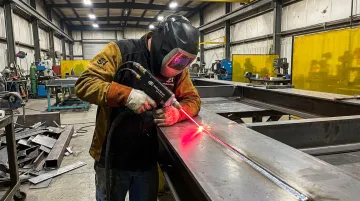
Getting laser precision dialed in upstream, at the cutting stage, sets up cleaner fit-up and smoother integration when a shop adds laser welding downstream. Piranha's MA1 Series handheld laser welders are built around that same logic, running roughly 4x faster than traditional MIG/TIG on mild steel in the company's own product testing.
After adoption, don't assume the gains are automatic. Review production data regularly:
- Track cycle time before and after implementation
- Monitor scrap and rework rates on a per-job basis
- Measure throughput across shifts, not just isolated runs
If the numbers aren't moving, something in the fit-up, fixturing, or training needs adjusting, not the equipment itself.
Conclusion
Laser welding earns its value through speed, precision, and flexibility, three qualities that directly boost a shop's daily production numbers.
These advantages stack over time. Faster cycles free up capacity, cleaner welds cut down on rework, and automation-readiness lets a shop grow without re-buying equipment every few years.
Piranha's handheld laser welders follow the same logic, giving shops room to scale without new equipment.
Evaluate laser welding against your shop's volume, tolerance requirements, and growth plans, not just the sticker price. That's where the real decision gets made.
Frequently Asked Questions
Is laser welding as strong as regular welding?
Laser welds can match or exceed the strength of traditional arc welds, particularly on thin-to-medium thickness materials. Deep penetration and minimal internal defects are the main reasons why.
How thick will a laser welder weld?
Most industrial systems handle up to about 0.5 inches (12mm) in a single passon standard equipment. Multi-pass techniques and specialized high-power systems can extend that range for thicker structural sections.
What are the main disadvantages of laser welding?
Higher equipment cost and strict joint fit-up requirements are the main tradeoffs compared to MIG or TIG welding. Specialized safety needs add another layer of complexity.
Is laser welding more expensive than traditional welding?
Upfront investment runs higher, but long-term savings from faster cycle times and reduced rework often offset that cost in higher-volume operations, especially once automation enters the picture.
Which industries benefit most from laser welding?
Automotive, aerospace, medical devices, and electronics lead adoption, with structural steel and trailer fabrication increasingly following as precision and repeatability become non-negotiable.
Is laser welding safe to operate?
Yes, when operators follow proper precautions. Laser-rated PPE and enclosures address the primary hazard, laser radiation exposure. Proper ventilation manages secondary risks like fumes and UV emissions.