Many fabrication shops struggle with the same problem: choosing a bending machine manufacturer based on brand reputation alone, then discovering slow parts delivery or thin service coverage once the machine is running three shifts. The manufacturer you pick affects cycle times, part accuracy, and how quickly you recover from downtime.
This guide ranks 15 bending machine manufacturers shaping the industry heading into 2026. Each profile covers what the company specializes in, where it stands out, and what buyers should know before committing.
Key Takeaways
- Press brakes, plate rolls, ironworkers, and tube benders each serve different materials and production volumes
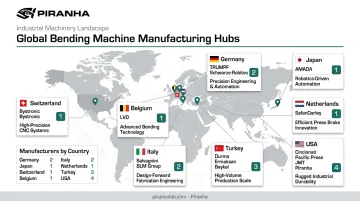
- Global leaders cluster in Germany, Japan, Italy, Switzerland, Turkey, and the U.S., each with unique technology strengths
- Service infrastructure and parts availability matter as much as machine specs for long-term uptime
- Single-source suppliers simplify vendor management for shops running multiple machine types
Overview of Bending Machines in the Metal Fabrication Industry
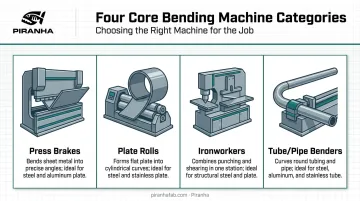
Bending machines are forming equipment that reshape sheet metal, plate, and tube into precise angles, curves, or profiles using hydraulic, mechanical, servo-electric, or manual force. The category covers four main equipment types:
- Press brakes for angular folds
- Plate rolls for cylindrical curves
- Ironworkers for combined punching and shearing
- Tube/pipe benders for round stock
This equipment category supports a fast-growing market. Fortune Business Insights projects the metal forming tools market to grow from $29.41 billion in 2025 to $64.85 billion by 2034, a 9.60% compound annual growth rate. That growth reflects rising automation demand and continued expansion in trucking, structural steel, and industrial fabrication.
The manufacturers below were selected for technological capability, regional reach, and proven reliability across trailer manufacturing, structural steel, aerospace, and power/transformer applications — not just brand recognition.
Top 15 Bending Machine Manufacturers in the World (2026)
Selection criteria for this ranking include CNC/automation capability, precision specifications, industry certifications, and demonstrated global or regional service footprint.
TRUMPF (Germany)
Founded in 1923 in Ditzingen, TRUMPF grew from a mechanical workshop into a global leader spanning bending, laser cutting, and electronics technology. Its TruBend series is known for ergonomic design and tight tolerances, though the machines sit at a premium price point. The TruBend 1000 line ranges from 600 to 3,200 kN of force with bending lengths up to 4,100 mm.
| Specialty | High-precision CNC press brakes and automated bending cells |
| Notable Feature | High-precision accuracy and full production line automation |
AMADA (Japan)
AMADA, founded in 1946 in Isehara, Kanagawa, holds strong market share across Asia and the Americas with its CNC hydraulic press brake lineup. The HD NT series delivers ram repeatability of ±0.00004 inches, backed by a comprehensive pre- and post-sale service network.
| Specialty | Eco-friendly hybrid-drive CNC press brakes (HD NT Series) |
| Notable Feature | Hardened, precision-ground tooling for long-term accuracy |
Bystronic (Switzerland)
Headquartered in Niederönz, Bystronic focuses on automating the entire sheet metal cutting-and-bending process chain. The ByBend Smart series runs 110 to 330 US tons with bending lengths up to roughly 13.4 feet, and the company maintains a strong presence across Europe, Asia-Pacific, and the Americas.
| Specialty | CNC plate bending integrated with laser cutting automation |
| Notable Feature | High-speed bending for small to medium-sized parts |
LVD (Belgium)
Founded in 1952 in Gullegem, LVD built its reputation on laser, punch, and precision bending technology. Its Easy-Form Laser system measures bend angle in real time and compensates automatically for material variation, with tooling compatible across machines from 120 kN to 30,000 kN.
| Specialty | Multi-axis CNC plate bending with adaptive laser bending tech |
| Notable Feature | Tooling compatible with 120kN to 30,000kN machines |
Salvagnini (Italy)
Salvagnini, tracing its history to 1963 near Vicenza, pioneered flexible sheet metal systems and lean automation. The company's ROBOformER cell runs a single program through fully automatic robotic bending — no operator required on the floor. Its B3 press brake line spans 80 to 400 tons.
| Specialty | Robotic and automated bending production lines |
| Notable Feature | Combines electric and hydraulic bending for Industry 4.0 plants |
SafanDarley (Netherlands)
Based in Lochem, SafanDarley covers the full bending and shearing production chain from R&D through service. The company credits itself as the inventor of the servo-electronic press brake, with its E-Brake line running 35 to 300 tons and offering safety advantages over conventional hydraulic systems.
| Specialty | Electric (e-brake) press brake technology |
| Notable Feature | Reduced energy consumption and enhanced operator safety |
Durma (Turkey)
Operating from Bursa since 1956, Durma North America reports producing roughly 8,000 machines annually and doing business in 156 countries (Durmazlar's own global materials cite 120 countries). Its AD-Servo, AD-R, and AD-ES lines cover electric and hydraulic bending, with Industry 4.0 connectivity built into current product generations.
| Specialty | AD-Servo, AD-R, and AD-ES electric/hydraulic bending machines |
| Notable Feature | Global machine-to-machine communication capability |
Ermaksan (Turkey)
Founded in Bursa in 1965, Ermaksan has expanded its manufacturing footprint and R&D investment over six decades. The company now operates in 120-plus countries, ranging from the compact 40-ton Micro-Bend to the Green Press FX Servo line, which claims roughly 69% lower operating energy versus conventional hydraulics.
| Specialty | Servo, hybrid, and synchronized hydraulic bending machines |
| Notable Feature | Small-footprint options for space-constrained shops |
Baykal (Turkey)
Baykal describes its own founding as the early 1950s, making it one of Turkey's oldest bending machine builders. Decades of hydraulic and CNC expertise back its APHS Pro series, which spans 400 to 6,000 kN and 1,250 to 6,100 mm — appealing to buyers who prioritize mechanical track record over newer entrants.
| Specialty | CNC and hydraulic sheet metal bending machines (APHS series) |
| Notable Feature | Long operational lifespan with minimal technology drift |
Cincinnati Inc. (USA)
Cincinnati traces its founding to the late 1890s in Harrison, Ohio, and has shipped more than 50,000 machines over its history. Its HYFORM, MAXFORM, and AUTOFORM press brake series cover 40 to 2,000 tons, including tandem configurations built for multi-shift, high-complexity operations.
| Specialty | HYFORM, MAXFORM, AUTOFORM press brake series |
| Notable Feature | Proven durability for continuous industrial use |
Pacific Press Technologies (USA)
Founded in 1945 in Mount Carmel, Illinois, Pacific built what it identifies as the first US-made hydraulic press brake and has since installed over 15,000 machines across North America. The lineup runs from 100-ton presses to 3,000-ton press brakes — a wide span aimed at both light and heavy fabrication.
| Specialty | High- and low-tonnage hydraulic and electric bending machines |
| Notable Feature | Decades of domestic manufacturing and field-proven reliability |
JMT USA (USA)
Founded in 1967 and based in Salt Lake City, JMT integrates sales, service, and support for metalworking equipment. Its JM-S press brake series claims bending accuracy to 0.01 mm with CNC crowning, and the company also offers robotic automation packages for high-precision applications.
| Specialty | Hydraulic and electrical plate bending machines with robotics |
| Notable Feature | American-engineered machines with tooling support |
BLM GROUP (Italy)
BLM built its first automatic tube bender in 1962 and now runs from its Cantù headquarters as a global name in tube processing. The ALL-IN-ONE platform links CNC tube bending with laser cutting and end forming through unified software, making it a fixture in automotive and aerospace tube fabrication.
| Specialty | CNC tube bending and integrated laser cutting systems |
| Notable Feature | Strong presence in automotive and aerospace supply chains |
Schwarze-Robitec (Germany)
Based in Cologne with roots dating to 1903, Schwarze-Robitec specializes in high-precision tube bending for complex, custom-engineered applications. Its single-stack CNC tube benders handle diameters up to 160 mm, and the company is recognized for tackling multi-radius bend geometries that standard equipment can't manage.
| Specialty | High-precision CNC tube bending machines |
| Notable Feature | Custom engineering for complex bend geometries |
Piranha (USA)
Piranha was founded in 1974 when developing an ironworker to solve a real production bottleneck at a foundry. That original design still influences the product line today. Backed by 140-plus years of combined heritage through the W.A. Whitney and Bertsch brands, Piranha manufactures ironworkers, press brakes, plate rollers, shears, fiber lasers, plasma tables, and laser welders, all from one manufacturer.
That one-source approach matters for shops like Hyundai Translead, Great Dane, Utility Trailer, and Heil, which rely on equipment built for trailer manufacturing and heavy industrial output. Piranha ships parts from its Belvidere, Illinois headquarters and provides US-based phone support, meaning fabricators aren't stuck waiting on overseas support queues when a machine goes down.
| Specialty | Ironworkers, press brakes, and structural bending/rolling equipment for North American fabricators |
| Notable Feature | Nationwide domestic service with no overseas support queues, plus scalable automation-ready equipment |
How We Chose the Best Bending Machine Manufacturers
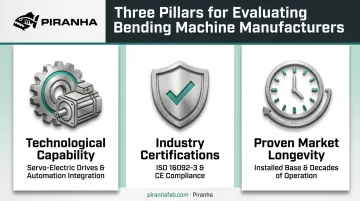
Evaluating 15 manufacturers required looking past brand recognition. The methodology centered on three factors:
- Technological capability — CNC control sophistication, servo-electric or hybrid drive options, and automation/robotics integration
- Industry certifications — compliance with safety frameworks such as ISO 16092-3, the machine tool safety standard covering press brakes, plus CE conformity for EU market access
- Proven market longevity — decades of operation, documented installed base, and consistent product development
These criteria only tell part of the story, though. A common buyer mistake is choosing a manufacturer purely on price or name recognition without checking after-sales service and parts availability. That decision looks fine on the purchase order and expensive six months later.
Domestic support matters more than most buyers assume before the sale. A machine waiting on an overseas parts shipment sits idle longer than one served by a manufacturer with US-based technicians and same-day shipping. That gap shows up directly in total cost of ownership, even when the upfront machine price looked identical.
Choosing the Right Bending Machine Partner for Your Shop
Picking a manufacturer isn't just about tonnage on a spec sheet. Weigh these factors before signing a purchase order:
- Production volume and tonnage needs — match machine capacity to your actual part mix, not your busiest month
- Material type — sheet, tube, and plate each demand different machine architecture (press brake vs. plate roll vs. tube bender)
- Automation readiness — consider whether the machine can scale with robotics or material handling as volume grows, so you're not replacing equipment in three years
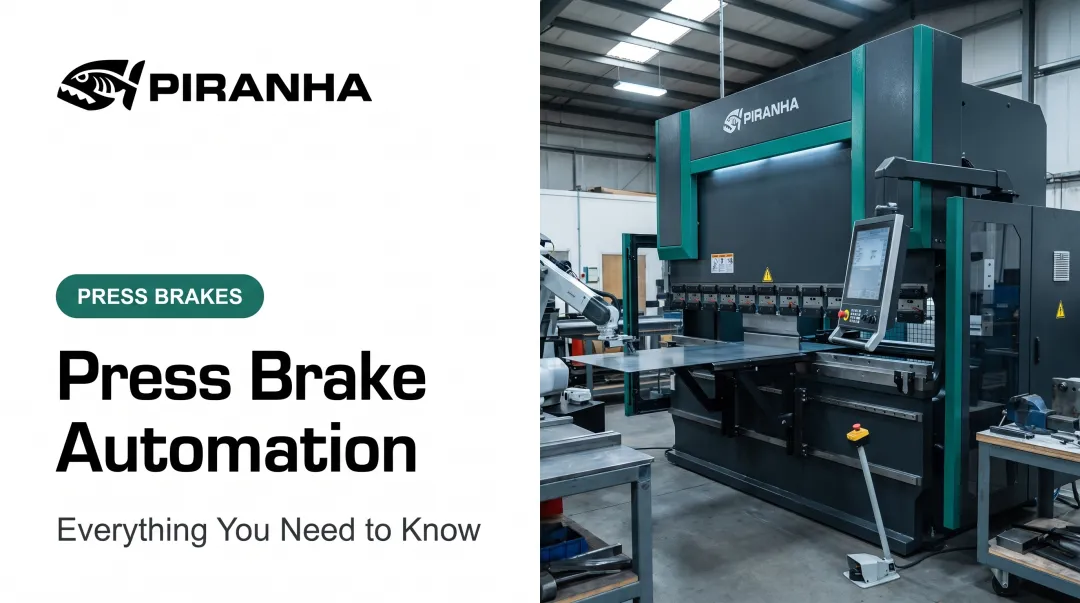
That automation question often points back to vendor structure. Suppliers like Piranha, which manufacture press brakes, ironworkers, and plate rolls under one roof, simplify vendor management considerably.
That consolidation delivers:
- One parts catalog across your entire equipment lineup
- A single service contact for troubleshooting calls
- One training curriculum as operators move between machines
The savings add up fast in shops running several fabrication processes at once.
Conclusion
Choosing a bending machine manufacturer comes down to matching your shop's tonnage requirements, material mix, and growth plans to the right fit. TRUMPF and AMADA lead on precision engineering, while Salvagnini and BLM push automation further than most competitors. Turkish and US manufacturers, meanwhile, often win on service responsiveness and total cost of ownership.
Before finalizing a purchase, evaluate long-term scalability, how quickly a manufacturer responds when something breaks, and what that machine actually costs over its working life — not just at checkout.
If you're weighing options for press brakes, ironworkers, or plate rolls, Piranha's fabrication experts can walk through tonnage, automation, and service questions specific to your production line. Reach the team at 800-338-5471.
Frequently Asked Questions
What is a bending machine used for in metal fabrication?
Bending machines shape metal sheets, plates, or tubes into precise angles or curves using hydraulic, mechanical, or electric force. This forms a core step in fabricating trailers, structural steel components, and industrial enclosures.
What is the difference between a press brake and a plate rolling machine?
Press brakes create angular bends and folds in flat sheet metal using a punch-and-die process. Plate rolling machines curve plate progressively into cylindrical or conical shapes for tanks, pipes, and structural components.
Which countries are known for leading bending machine manufacturing?
Germany, Japan, Italy, Turkey, and the United States are recognized hubs. Each brings different strengths: Germany and Japan lean toward precision engineering, Italy toward automation, Turkey toward high-volume export production, and the US toward domestic service and durability.
How much does an industrial bending machine typically cost?
Pricing varies widely by tonnage and automation level. A small, basic hydraulic press brake typically runs in the $50,000 to $120,000 range, while large CNC or robotic bending systems are quote-based depending on configuration.
Are there strong American manufacturers of bending machines?
Yes. Piranha, Cincinnati Inc., Pacific Press Technologies, and JMT USA are established US-based manufacturers known for domestic service, same-day parts availability, and field-proven durability.
What factors should I evaluate before choosing a bending machine manufacturer?
Assess tonnage and capacity needs, automation compatibility, tooling support, safety certifications, and the availability of local service and parts. Price alone shouldn't drive the decision: after-sales support determines your actual uptime.