Three months later, the same shop is scrapping parts because hole positions drift out of tolerance on a NEMA enclosure run. Cycle times on stainless are twice what the quote promised. Nobody specified kerf offset, focal position, or assist gas pressure before the machine hit the floor.
The stakes here aren't abstract. Wrong specifications show up directly on the P&L — as scrap rate, missed tolerances, slower cycle times, and unplanned downtime. In high-mix fabrication environments running trucking, trailer, power, and structural work, those margin leaks compound fast.
This guide breaks laser cutting specifications into the core parameters buyers and operators need to define, and the factors that should actually drive those choices.
Key Takeaways
- Power should match your thickest regular job, not your average part
- Tolerance and kerf are different specs that both need defining before programming
- Assist gas choice (oxygen, nitrogen, air) changes edge quality, dross, and per-part cost
- NEMA/UL enclosure work demands tighter, repeatable positioning across long runs
- Specify for growth so automation can be added without replacing the machine
What Are Laser Cutting Specifications?
Laser cutting specifications are the measurable parameters that determine how precisely and efficiently a laser can process a given material at a given thickness. That includes power, kerf, tolerance, focal position, and assist gas settings, none of which work in isolation.
Two laser types dominate metal fabrication today: fiber and CO2. Fiber has become the default for sheet metal because of its shorter wavelength, which delivers far greater absorption on reflective metals.
Bystronic reports up to 5x higher cutting speed below 1/2 in. material thickness compared to CO2, along with roughly half the operating cost. That's a manufacturer comparison, not an independent market study, but it lines up with why most job shops buying new equipment today are looking at fiber first.
Core Components of a Laser Cutting Spec Sheet
Every spec sheet a buyer reviews boils down to four functional categories. Understanding what each one actually controls is the difference between reading a chart and knowing whether a machine fits your work.
Laser Power (Wattage/kW)
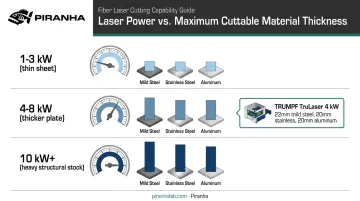
Power output sets the ceiling on cuttable thickness and cutting speed. Published selection bands generally fall into three tiers: lower-power systems (1-3 kW) for thin sheet, mid-power (4-8 kW) for thicker plate, and 10 kW-plus for heavy structural stock. Actual maximum thickness varies by machine: TRUMPF's TruLaser 4 kW configuration, for example, is rated for 22mm (0.87 in.) mild steel but only 20mm (0.79 in.) stainless and 20mm (0.79 in.) aluminum, because reflectivity and thermal conductivity change the math per material.
Cutting Tolerance & Positioning Accuracy
These are two separate specs, and buyers often conflate them:
- Positioning accuracy: how precisely the machine's axes move to a commanded location
- Cutting tolerance: the allowable deviation between the drawing dimension and the finished part
Repeatable hole positioning matters most when parts need hardware fit-up downstream: brackets, enclosure panels, and mounting plates that get bolted together on the assembly line.
Kerf Width
Kerf is the width of material the beam actually removes during the cut. It varies by material and thickness, and it should be compensated for in your CAM/CAD offset settings (never baked into the original CAD file), since kerf changes when you switch materials or gas type.
Assist Gas Type & Pressure
Oxygen, nitrogen, and compressed air each change cut speed, edge oxidation, and operating cost. Pressure has to be matched to material and thickness: too little and you get incomplete cuts, too much and you waste gas and risk edge damage.
Benefits of Getting Laser Cutting Specifications Right
Getting these parameters dialed in delivers measurable shop-floor outcomes:
- Lower scrap and rework, since parts hold tolerance the first time
- Faster cycle times, because feed rate matches what the power and gas can actually support
- Consistent repeatability, so batch 500 fits the same as batch 1
- Reduced consumable spend, from right-sized gas pressure instead of guesswork
- Fewer unplanned faults, since mismatched settings stop causing nozzle collisions and pierce failures
What to Consider When Choosing the Right Laser Cutting Specifications
There's no universal "best" spec. The right combination depends on your material mix, the tolerances your customers demand, and your production volume. The factors below connect the technical chart to the KPIs that actually matter on your shop floor.
Material, Thickness, and Power Requirements
Mild steel, stainless, aluminum, and reflective metals like copper or brass respond differently to identical power and gas settings. A spec that works well on 10-gauge mild steel can underperform on 3/16 in. stainless run through the same program.
Power requirements follow the same logic: size the machine to your thickest regular job, not your current average. A shop that mostly cuts 1/4 in. but occasionally needs 3/4 in. structural plate will bottleneck badly if it buys for the average instead of the outlier.
KPIs affected: first-pass yield, material waste, maximum throughput, and cycle time per part.
Tolerance, Repeatability, and Cutting Speed
Shops supplying NEMA/UL-compliant electrical enclosures or structural steel need machines that hold tight, repeatable tolerances across long runs, not just on a single test cut. NEMA has confirmed there are no standard enclosure dimensions; every manufacturer sets its own, so the controlled drawing (not a generic NEMA number) is what your laser has to hold.
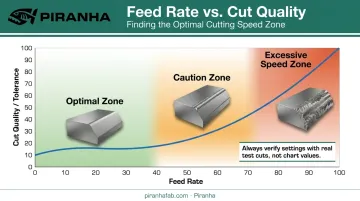
Speed and tolerance pull against each other, too. Push feed rate past what your assist gas and power can support, and dross plus edge roughness climb fast. Chart values are a starting point; validate speed with real test cuts on your actual material lot, not just the manufacturer's parameter table.
KPIs affected: rework rate, compliance pass rate, and finishing labor hours.
Assist Gas, Consumables, and Scalability
| Gas | Best For | Trade-off |
|---|---|---|
| Oxygen | Fast mild steel cuts | Oxidized edge, needs cleanup for painted parts |
| Nitrogen | Clean stainless/aluminum edges | Higher pressure, higher gas cost |
| Compressed air | Thin mild steel, lower cost | Can leave discoloration or burr |
Beyond gas choice, think past today's volume. A machine specified only for current production often needs replacing when orders scale up. Specifying for automation upfront, with robotic loading/unloading and nesting software integration built in, means you add capacity without swapping the base machine.
KPIs affected: consumables cost per part, coating adhesion quality, and long-term capital efficiency.
How Piranha Can Help
Piranha builds fiber laser systems around the same problem this guide addresses: matching real specifications to real production, not selling on a wattage number alone.
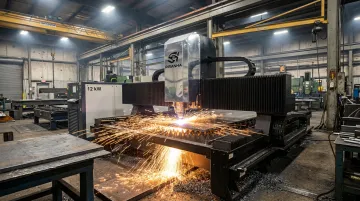
The Piranha-Whitney PlateLASER at 12 kW uses a sealed reflective cutting head to hold cut quality at power levels where lesser optics degrade. It's documented cutting steel plate up to 5/8 in. thick with nitrogen, running up to 3x faster than a comparable 6 kW system on thick plate.
For shops earlier in the thickness curve, the Flex Series spans 3 kW to 20 kW across bed sizes from 5'x10' up to 8'x20', starting around $282,000.
The compact SP404 and SP510 models start at $134,900 and $173,900 respectively, with several available in-stock for fast delivery straight from Belvidere, Illinois.
What differentiates the approach:
- Automation-ready design on the fiber laser lineup, so material loading and unloading can be added later without replacing the machine
- One source for the whole fabrication line: laser, press brake, ironworker, plate roll, and shear, simplifying spec compatibility instead of juggling multiple vendors' tolerances
- U.S.-based phone support at 800-338-5471 and same-day parts shipping from Belvidere, IL, with no overseas queue when a nozzle or lens needs replacing mid-run
- 140+ years of combined heritage, including the W.A. Whitney and Bertsch brands, behind the cutting guidance customers get before and after the sale
That heritage matters in practice. In documented engagements with fabricators like Degelman Industries and Great Plains Manufacturing, Piranha's applications team ran actual time studies comparing laser against combination punch-plasma platforms.
In one case, the studies showed a punch-plasma machine could outrun laser on heavy plate at three times the rate. That's the kind of cross-technology honesty a single-product laser vendor can't offer.
Conclusion
The right laser cutting specifications match power, tolerance, kerf, and gas settings to your shop's actual materials, tolerances, and growth plans, not the highest wattage or the most popular machine on a spec sheet.
Manufacturer parameter charts are a starting point, not a guarantee. Real-world validation through test cuts on your material, your thickness, and your tolerance requirements remains essential, and Piranha's team can help verify those results before you buy.
Specifications aren't a one-time decision, either. Revisit them whenever your material mix shifts, tolerance demands tighten, or production volume changes.
Frequently Asked Questions
What are the standards for laser cutting?
Machinery safety is governed by standards like ISO 11553-1 and ANSI Z136.1, which cover laser radiation hazards and operational safety. Part tolerances typically come from industry standards like NEMA and UL for enclosures, plus general engineering tolerance practices on the controlled drawing.
What are the parameters for laser cutting?
The core parameters are laser power, cutting speed, focal position, assist gas type and pressure, frequency/pulse settings, and nozzle standoff distance. These parameters need to be tuned together; changing one without adjusting the others usually hurts cut quality.
How thick of steel can a 1000W or 4000W laser cut?
Lower-power lasers (1-2 kW) suit thinner material, while a 4 kW laser pierces 3/4 in. mild steel in about 2 seconds versus 20+ seconds at 2 kW. Stainless and aluminum cut thinner at the same power due to reflectivity and conductivity differences.
What is the difference between kerf and cutting tolerance?
Kerf is the width of material the beam physically removes during the cut. Tolerance is the allowable deviation between the part's designed dimension and its finished measurement. These are two different specs governed by different factors.
How often should a fabrication shop review its laser cutting specifications?
Review specs whenever your material mix, tolerance requirements, or production volume changes. Validate with periodic test cuts rather than relying solely on original chart values.
What laser power is best for cutting stainless steel versus mild steel?
Mild steel cuts efficiently at lower power with oxygen assist, which adds its own reaction energy to the process. Stainless steel commonly uses nitrogen assist at higher pressure to prevent oxidation and keep the edge clean for welding or coating.