Introduction
Laser welding brass means using a focused laser beam, typically a fiber laser, to melt and fuse copper-zinc alloy parts into a permanent joint with minimal heat input.
This guide serves metal fabrication shops, electrical enclosure and switchgear builders, and trailer and truck OEMs. It's built for any fabricator working with brass fittings, contacts, or busbars where precision and repeatability matter.
Here's the problem: many shops treat brass welding like an afterthought, assuming it behaves "just like steel." It doesn't. Zinc evaporation and high surface reflectivity make brass a genuinely different process. Zinc begins vaporizing around 907°F, well below brass's melting point, and that gap gets misunderstood constantly at the operational level.
This article covers how laser welding brass actually works, why fabricators choose it, what drives weld quality, and when it's the wrong tool for the job.
Key Takeaways
- Laser welding concentrates energy tightly, cutting zinc loss and distortion versus TIG or MIG
- Identifying the alloy's zinc and lead content comes before setting any parameter
- Zinc's low boiling point relative to copper's melting point drives most porosity and cracking issues
- Shielding gas, joint fit-up, focus offset, and travel speed are your main quality levers
- Fume extraction and Class 4 laser safety planning aren't optional add-ons
What Is Laser Welding Brass and Why Is It a Unique Challenge
Laser welding brass uses a focused beam to create a keyhole melt pool that fuses copper-zinc alloy parts together. The result is a narrow, deep seam with a small heat-affected zone.
The goal is straightforward: a dense, low-distortion joint that meets whatever mechanical, leak-tight, or cosmetic requirement the part demands.
Achieving that joint means melting the base brass itself, which sets laser welding apart from brazing or soldering. Both processes join parts using a separate, lower-melting filler alloy without melting the base metal.
Why Brass Behaves Differently Under a Laser Beam
Brass presents a strange combination: a reflective, copper-rich surface paired with volatile zinc. The beam first has to overcome poor cold-state absorption, then manage rising vapor pressure as zinc starts to boil off.
The numbers explain why this matters. Zinc boils near 907°C, according to the Royal Society of Chemistry's periodic table reference, while pure copper doesn't melt until roughly 1085°C. That's a massive gap.
Zinc can vaporize well before the base metal is fully molten. This mismatch is the underlying driver of porosity and hot cracking — defects that simply don't show up to the same degree when laser welding steel.
Why Fabricators Choose Laser Welding Anyway
Despite the added complexity, laser welding wins out for good reasons:
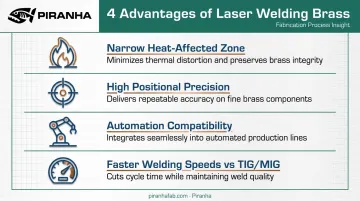
- Narrow heat-affected zone, meaning less warping on finished parts
- High positional precision for tight-tolerance components
- Strong automation compatibility for repeat production
- Welding speeds that outpace TIG or MIG on comparable joints
That speed advantage doesn't come at the cost of quality. A 2015 study presented at the WLT laser materials processing proceedings tested CuZn10, CuZn20, and CuZn37 brass at feed rates from 33 to 200 mm/s using a 1030 nm disk laser. Zinc loss stayed below 5% by mass across all three alloys. That's proof that controlled energy input keeps evaporation in check even at higher speeds.
Industries that lean on this precision most include:
- Electrical contacts and switchgear components
- Decorative and architectural brass
- Musical instrument manufacturing
How Laser Welding Brass Works: Process Flow and Key Parameters
The end-to-end flow looks like this: identify the alloy, prep the joint surfaces, initiate the beam and form a keyhole, travel with vapor management, then let it solidify and inspect.
What goes into the process:
- Identified brass alloy (confirmed zinc and lead content)
- Cleaned, degreased joint surfaces
- Shielding gas
- Filler wire, when the joint calls for it
During the core action, the laser forms a keyhole in the melt pool. Zinc vapor has to escape that keyhole without destabilizing it — this is the tightrope every brass weld walks.
What controls the outcome: These parameters interact to keep the keyhole stable. Get one wrong, and the others can't compensate.
- Laser power and pulse energy
- Travel speed
- Focus offset
- Beam wobble or oscillation
- Shielding gas flow
The end result, when everything's dialed in, is a fused seam with controlled zinc loss, minimal distortion, and properties matching the joint's actual requirement.
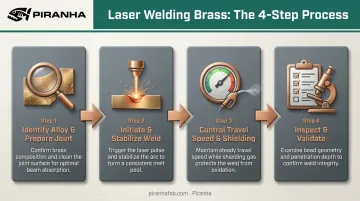
Here's how the process breaks down into four steps:
- Identify the alloy and prepare the joint. Confirm zinc and lead content before anything else. Remove oxide and oil from the joint surfaces, and verify the fit-up gap. Skip this step, and every parameter you set afterward is a guess.
- Initiate and stabilize the weld. The beam has to couple with a reflective, cold surface first, which isn't easy. Once melting starts, pulse modulation or beam wobble helps manage the zinc vapor and keep the keyhole from collapsing.
- Control travel speed, shielding, and solidification. Consistent travel speed and full shielding gas coverage keep the pool stable. Controlled cooling afterward reduces the risk of hot cracking as the seam solidifies.
- Inspect and validate the weld. Cross-sectioning, leak testing, or nondestructive testing confirm subsurface quality. Don't approve a process for production based on how the top of the seam looks.
Brass Alloys, Applications, and Joint Design Considerations
Not all brass welds the same way. Lower-zinc alloys like red brass (C23000) or cartridge brass (C26000) weld more easily than high-zinc yellow brass (CuZn37) or leaded, free-machining grades like C36000.
Common applications across the industry:
- Electrical contacts and switchgear components
- Plumbing fittings
- Decorative and architectural brass
- Musical instruments
- Busbars and connectors in power equipment
Beyond alloy selection, joint design shapes the outcome just as much:
| Joint Type | Consideration |
|---|---|
| Butt joint | Best for cosmetic seams |
| Lap joint | Risks trapping zinc vapor in enclosed gaps |
| Corner/T-joint | Needs careful heat management |
Filler wire (often copper-based or silicon-bronze) can bridge gaps or adjust weld chemistry. It also changes dilution, so it needs validation for the specific application before it goes into a production run.
Before any of this welding happens, though, the brass blank has to be cut and punched accurately. Many electrical enclosure fabricators and switchgear builders rely on precisely sized, clean-edged brass parts to get consistent fit-up.
Piranha's fiber laser cutting and punching equipment supports exactly this upstream step, producing blanks that are easier to fit up and weld consistently once they hit the welding station.
Whichever machine cuts the blank, alloy certification and a coupon test should come before full production. No exceptions.
Common Defects, Misconceptions, and Safety Considerations
Four defects show up repeatedly in brass welding, and each has a fairly predictable root cause:
- Porosity: trapped zinc vapor that couldn't escape before solidification
- Hot cracking: often tied to poor fit-up or excessive heat input
- Spatter and underfill: keyhole instability during welding
- Discoloration: inadequate shielding gas coverage
Here's a misconception worth killing outright: a shiny top bead does not prove weld quality. Subsurface porosity or cracking can sit comfortably below an attractive-looking surface. Cross-sectioning or nondestructive testing is the only way to know for sure.
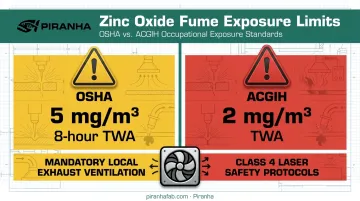
The same diligence that catches hidden defects applies to safety, which isn't a nice-to-have here. Class 4 laser protocols and local exhaust ventilation for zinc oxide fume are mandatory.
According to the American Welding Society's Fact Sheet on zinc oxide fume exposure, OSHA sets the zinc oxide fume limit at 5 mg/m³ over an 8-hour period. ACGIH recommends a stricter 2 mg/m³ time-weighted average.
Ventilation and air sampling should confirm your setup actually keeps fume out of the operator's breathing zone — don't assume it does.
When Laser Welding Brass Isn't the Right Choice
Laser welding isn't automatically the right call for every brass job. Consider alternatives when:
- The alloy or coating is unknown and hasn't been verified
- You're working with lead-containing, free-machining brass that needs specialist review
- The joint is purely decorative with low load requirements, where TIG brazing may be simpler and cheaper
Once one of these conditions applies, the right substitute depends on the joint's function. Quick comparison of alternatives:
- TIG brazing: better for gap-sensitive assemblies where fit-up isn't perfect
- Soldering: sufficient for low-load electrical or plumbing joints
- Resistance welding: efficient for high-volume spot joins
One warning sign that laser welding is being used by default rather than by need: skipping alloy identification and coupon testing before committing a part to full production. If your team can't tell you the zinc content of the brass on the bench, that's a process gap worth closing before the laser even powers on.
Frequently Asked Questions
Can a laser welder weld brass?
Yes, when the alloy is identified and the process controls reflectivity, zinc evaporation, joint fit-up, and shielding. High-zinc or leaded grades need more cautious evaluation before production.
What metals can a laser welder weld?
Common laser-weldable metals include steel, stainless steel, aluminum, brass, copper alloys, and titanium. Each has different reflectivity and thermal behavior, so parameters need to be tailored per material.
Why does laser-welded brass develop pores?
Zinc vaporizes before the copper-rich matrix fully melts. If that vapor gets trapped as the pool solidifies, it leaves behind pores in the finished weld.
Do you need filler wire for laser welding brass?
Not always. Filler wire can help bridge gaps or adjust weld chemistry, but it changes dilution and needs to be validated for your specific application first.
Is laser welding better than TIG or MIG welding for brass?
Laser welding typically produces less zinc loss, a narrower heat-affected zone, and faster processing speeds than MIG or TIG. That said, TIG or brazing may still suit gap-sensitive or decorative joints better.
Does laser welding brass require shielding gas?
Most brass welding trials use an inert gas, commonly argon, to prevent oxidation and stabilize the melt pool during welding.