That shift matters more in 2026 than it did five years ago. Spec-driven customers now demand NEMA and UL-compliant tolerances on enclosures and structural components, and a machine that can't hold those tolerances consistently creates scrap, rework, and missed delivery dates.
Choosing the right fiber laser cutting machine affects everything downstream, from cut quality to how well your shop scales into automation later. This guide breaks down the top 7 fiber laser cutting machines for metal in 2026, plus what actually separates a good fit from an expensive mistake.
TL;DR
- Fiber lasers use a solid-state, fiber-optic source to cut steel, aluminum, and copper with minimal heat distortion
- Match power, thickness range, and automation level to your actual production flow, not the spec sheet
- Our top 7 range from U.S.-based builders like Piranha to global leaders like TRUMPF, Amada, and Bystronic
- The right machine depends on volume, part complexity, and your automation needs
Overview of Fiber Laser Cutting Machines in the Metal Fabrication Industry
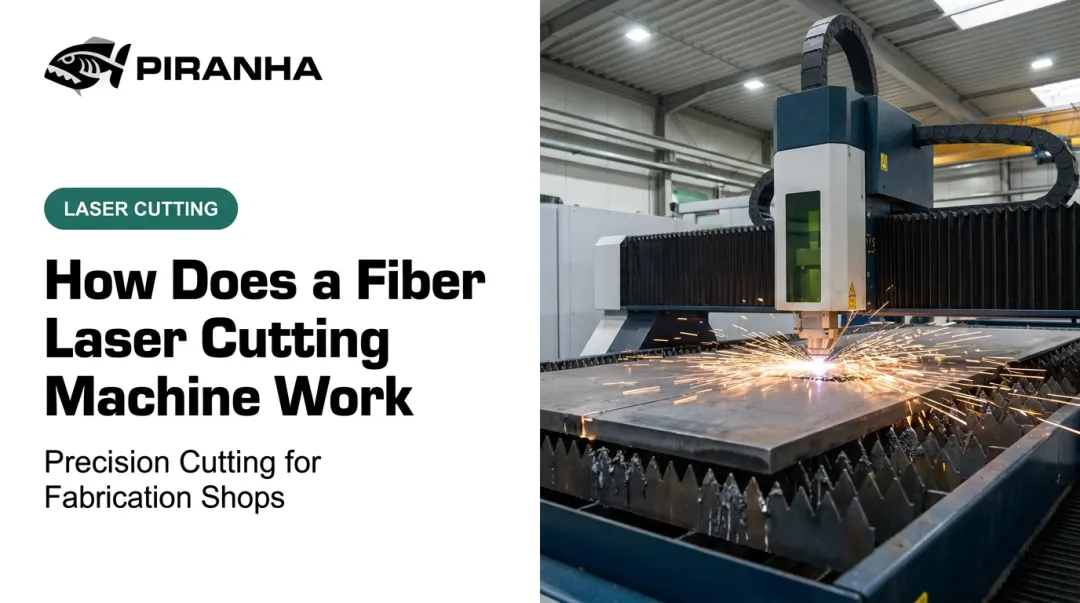
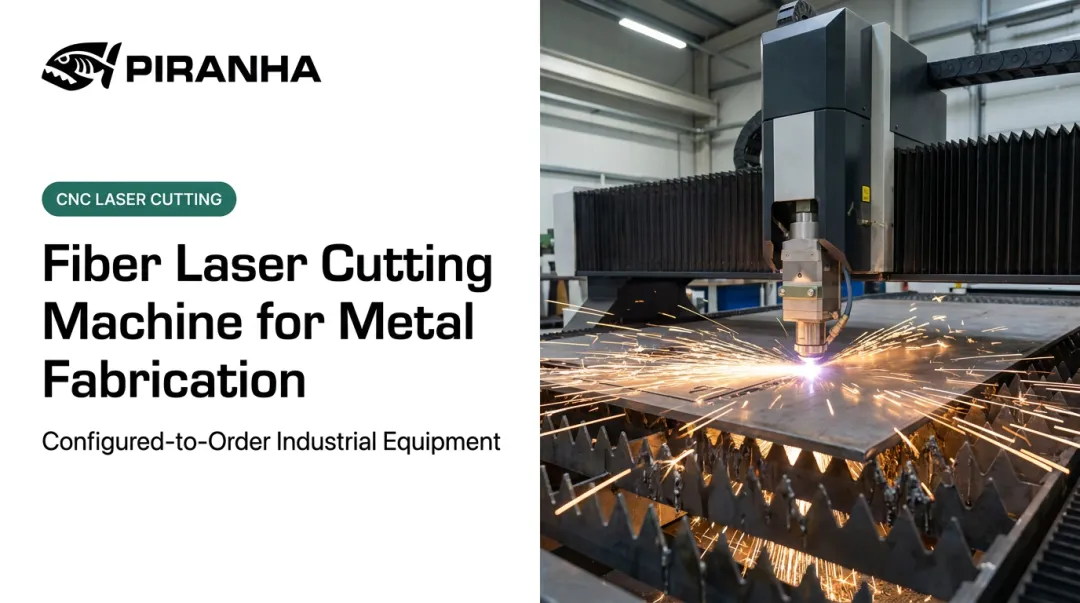
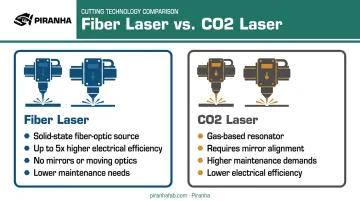
A fiber laser cutting machine channels a high-intensity beam through a fiber-optic cable doped with rare-earth elements like ytterbium. That beam slices through reflective metals with a narrow kerf and a clean edge.
Fiber lasers also skip the mirrors and moving optical parts that CO2 systems rely on, so they run with lower maintenance and higher electrical efficiency. That reliability is one reason adoption is climbing fast.
The CNC fiber-laser market was valued at $6.192 billion in 2024 and is projected to grow at an 8.06% CAGR through 2035, with metal cutting representing the largest application segment.
Trailer OEMs, structural fabricators, and electrical enclosure builders are driving a meaningful share of that growth. Many still struggle with the downtime that aging CO2 systems create.
They need machines that hold tight tolerances on mild steel, stainless, and aluminum without babysitting the process. The seven machines below are the ones showing up most often in North American fabrication shops right now.
Top 7 Fiber Laser Cutting Machines for Metal in 2026
We selected these machines based on cutting power range, material versatility, automation readiness, service network presence, and reputation among trailer OEMs, structural fabricators, and switchgear/enclosure builders.
Piranha
Piranha builds fiber laser cutting machines as part of a 145+ year U.S. manufacturing heritage, including the W.A. Whitney and Bertsch brands. Whitney sold its first CO2 laser in 1980 and its first fiber laser in 2013, so today's Piranha-Whitney lasers carry decades of application engineering, not a fresh start.
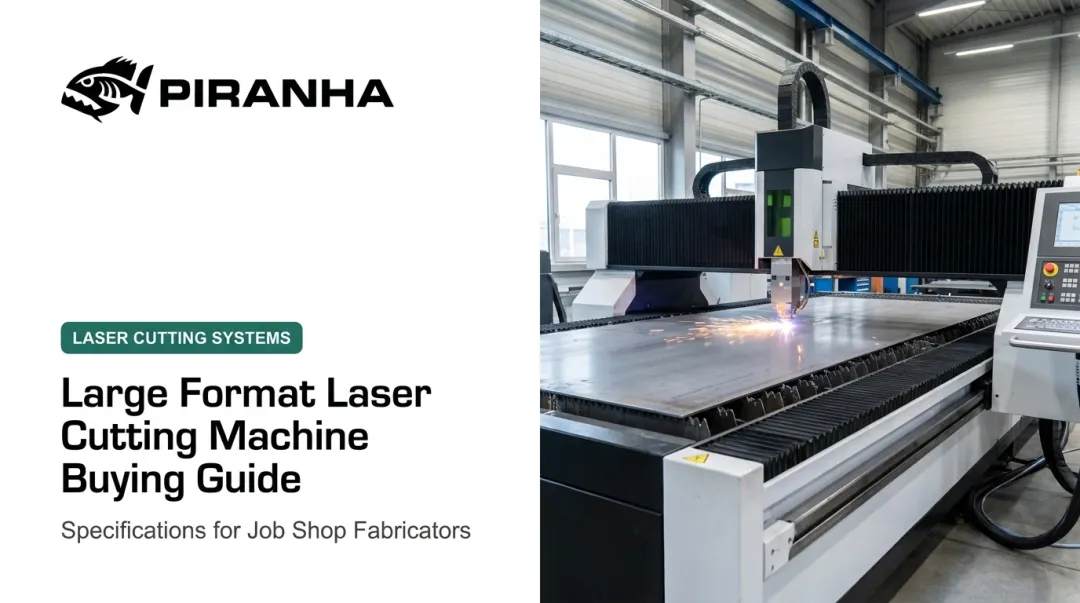
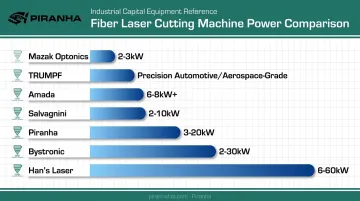
The Flex Series spans 3kW to 20kW with bed sizes from 5'×10' to 8'×20'. The compact SP404 runs 3kW or 6kW with ±0.001" repeatability. Piranha describes these systems as automation-ready for future expansion, meaning shops can add material load/unload later without swapping the base machine.
| Category | Details |
|---|---|
| Best For | Trailer OEMs, structural fabricators, and switchgear builders wanting one-vendor simplicity across an entire fabrication line |
| Key Features | Automation-ready platform, in-stock availability on select units, U.S.-based support, same-day parts shipping from Belvidere, IL |
| Support Model | One quote, one install team, one parts catalog — no overseas support queues |
TRUMPF
TRUMPF has spent over 100 years in laser technology and now operates production across 11 countries, from Germany to the United States. Its 2D/3D fiber laser cutting machines show up heavily in automotive and aerospace metal fabrication, where tolerance requirements leave no margin for error.
TRUMPF's BrightLine Speed beam-shaping technology raises cutting speed while drawing less laser power, and the company backs it with continuous R&D investment.
| Category | Details |
|---|---|
| Best For | Large manufacturers needing high-precision, highly automated cutting for automotive and aerospace-grade parts |
| Key Features | Beam-shaping technology, smart-factory and robotics integration, broad automation options |
| Considerations | Premium investment level suited to large-scale operations rather than budget-conscious small shops |
Amada
Founded in 1946 in Japan, Amada now supplies laser and bending machines to 100+ countries. Its VENTIS AJe series uses Locus Beam Control (LBC) to manipulate the beam into flexible patterns while holding energy density steady. Amada states this can cut speeds up to three times faster than conventional 6-8kW fiber lasers.
The ENSIS resonator continuously varies beam diameter, letting operators move between thin and thick material without a manual lens change.
| Category | Details |
|---|---|
| Best For | Heavy-duty fabrication shops needing thickness versatility without manual lens changes |
| Key Features | LBC technology, ENSIS variable beam control, global service center network |
| Considerations | Custom configurations may extend lead times |
Bystronic
Bystronic has built precision machinery in Switzerland since 1964. Its ByStar Fiber line reaches up to 30kW and handles sheet up to 50mm thick, while the ByCut Smart line runs up to 15kW with stainless steel capacity around 1.18 inches.
Automation options are extensive and named specifically: ByLoader, ByTrans, BySort, and ByTower cover loading, unloading, sorting, and storage. Bystronic also promotes predictive maintenance monitoring to flag wear before it causes downtime.
| Category | Details |
|---|---|
| Best For | High-volume manufacturers scaling toward full production automation |
| Key Features | Up to 30kW power output, named automation modules, predictive maintenance monitoring |
| Considerations | Advanced systems carry a learning curve before reaching peak operator efficiency |
Mazak Optonics
Mazak Optonics, the U.S. laser division of Yamazaki Mazak, has operated in North America for over 30 years from its Elgin, Illinois technology center. The company's laser lineage includes early Direct Diode Laser development.
Its current SUPER TURBO-X FIBER line offers 2.0 or 3.0kW models in compact footprints (up to 1,525mm × 3,050mm), with beam-diameter control and intelligent setup monitoring.
| Category | Details |
|---|---|
| Best For | Mid-to-large shops wanting North American-based manufacturing with compact, high-speed cutting |
| Key Features | Beam-diameter control, intelligent setup and monitoring, compact Super Turbo-X footprint |
| Considerations | Software licensing can add to total ownership cost |
Han's Laser
Founded in 1996 in Shenzhen, Han's Laser now reports 100+ branches and 40,000+ industrial customers worldwide. Its HF Expert series covers an unusually wide power range, from 6kW to 60kW, which suits shops running everything from thin gauge to heavy plate on one platform.
Han's markets the HF Expert line for smart manufacturing environments, though buyers should confirm which specific automation features, like pallet handling or AI-driven diagnostics, ship standard on any given configuration versus as an add-on.
| Category | Details |
|---|---|
| Best For | High-volume fabricators needing a wide power range on a single machine platform |
| Key Features | 6kW-60kW source options, side-adjustable table, protective glass rated for high power |
| Considerations | Sourcing replacement parts for older models can take longer |
Salvagnini
Salvagnini has specialized in flexible, automated sheet metal processing since 1963, with more than 9,500 active installations across 87 countries. Its L3 and L5 series use a single optical head with patented DRY-COOLING temperature control.
A carbon-fiber compass structure moves the head using rotary motors instead of linear motors, hitting up to 5g acceleration on short moves.
Power options range from 2kW to 10kW, and automation add-ons include pallet changing, automatic load/unload, and tower storage.
| Category | Details |
|---|---|
| Best For | Large-scale operations wanting fully integrated cutting, bending, and storage automation |
| Key Features | Patented DRY-COOLING optics, compass-drive motion system, automatic load/unload and storage options |
| Considerations | Custom replacement parts can raise long-term maintenance costs |
How We Chose the Best Fiber Laser Cutting Machines
We evaluated each machine on five factors:
- Cutting power range
- Material thickness capability
- Automation and integration options
- Domestic versus overseas service support
- Reputation among metal fabrication shops
The biggest buyer mistake we see is prioritizing sticker price over total cost of ownership. A lower purchase price means little if downtime, parts lead times, or a thin service network eat the savings within the first year.
Power is a good example of why this matters. One documented shop case chose a 9kW laser over 12kW and 15kW options, not because 9kW was cheaper, but because faster cutting would have overwhelmed their downstream sorting process anyway. More power only helps if the rest of your material flow can keep up.
Beyond raw power, three business outcomes should drive the decision:
- Compliance-ready precision: Can the machine hold the cut tolerances your NEMA or UL-spec customers demand, consistently, not just on a demo cut?
- Automation runway: Does the platform support load/unload integration now or later, without forcing a full machine replacement?
- Single-vendor vs. multi-vendor sourcing: One vendor across your laser, press brake, and shear simplifies service calls and parts orders, but a specialist may edge out a generalist on a narrow capability.
Conclusion
The right fiber laser cutting machine matches your cutting capability, automation runway, and service support to what your shop actually produces. The kW number on the spec sheet matters less than that fit.
Before you sign a purchase order, ask about uptime history, parts lead times, and how easily the machine scales as your volume grows. Those answers matter more than brand recognition once the machine is running three shifts a day.
If you're ready to compare options, Piranha offers fiber laser cutting quotes backed by U.S.-based service and same-day parts shipping from Belvidere, IL. The single-source fabrication line grows with your shop as production needs change. Reach out for a quote or call 800-338-5471 to talk through your production goals with a real person.
Frequently Asked Questions
What is the best laser cutter for carbon fiber?
Fiber lasers cut metals like steel and aluminum, not carbon fiber composites. CO2 or waterjet systems typically process carbon fiber composites instead, avoiding delamination and charring.
What is the cost of a CNC fiber laser cutting machine?
Industrial CNC fiber laser cutting machines generally range from $100,000 to over $1 million, depending on power, bed size, and automation features. Request a quote based on your material thickness and production volume.
How do I choose a fiber laser cutting machine?
Match laser power to your material thickness range, confirm bed or tube size fits your parts, and check automation compatibility. Then weigh service network proximity and total cost of ownership, including maintenance and parts availability.
Can CNC cut fiber?
CNC fiber laser machines cut metal, not fiber or composite materials. The "fiber" in the name refers to the fiber-optic laser source technology, not the material being processed.
What's the difference between a fiber laser and a CO2 laser for cutting metal?
Fiber lasers use a solid-state fiber-optic source with electrical efficiency up to five times higher than comparable CO2 systems, cutting reflective metals faster and at lower operating cost.
How thick of metal can a fiber laser cutter cut?
Cutting capacity scales with laser power, and typical industrial fiber lasers (2kW-12kW+) handle carbon steel up to roughly an inch thick, with thinner maximums for stainless steel and aluminum. Always check machine-specific specs before buying.