The pressure is real. Skilled brake operators are harder to find and keep. Bend quality drifts from shift to shift, or even part to part, when fatigue sets in. And customers expect faster turnaround than ever, whether you're running trailer side rails or a batch of custom enclosures.
Press brake automation addresses all three problems, but it isn't a single product you buy off a shelf. It's a spectrum of technology, from CNC controls that assist an operator to full robotic cells that load, bend, and unload without anyone standing at the machine.
This guide breaks down what press brake automation actually means, the technology types available, the real benefits behind the marketing claims, and how to figure out if it makes sense for your shop.
Key Takeaways
- Automation spans CNC bending to full robotic cells—context matters more than the "automated" vs. "automatic" label
- Utilization, consistency, and safety gains pay off fastest on repeatable, higher-volume work—not one-off prototypes
- Match automation level to part volume, material mix, budget, and fit with your existing or new press brake
What Is Press Brake Automation?
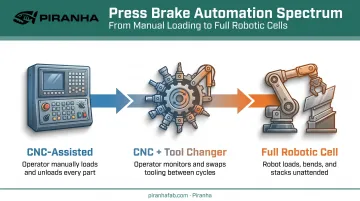
Press brake automation covers any use of computer controls, robotics, sensors, or software that performs or assists sheet metal bending with less manual intervention. It spans a range of technologies, not a single product category.
On one end, you have a CNC-controlled press brake where an operator still loads and unloads material by hand, but a controller manages the back gauge position, ram movement, and bend sequence. Piranha's P Series brakes work this way: program the material type, thickness, and tooling into the Delem controller, and the machine adjusts itself for accuracy instead of relying on manual shimming.
On the other end sits a fully robotic cell, where a robot arm picks blanks from a stack, positions them in the tooling, coordinates with the brake through the bend sequence, and stacks finished parts. No operator stands at the machine during the cycle.
Most shops land somewhere between those two extremes. The right amount of automation depends on your parts, not on chasing the most advanced setup on the market.
Automated vs. Automatic Press Brake: Is There a Difference?
In casual shop talk, "automatic" and "automated" get used as if they mean the same thing, and often, they do. Manufacturers still draw a useful distinction:
- Automatic usually points to machine-level features: CNC controls, programmable back gauges, automatic crowning systems like Piranha's EasyCrown. The operator still loads and unloads parts.
- Automated more often describes cell-level automation, where robotic material handling removes the operator from the load/unload cycle entirely.
Neither term has a formal industry standard. When someone mentions an "automated press brake," ask whether they mean the machine or the whole cell. That distinction matters more than the word itself.
Other Terms You'll Hear in the Industry
You'll see overlapping labels as you compare options:
- Robotic bending cell
- Robotic press brake
- CNC press brake automation
- Bend cell
One term that sounds related but isn't: panel bender. A press brake forms metal with a punch pressing sheet into a V-die. A panel bender clamps the sheet and wipes the flange up or down through a completely different mechanism. It's a separate machine category, not a robot-assisted press brake.
Types of Press Brake Automation Systems
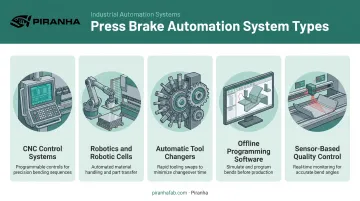
Most shops combine two or three of these systems rather than picking just one.
CNC Control Systems
Servo and electric-driven CNC brakes handle back gauge positioning, ram speed, and bend angle repeatability without the oil temperature swings that come with hydraulic systems.
Piranha's T Series ships with a standard CNC control and X-axis back gauge for shops that want reliable, programmable bending without a full control suite. The P Series steps up to a Delem controller with automatic crowning built in.
Robotics and Robotic Cells
Robotic arms handle loading, positioning, and unloading around the brake, typically in one of two layouts:
- Floor-mounted (pedestal) robots, which can sometimes move aside so the brake stays usable for manual jobs
- Overhead gantry robots, mounted off the floor to avoid cables and tracking hardware in front of the machine
Floor robots tend to be simpler to install; gantry setups preserve floor access for mixed manual and automated use.
Automatic Tool Changers (ATC)
ATC systems swap upper and lower tooling automatically. Trade press coverage has documented staged manual setups taking 15 to 30 minutes, compared with roughly 2.5 to 3 minutes using automated tooling changers.
One shop cited in that same reporting went from 11 jobs a day on four stand-alone brakes to about 38 jobs a day on three ATC-equipped machines. For high-mix shops juggling frequent job changes, that's the difference between chasing setups all day and actually running parts.
Offline Programming and Simulation Software
Offline programming lets operators build and test bend programs on a computer, away from the machine, before committing floor time to a new job. Piranha's Delem-equipped press brakes work with Delem's PROFILE T-3D offline software, so a programmer can simulate a part's bend sequence and catch tooling collisions or sequencing errors before the first piece hits the brake.
Sensor-Based Quality Control
Angle-control and part-position sensors detect variation in material thickness or hardness in real time and adjust the bend accordingly. That beats relying on a fixed program and hoping the material behaves consistently. It matters most on jobs where material certs vary batch to batch.
Key Benefits of Press Brake Automation
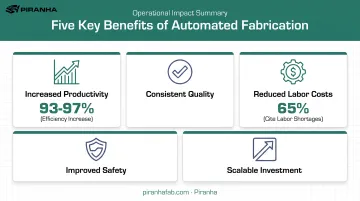
Automation's return comes down to a handful of concrete advantages.
Increased productivity and utilization. Manual press brake cells often sit idle more than shops realize, waiting on the next operator, setup, or material. Robotic cells close that gap.
One trade analysis found early robotic bending cell customers achieved 93% to 97% unattended efficiency, well above the 80% shops had originally expected. That same reporting noted a single operator monitoring a cell can cover output equivalent to three or four manual brakes.
Consistent, repeatable quality. An automated system bends at the same speed, the same distance, the same sequence, every time. Operator fatigue doesn't creep in over a ten-hour shift, and neither does the angle drift that happens when someone's rushing to hit a deadline late on a Friday.
Reduced labor costs and a smaller skilled-labor gap. Finding brake operators is genuinely hard right now. A 2024 National Association of Manufacturers survey found 65% of manufacturers cited an inability to attract and retain employees as their top challenge.
Automation doesn't eliminate the need for skilled people; it shifts what they do. Instead of standing at a brake all day running repetitive bends, existing staff move into programming, quality checks, and higher-value fabrication work.
Improved workplace safety. Manual handling of heavy sheet stock and pinch-point exposure near small parts are two of the most common injury sources at a brake. Robotic material handling removes operators from both risks during the cycle.
Heavy-payload bending that once needed two or three people can run on a robotic cell instead. On the small end, robots handle tight-tolerance parts near the tool zone without putting a human hand in the pinch zone.
A scalable investment. Buying a press brake built with automation compatibility in mind means you're not stuck replacing the whole machine when volume grows.
Piranha designs its T Series and P Series press brakes, with Delem CNC controls, EasyCrown automatic crowning, and ram repeatability as tight as ±0.0004 inches, as a foundation for tooling automation or robotic integration later—not a dead end you outgrow.
Industries and Applications Best Suited for Automation
Press brake automation pays off fastest where parts repeat. Shops running one-off prototypes or highly custom jobs rarely see the same return as shops running recurring production.
Industries that lean heavily on press brake automation include:
- Trailer and truck body manufacturing
- Power and transformer production
- Structural steel fabrication
- Electrical enclosure and switchgear building
- Automotive component fabrication
- Agricultural equipment manufacturing
Piranha's own customer base reflects this pattern. Major trailer OEMs like Great Dane, Utility Trailer, Heil, and Hyundai Translead run high volumes of repeatable parts, from side rails to cross members, that suit automated bending workflows well.
You don't need massive single-part volumes to justify automation. A shop building a family of similar enclosures, for example, can share one bend program across dozens of size variations.
The repeatability comes from the part family, not from cranking out the exact same part thousands of times. That opens automation up to job shops that assumed it wasn't for them.
Is Press Brake Automation Right for Your Shop?
Key Decision Factors
Before committing to any level of automation, weigh these factors:
- Part volume and repeatability: Recurring jobs justify the investment. One-off prototypes generally don't pay back the setup time.
- Part size and material mix: Very small parts carry pinch-point risk; very large parts carry ergonomic and labor risk. Magnetic versus non-magnetic material also affects which end-effector or gripper design works.
- Compatibility with existing or new equipment: Confirm the automation system matches your press brake's tonnage, bed length, and open height. A brake built without automation in mind can be a costly retrofit later.
- Operator training and workforce transition: Plan to train current staff on programming and maintenance. Automation redirects skilled labor; it doesn't make it unnecessary.
Understanding the Investment: Cost and ROI
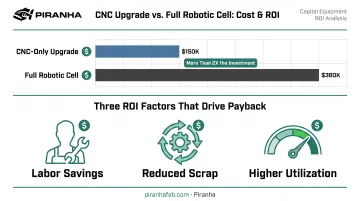
Cost varies enormously based on automation level. A CNC-only upgrade costs far less than a full robotic cell with tooling and software layered on top. Older industry cost analyses found robotic press brake cells costing more than double comparable manual systems, with initial setup costs sometimes 10 times higher during commissioning.
That upfront number isn't the whole story. Per-piece production costs can drop by close to half once volume and utilization catch up, but only after the cell is dialed in. Early setup on a new robotic cell can burn through hundreds of scrap blanks before it's running clean, so budget for that learning curve.
Calculate ROI by weighing:
- Labor savings from redeployed operators
- Reduced scrap once the cell is running
- Higher machine utilization across shifts
Working with a single manufacturer for both the press brake and automation-ready features avoids juggling separate vendors for the machine, the robot, and the tooling. Piranha builds its press brakes, fiber lasers, and fabrication line around that model: one quote, one install team, one parts catalog.
Piranha's financing program also covers staged automation rollouts, with up to $750,000 in same-day approval and a six-month payment deferral option. That keeps capital available during installation and ramp-up.
Frequently Asked Questions
What is an automated press brake?
An automated press brake uses CNC controls, robotics, sensors, or software to run or assist bending with less operator involvement. Systems range from simple programmable controls to full robotic load/bend/unload cells.
Is an automated press brake the same as an automatic press brake?
Not exactly, though the terms are often used interchangeably. "Automatic" usually refers to machine-level controls like programmable back gauges, while "automated" more often implies robotic handling that removes the operator from loading and unloading.
What are other terms for an automated press brake?
You'll also see robotic bending cell, robotic press brake, bend cell, and CNC press brake automation. Panel benders are a related but distinct machine category, not a type of robotic press brake.
How much does press brake automation cost?
Cost depends heavily on the automation level. A CNC upgrade costs far less than a full robotic cell with tooling and software, and a robotic cell can run more than double the cost of a comparable manual system.
Do I need robotics to automate my press brake, or are there simpler options?
No. CNC controls, automatic tool changers, and offline programming software all automate parts of the bending process without a full robotic cell—or the extra footprint and integration work that comes with one.
Can small fabrication shops benefit from press brake automation?
Yes, if they run a repeatable family of parts rather than only high volumes of one identical part. Shops building similar enclosures or brackets across size variations can share one bend program and still see strong returns.