For shop owners comparing their first quotes, the terminology gets confusing fast. Mechanical, hydraulic, servo-electric, CNC turret: the labels blur together, and it's not always clear which components determine whether a machine holds tolerance, survives high-volume runs, or needs a guarding overhaul.
This guide breaks down what a punch press machine actually is, walks through the core parts that make it work, and compares the four main drive types so you can match tonnage, precision, and production volume to the right equipment for your shop.
Key Takeaways
- Punch presses shear or form metal by forcing a punch through a die with controlled tonnage.
- Five parts—ram, frame, flywheel, bolster plate, brake/clutch—deliver safe, precise force.
- Drive type (mechanical, hydraulic, servo-electric, or CNC turret) shapes force, speed, and precision.
- Match tonnage, throat depth, and automation needs to your production volume, not brand loyalty.
What Is a Punch Press Machine?
A punch press is a metal fabrication machine that shapes or cuts sheet metal and plate by driving a punch through a die, shearing, forming, or piercing the material in one stroke.
OSHA's definition describes it as a machine that shears, punches, forms, or assembles metal using tools mounted on a reciprocating ram or slide moving toward a stationary bed.
Every punch press, regardless of size or drive type, comes down to two coacting parts:
The punch is the male tool, mounted to the ram, that descends into the material. The die is the female tool, fixed to the bed, that the punch drives through.
Their interaction determines hole size, edge quality, and whether the operation shears a slug free or forms a feature without cutting all the way through.
From Flywheel Presses to CNC Turrets
Machine-tool history stretches back to 1852, when Schuler began building sheet-metal equipment, with mechanically driven eccentric presses following later that century. Wiedemann introduced the first NC turret punch press in 1955, and that innovation eventually led to today's CNC-controlled systems that index dozens of tools automatically.
Why Punching Still Beats Cutting-Only Methods
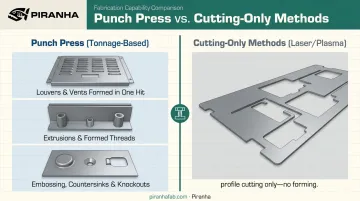
Laser and plasma cutting produce clean profiles, but neither applies physical tonnage. A punch press does, which is what makes it capable of:
- Louvers and vents formed in a single hit
- Extrusions and formed threads without a secondary tapping operation
- Embossing, countersinks, and knockouts, all without cutting through the metal
That forming capability keeps punch presses foundational in fabrication shops, even as laser cutting has grown more common. It's also the thinking behind Piranha's approach to ironworkers and punching systems: building tonnage-rated equipment meant to hold up under repeatable, spec-driven production runs rather than one-off jobs.
Key Parts and Components of a Punch Press Machine
A punch press might look like a simple frame with a moving head, but underneath, it's a coordinated system. A weak bolster plate or a slow brake response can throw off tolerances or create a safety hazard.
Ram, Flywheel, and Brake System
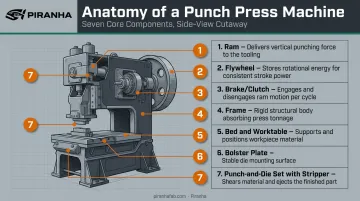
The ram is the moving component that delivers the punching force, driven by a motor-and-flywheel combination or a hydraulic cylinder. It travels toward the bed, drives the punch into the material, then retracts to reset the cycle.
On mechanical presses, the flywheel stores rotational energy while the machine idles, then releases it in a burst during the punching stroke. That lets a smaller motor handle intermittent power demands instead of sizing for peak load every cycle.
Brakes and clutches decide when the ram can stop mid-cycle, and that distinction defines whether a press runs full-revolution or part-revolution. Part-revolution presses can disengage at any point in the stroke, which is why they're the safer, more common design in modern shops.
Frame, Bed, Worktable, and Bolster Plate
The frame, typically a C-type or bridge-type design, supports the press structure and absorbs the reaction force of every stroke. The bed and worktable below it hold the workpiece and bottom die steady, preventing shift that would ruin hole placement.
The bolster plate is the thick mounting surface bolted to the bed, giving the die a stable, flat foundation. The stripper, a spring-loaded plate, pins the sheet down as the punch retracts, so the metal doesn't lift or drag with the tool. Together, these load-bearing components anchor the tooling and absorb the impact of every stroke, keeping every cut aligned and accurate.
Punch and Die Set
The punch (male) and die (female) are interchangeable tooling, and they're what determine the shape cut or formed into the metal. Clearance, the small gap around the punch as it enters the die, controls cut quality directly. Wilson Tool notes that roughly 10% of material thickness is a common starting clearance in stamping work, though the right figure depends on alloy and finish.
Because tooling wears and breaks, most shops keep several interchangeable sets on hand. Piranha's die catalog spans round, oblong, and special-shape configurations cross-referenced to Buffalo, Cleveland, and American Punch Co. standards, so shops can swap tooling without matching brands exactly.
Types of Punch Press Machines
Punch presses are classified primarily by how they deliver power to the ram. Each drive type carries different tradeoffs in force control, speed, and precision.
| Drive Type | How It Powers the Ram | Best Suited For |
|---|---|---|
| Mechanical (flywheel) | Rotating flywheel and crankshaft | High-volume, repetitive punching |
| Hydraulic | Hydraulic cylinder | Variable tonnage, mixed thicknesses |
| Servo-electric | Servo motor | Energy efficiency, low maintenance |
| CNC turret | Rotating tool turret (any drive type) | High-mix parts, multiple hole sizes |
Mechanical (Flywheel-Driven) Punch Press
A rotating flywheel and crankshaft deliver a consistent, repeatable stroke every cycle. This design is durable and cost-effective for shops running the same part over and over. However, force output is fixed by the crank geometry, leaving little flexibility to adjust tonnage mid-job.
Hydraulic Punch Press
Hydraulic cylinders power the ram instead, giving operators variable control over stroke speed and tonnage. This makes hydraulic presses a strong fit for shops running mixed material thicknesses or jobs that need precise force control rather than one fixed setting.
Piranha's hydraulic ironworkers, including the BII-88 and P-90, use dual-motor, dual-pump systems so punching and shearing operations can run independently.
Servo-Electric Drive Punch Press
Servo motors combine mechanical reliability with hydraulic-style control. Because there's no hydraulic fluid or chiller system to maintain, Prima Power reports up to 75% lower energy consumption compared to hydraulic technology on its servo-electric punching lines. That efficiency comes with a tradeoff: servo systems generally carry a higher upfront cost than comparable hydraulic setups.
CNC Turret Punch Press
A rotating turret holding dozens of tools lets a CNC-controlled machine switch punches automatically mid-cycle. This enables multiple hole sizes and forming operations without a manual tool change.
Piranha extends this concept with combination punch/plasma systems like the 4400 MAX. The machine pairs 100 tons of hydraulic punching force with an optional plasma cutting head, letting a shop consolidate punching, notching, and cutting into fewer setups as production scales.
How a Punch Press Works
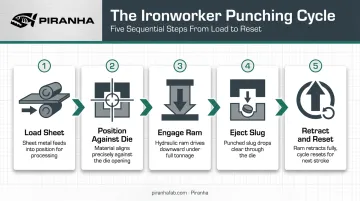
The punch-die interaction follows the same basic sequence whether the machine is a manual single-station press or a CNC turret running unattended.
- Load the sheet - the operator or an automated feeder positions the material on the bed.
- Position against the die - the sheet is aligned so the target feature sits directly over the die opening.
- Engage the ram - the punch descends, deforms the material, then shears or forms it as it passes through.
- Eject the slug - the cut-out drops through the die opening while the stripper holds the surrounding sheet flat.
- Retract and reset - the ram returns to the top of the stroke, ready for the next hit.
What the Operator Actually Does
Day to day, a punch press operator handles more than running the cycle. Responsibilities typically include:
- Setting up tooling and confirming punch-die clearance before the first hit
- Adjusting stroke depth for the material and feature being formed
- Monitoring tonnage limits to avoid overloading the press or tooling
- Confirming clear guarding and safe hand placement before every cycle
CNC and turret systems shift the skill set. On CNC and turret machines, much of that manual attention moves into programming. Operators spend more time sequencing tool changes and nesting parts on the sheet for maximum material yield, and less time physically adjusting the press between hits.
Applications and Choosing the Right Punch Press
Common Applications
Punch presses show up wherever repeatable hole patterns and clean edges matter as much as speed. Common users include:
- Trailer and truck body manufacturers punching mounting holes and structural brackets
- Structural steel fabricators punching plate and angle for connections
- Electrical enclosure builders meeting NEMA and UL knockout requirements
- Switchgear manufacturers producing consistent panel cutouts at volume
Key Factors When Choosing a Punch Press
Before comparing quotes, weigh these factors against your actual production needs:
- Tonnage capacity - match required force to your thickest, highest-shear-strength material, not just your average job
- Throat depth - confirm the machine can reach the part geometry you fabricate most often
- Precision needs - tighter tolerances may justify hydraulic or servo-electric control over a fixed mechanical stroke
- Automation and scalability - consider whether the machine can grow with production demand without a full replacement
Sourcing strategy matters too. Shops that buy ironworkers, punching equipment, and cutting systems from one manufacturer, such as Piranha, simplify vendor management, parts sourcing, and long-term service support instead of juggling separate contracts for every machine.
Frequently Asked Questions
How does a punch press work?
A ram drives a punch through the material and into a matching die, shearing or forming the metal as it descends. The cut-out slug ejects through the die opening as the ram retracts for the next cycle.
What are the different types of punch presses?
The four main types are mechanical, hydraulic, servo-electric, and CNC turret. Each is defined by how it powers the ram, which affects force control, speed, and precision.
What does a punch press operator do?
Operators set up tooling and clearances, adjust stroke depth, load material, and monitor tonnage and safety systems throughout each cycle. On CNC machines, much of this shifts to programming tool sequences and part nesting.
What materials can a punch press cut or form?
Common materials include mild steel, stainless steel, and aluminum. Required tonnage depends on material thickness and shear strength, not just the type of metal being processed.
How much does a punch press cost?
Pricing varies widely by type and tonnage. Piranha's P-90 ironworker, for example, starts around $43,995, while CNC turret systems typically run higher. Get current quotes across categories for an accurate comparison.
Is a punch press safe to operate?
Modern presses include point-of-operation guarding, brakes, and part-revolution clutch systems to prevent accidents. Proper training and clearance checks before every cycle remain essential regardless of the machine's built-in safeguards.