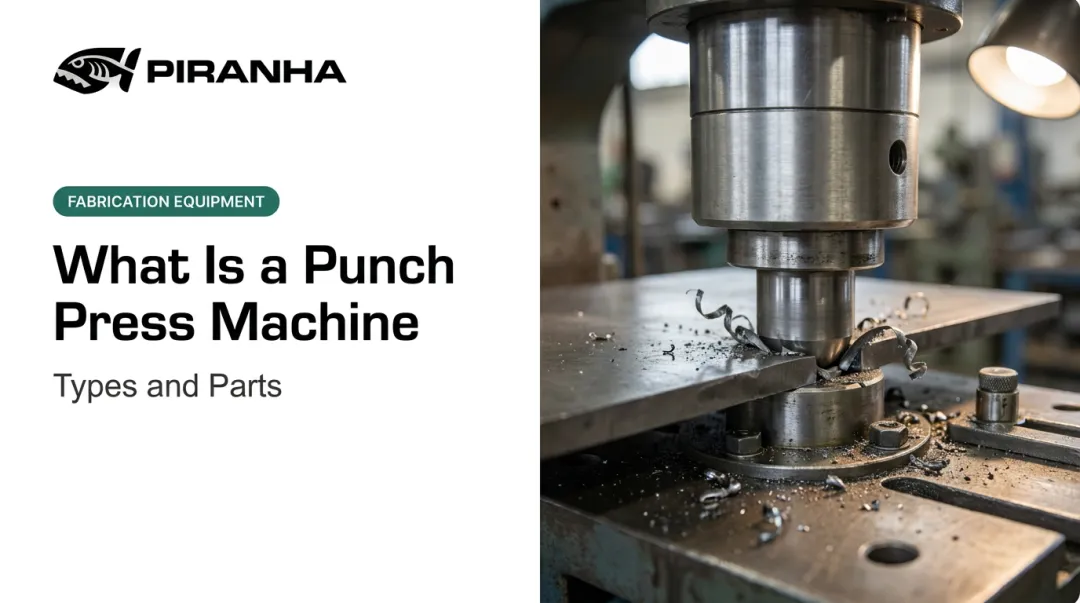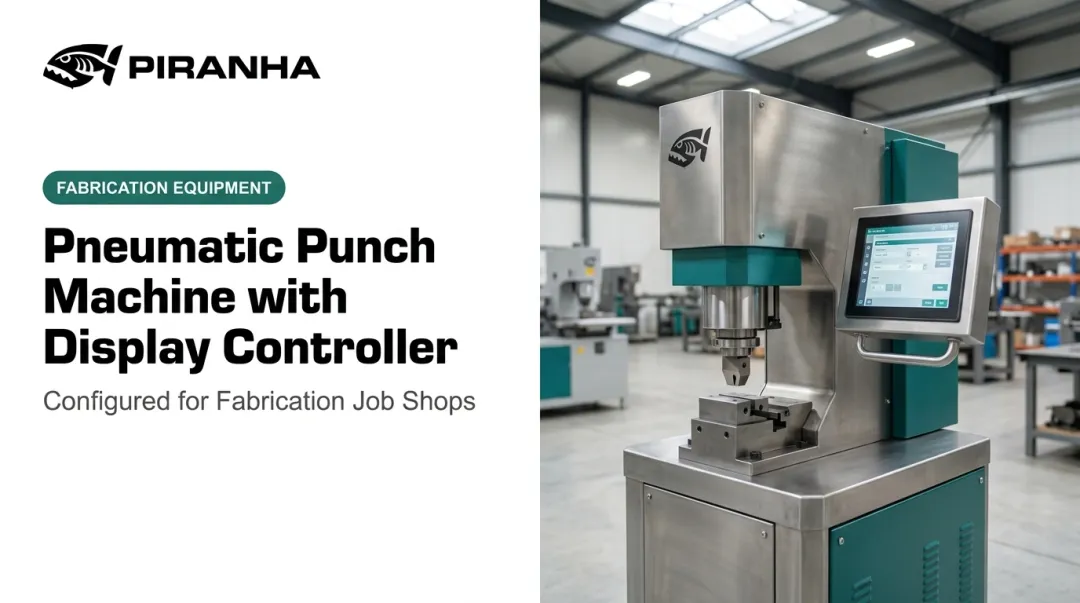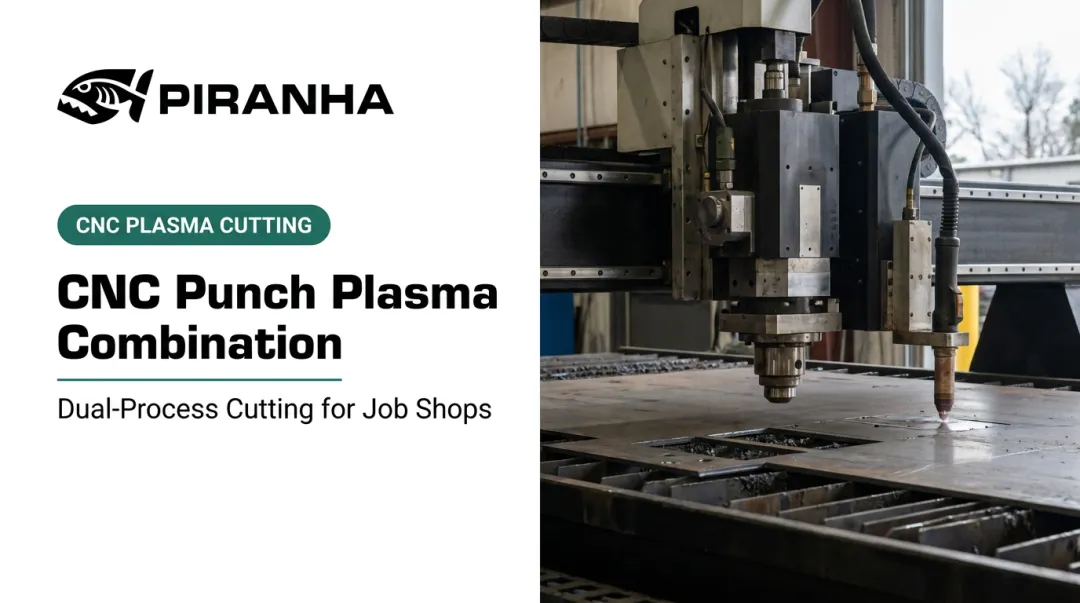
That's the problem the punching and shearing machine was built to solve. Known across North America as an ironworker, this piece of equipment combines several metal-forming operations into one machine, one setup, and often one operator.
This guide breaks down what a punching and shearing machine actually is, how it works, the different types on the market, and where shops put them to use every day.
Key Takeaways
- Combines punching, shearing, notching, and bending in one machine.
- Hydraulic or mechanical force drives the punch or blade through material.
- Trailer builders, steel fabricators, and enclosure makers rely on it for speed and accuracy.
- Hydraulic vs. mechanical, single vs. multi-station: the choice directly affects throughput and ROI.
What Is a Punching and Shearing Machine?
A punching and shearing machine is multi-station equipment that punches holes and shears metal plate, bar, and structural profiles in a single setup. Instead of running material through a punch press, then a separate shear, then a notcher, one machine handles it all.
That consolidation is the whole point. A fabrication shop that needs to cut angle iron, punch mounting holes, and notch a corner can do it at one station instead of three, without moving the part between machines.
Ironworker or Punching and Shearing Machine — Same Equipment
In the U.S. and Canada, this equipment is almost universally called an ironworker. That naming isn't limited to North America, either; manufacturers overseas use similar terms, with some calling their machines "steelworkers" and others sticking with "ironworker."
Piranha has been building these machines since 1974, when founders Harry Oswald and Bob Brown developed the original ironworker to solve a production bottleneck at the foundry where they worked. More than 50 years later, the Piranha ironworker lineup still centers on that same core idea: one machine, multiple stations, less downtime between operations.
How Does a Punching and Shearing Machine Work?
Modern ironworkers rely on hydraulic cylinders to generate cutting force:
- Punching station: A hydraulic ram drives a punch through a die, shearing a clean hole and ejecting a slug of material.
- Shearing station: A moving upper blade cuts against a fixed lower blade, separating material along a straight line.
- Tonnage rating: Determines how much force the machine can apply. A 50-ton machine handles thinner stock than a 120-ton machine.
- Blade and punch clearance: The gap between blade edges or punch-to-die fit directly affects cut quality and the maximum thickness the machine can handle cleanly.
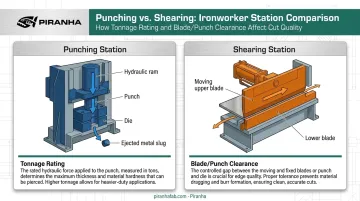
Two-cylinder designs are common on larger ironworkers, with one cylinder dedicated to punching and a second running the shear, notcher, or bending station.
Punching vs. Shearing: What's the Difference?
These two operations look similar but do very different jobs:
| Process | What It Does | Result |
|---|---|---|
| Punching | Drives a punch through a die into material | Creates a hole; removes a slug |
| Shearing | Moves a blade against a fixed blade edge | Makes a straight-line cut, without punching a hole |
Punching is how you make round, square, or custom-shaped holes. Shearing is how you cut bars, angles, plate, and structural profiles down to length. Most fabrication jobs need both, and running them on separate machines adds extra setup time and material handling.
Types of Punching and Shearing Machines
Not every ironworker is built the same way. Choosing the right configuration matters as much as choosing the right tonnage.
Hydraulic vs. Mechanical
Older mechanical ironworkers use a flywheel-driven ram. Once triggered, the stroke has to complete before it can stop. Hydraulic machines control the entire stroke, meaning an operator or an emergency stop can halt the ram mid-cycle. That control is a major reason hydraulic designs have become the standard in modern fabrication shops.
Single-Station vs. Multi-Station (Combination) Machines
A single-station machine does one job. A combination ironworker integrates several:
- Punching
- Flat bar shearing
- Angle shearing
- Round bar shearing
- Notching/coping
- Bending
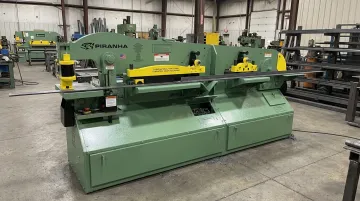
Piranha's larger models pack up to six workstations into a single frame, combining punching, shearing, coping, and notching. Every station sits at the same working height, so material moves smoothly from one operation to the next without re-fixturing.
Single-Motor vs. Double-Motor Designs
Double-motor, double-cylinder machines, like Piranha's BII Series, run two hydraulic pumps and valve bodies independently. That means the punching station and the shearing/notching station can operate at the same time, with two operators working simultaneously instead of taking turns. For high-volume shops, that difference shows up directly in parts-per-hour output.
Manual vs. CNC/Automated Positioning
Manual ironworkers rely on finger stops and measuring rules for repeat hole spacing. Automated options add electronic backgauges with compression-sleeve adjustment for precise, repeatable positioning, plus quickset gauging tables for punching hole series without remeasuring each time.
For shops producing electrical enclosures, busbars, or other spec-driven parts, this kind of repeatable positioning matters a lot more than it does for one-off job shop work.
Portable and Light-Duty Bar and Angle Shears
Smaller shops or field crews with lower-volume needs sometimes opt for portable or light-duty bar and angle shears instead of a full industrial ironworker. These trade capacity and station count for a smaller footprint and lower upfront cost. That's a reasonable tradeoff if you're not running high-tonnage structural work.
Uses and Applications Across Industries
Punching and shearing machines show up anywhere steel needs to be cut, punched, or shaped in volume.
- Construction and structural steel fabrication: Base plates, splice plates, gussets, shear tabs, and stair stringers for buildings and bridges.
- Trucking and trailer manufacturing: Chassis components, brackets, crossmembers, and suspension parts for trailer OEMs and truck body builders.
- Power, transformer, and switchgear manufacturing: Precise hole punching for electrical enclosures and busbars, where hole spacing has to match spec every time.
- General metal fabrication shops: Custom part production, prototyping, and the flexibility to switch jobs quickly.
- Heavy equipment manufacturing: Shaping thick steel plate and profiles for industrial machinery components.
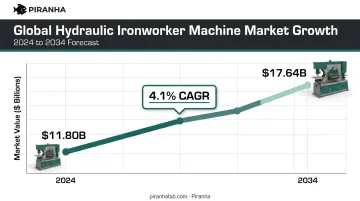
Demand for this kind of multi-function equipment keeps climbing. According to a 2024 market report from Zion Market Research, the global hydraulic ironworker machine market was valued at $11.80 billion in 2024. It's projected to reach $17.64 billion by 2034 — a 4.1% compound annual growth rate. That trajectory tracks with what shops are asking for: fewer standalone machines, more consolidated capability.
Piranha's own customer base reflects this spread. Companies like Great Dane, Utility Trailer, Heil, and Hyundai Translead run ironworkers to keep chassis and structural component production moving without shuffling parts between multiple machines.
Benefits of Using a Punching and Shearing Machine
The case for consolidating equipment comes down to three things: space, speed, and reliability.
Space and cost savings. One ironworker replaces what would otherwise be a punch press, a shear, and a notcher, collapsing three machine footprints into one. For shops paying by the square foot, that adds up fast.
Higher throughput, lower labor costs. Faster job changeovers and less material handling between stations mean fewer hands touching each part. A part that used to travel between three stations now stays in one place.
Long-term reliability and simpler sourcing. Well-built ironworkers run for decades with routine maintenance — some of Piranha's original machines from the 1970s are still in service. Buying from a single manufacturer also means one quote, one install team, and one parts catalog instead of juggling multiple vendors for tooling and support.
Safety Considerations When Operating a Punching and Shearing Machine
Ironworkers combine several cutting operations in one machine, creating multiple distinct pinch points and hazard zones. Safety has to be layered, not left to a single control.
Required PPE:
- Safety glasses or goggles
- Hearing protection
- Steel-toed boots
- A strict no-gloves rule near punching and shearing stations, where loose material can get pulled into the die
Built-in machine safeguards commonly include:
- Emergency stop buttons on the control panel, positioned for quick access
- Protective covers over punch tooling and shear blades
- Foot-pedal controls that require deliberate activation
The Occupational Safety and Health Administration's guidance on power press safeguarding is clear that an e-stop is a reactive control, not a substitute for point-of-operation guarding. ANSI B11.5 sets the specific safety standard covering powered machines that punch, shear, notch, and form.
Core operating rules:
- Keep hands clear of the die and blade area at all times.
- Never stack multiple pieces of material for punching in a single stroke.
- Follow lockout/tagout procedures before any maintenance or die change.
Frequently Asked Questions
How does a punching and shearing machine work?
A hydraulic ram drives a punch through a die to create clean holes, while a separate station shears material between a moving blade and a fixed blade. Tonnage and clearance settings determine the thickness the machine can handle.
What are the uses of a punching and shearing machine?
These machines serve construction and structural steel fabrication, trailer and truck body manufacturing, power and electrical enclosure production, and general metal fabrication shops. Any operation that needs repeated punching and cutting benefits from one.
What is the difference between punching and shearing?
Punching creates a hole by driving a punch through a die and ejecting a slug. Shearing makes a straight-line cut using two opposing blades, without producing a punched-out slug.
What metal thickness can a punching and shearing machine handle?
Capacity depends on tonnage and tooling. Lighter 50-ton machines typically punch up to roughly 3/4-inch mild steel plate, while 90- to 120-ton models handle 1 inch or more, depending on hole size and shear width.
Is a punching and shearing machine the same as an ironworker?
Yes. "Ironworker" is the common North American term for this exact type of multi-function punching and shearing equipment. Both names describe the same machine.
How much does a punching and shearing machine cost?
Pricing depends on tonnage, station count, and automation features like CNC positioning. For an accurate quote based on your production needs, Piranha's shop-builder tool lets you configure a machine and request pricing directly.