Introduction
Walk into most metal fabrication shops and you'll see the same bottleneck: a punch press in one corner, a plasma table across the floor, and a forklift shuttling plate between them. Every trip adds handling time and setup time, plus a real risk of scratching or misaligning the part.
That gap between "touch time" and total production time is real. In many job shops, actual machine work happens in hours, while the full job stretches across weeks once you count queueing, transport, and setup between processes, according to an analysis of non-value-added production time from The Fabricator.
A CNC punch plasma combination machine solves this by putting punching and plasma cutting on one CNC-controlled platform. This guide covers how these machines work, where they deliver the most value, and how to choose one for a growing shop.
Key Takeaways
- One CNC platform handles punching and plasma cutting without re-fixturing the part
- Combination machines suit parts needing both precision holes and irregular profile cuts
- Shops skip the cost of two dedicated machines while still meeting NEMA/UL specs
- Plate thickness, tooling capacity, and vendor support should drive your machine selection
What Is a CNC Punch Plasma Combination Machine?
A CNC punch plasma combination machine is a single platform that pairs a punch press turret (or single-station tool holder) with a plasma torch on one gantry. Both processes run from one CNC program, on one table, without moving the part between stations.
Core components typically include:
- CNC controller that sequences punch and plasma operations
- Punch tooling stations, either a turret or single-station setup
- Plasma torch and power supply
- Material clamps and work table
- Software that coordinates both toolpaths in a single job file
True Combination vs. Combination in Name Only
Not every machine marketed as a "combo" runs both processes on the same frame with shared programming. W.A. Whitney pioneered genuine integrated punch/plasma equipment, adding plasma cutting to a numerically controlled punching unit back in 1974 and launching a dedicated combination machine in 1982.
That heritage matters — legacy engineering means the punch and plasma systems were designed to work as one tool, not bolted together as an afterthought.
Why Combine the Two Processes?
Punching and plasma solve different problems on the shop floor:
| Process | Best Suited For |
|---|---|
| Punching | Small, repeated holes such as bolt patterns, mounting holes, and ventilation grids |
| Plasma | Larger contours, slots, and irregular shapes, particularly on thicker plate |
A rule of thumb worth remembering: don't punch a hole smaller in diameter than the material thickness. That's where plasma picks up the slack. Combination machines cover both jobs on parts needing precision holes and full-profile cutouts, which describes a lot of structural brackets, enclosure panels, and chassis components.
How Does a Punch Plasma Combo Machine Work?
The workflow is simpler than shops running two separate machines expect.
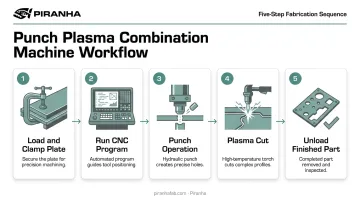
- Load and clamp the plate once — this is the only material handling step
- Run the CNC program, which sequences punching and plasma operations automatically
- Punch first (typically), indexing through tooling stations for different hole shapes and sizes
- Plasma-cut the perimeter, slots, and complex geometries after punching completes
- Unload the finished part — no secondary deburring or repositioning required
The Role of Nested CAM Software
Nesting software is essential here: it drives the efficiency of the punch-plasma combination process. The CAM system assigns punch tooling and plasma toolpaths, nests multiple parts on a sheet, and sequences operations to minimize head travel.
Software platforms built for punch-plasma combinations, like SigmaNEST, handle this automatic nesting and programming rather than treating punching and plasma as two unrelated jobs.
Quality Outcomes You Can Expect
- Repeatable hole positioning for bolted assemblies and spec-driven builds
- Clean, low-dross cut edges on plasma-cut profiles, within the machine's process window
- Program flexibility to run punch-only, plasma-only, or combined operations depending on the part
That flexibility matters on the shop floor. A job that's all holes doesn't need to fire the torch, and a job that's all contour cutting doesn't need to index the turret. The controller adapts to whatever the part requires.
Key Benefits of CNC Punch Plasma Combination Machines
Labor and Floor-Space Savings
Every material transfer between machines costs time and floor space. Combining processes onto one table removes a transport step, a second setup, and a second machine footprint entirely. For shops with limited square footage, that reclaimed space often matters as much as the cycle-time gain.
A Stronger ROI Argument
One capital investment covers two processes. That's a meaningful difference for small-to-mid-size shops that can't yet justify buying, or maintaining, separate punch and plasma machines.
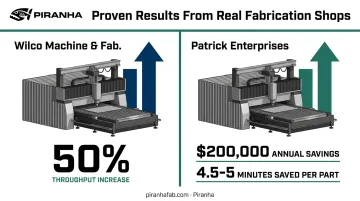
Real-world results back this up. Wilco Machine & Fab. saw throughput increase by nearly 50% after installing a Whitney punch/plasma combination machine.
Patrick Enterprises cut cycle time by 4.5 to 5 minutes per part and reported roughly $200,000 in annual savings after consolidating punching and plasma cutting while eliminating a deburring step, according to Piranha-Whitney case study data.
Quality and Scalability
- Punching delivers tight-tolerance, repeatable holes for bolted assemblies
- Plasma delivers fast, clean cuts on thicker or irregular profiles
- The part stays fixtured through both operations, reducing handling errors and scrap
Shops can also start with core punch/plasma capability now and add automation, such as load/unload systems or sheet routing, later without replacing the core machine. Piranha builds its equipment with that growth path in mind, so a shop scaling from single-shift to multi-shift production doesn't need to start over.
Piranha's Whitney Combo line reflects a single-vendor approach: a single quote, one install team, and one parts catalog. Chasing down two separate vendors for warranty issues on an integrated machine gets complicated fast. Single-vendor support avoids that entirely.
Punch vs. Plasma vs. Combination: Choosing the Right Process
| Criterion | CNC Punch | Plasma | Combination |
|---|---|---|---|
| Best-fit geometry | Repeated holes, bolt patterns | Irregular profiles, large contours | Both on one part, one setup |
| Thickness fit | Thinner gauge, hole diameter ≥ stock thickness | Gauge material through thick plate | Model-dependent, spans both ranges |
| Edge quality | No thermal effect, tool-defined | Fast but can leave dross/taper | Punch for holes, plasma for contours |
| Volume fit | High-volume repeat features | High-mix irregular shapes | High-mix, low-to-mid volume mixed parts |
When does combination win? Whenever a part needs both precision holes and free-form cuts in the same production run — think a bracket with mounting holes and a curved profile edge. Piranha's punch-plasma combination machines are built for exactly this kind of mixed-process work.
When doesn't it win? Extremely high-volume, single-process shops running one part type at massive scale may still get more out of two dedicated machines running in parallel. Combination equipment is built for flexibility, not maximum single-process throughput.
Industries and Applications Best Suited for Combination Machines
Combination machines earn their keep in industries where parts routinely need holes and profiles in the same production run.
- Trailer and truck body manufacturing — chassis brackets and structural components need punched mounting holes paired with plasma-cut profiles.
- Heavy agricultural equipment manufacturing — Degelman Industries used combination punching to hold precision hole tolerances through 1-inch plate for compression bushing installation.
- Electrical enclosure and switchgear fabrication — NEMA/UL-relevant hole patterns pair with clean cutout edges on mounting frames and vent grids.
- Power and transformer manufacturing — lifting lugs and mounting frames often need both punched patterns and cut profiles.
- Structural steel and general fabrication — panel and frame components across foundries, OEMs, and regional fabricators benefit from combined processes rather than routing plate through two separate machines.
Across these applications, the heaviest plate work often comes from agricultural equipment manufacturing, where more than half the material processed runs at or near 1-inch thickness.
Choosing the Right CNC Punch Plasma Combination Machine
Buying the wrong combo machine is expensive in a different way than buying two separate machines — you're stuck with one platform, so get the fit right upfront.
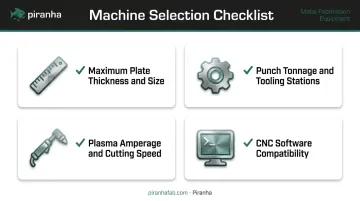
Key evaluation criteria:
- Maximum plate thickness and size the machine can handle for your typical part mix
- Punch tonnage and tooling station count: more stations mean fewer tool changes mid-run
- Plasma amperage and cutting speed at your target material thickness
- CNC software compatibility with your existing nesting and CAD/CAM systems
Support Matters as Much as Specs
A machine is only as good as the support behind it. Ask vendors about:
- Preventive maintenance programs
- Parts availability and shipping turnaround
- Technical support responsiveness
Piranha ships parts same-day from its Belvidere, IL facility and backs machines with U.S.-based service across all 50 states. That's a meaningful difference when a torch consumable or tooling component fails mid-shift.
Get Vendors Involved Early
Bring equipment vendors into the conversation before you finalize specs. A vendor who understands your specific part mix (hole patterns, plate thickness, run volume) can steer you toward the right tonnage and plasma power instead of overselling capacity you'll never use.
Piranha's approach leans on fabrication expertise before and after the sale, which matters most in year two, when you're troubleshooting a program, not signing a purchase order.
Single-vendor simplicity also pays off during integration. One quote, one install team, and one parts catalog reduce the friction of slotting a new combo machine into an existing fabrication line.
Frequently Asked Questions
What is plasma blast?
"Plasma blast" isn't a standard technical term. It informally describes molten metal ejecting when the pilot arc strikes during plasma piercing, a normal part of plasma operation rather than something unique to combination machines.
What can't plasma cut?
Plasma cutting requires an electrically conductive workpiece, so it can't cut wood, plastic, stone, glass, or ceramic, according to ESAB's guide to plasma-cuttable metals. It also has practical thickness limits compared to methods like waterjet.
What's the difference between a CNC punch and a plasma cutter?
A CNC punch uses mechanical force through tooling to shear precise holes. A plasma cutter uses a thermal, ionized-gas arc to melt and cut profiles and contours. Combination machines run both processes on the same table.
How much does a CNC punch plasma combination machine cost?
Pricing depends on punch tonnage, plasma power, tooling capacity, table size, and automation options. Contact a manufacturer like Piranha directly for a quote tailored to your part mix and volume.
Can a combination machine handle thick steel plate?
Yes, plasma cutting on combo machines generally handles thicker plate than punching alone, with some models processing up to roughly 1 inch. Actual limits depend on the machine's punch tonnage and plasma power rating.
Do combination machines require special CAM software?
Yes. Nesting and CAM software that coordinates both punch tooling and plasma toolpaths is standard for these machines, and most manufacturers supply integrated software as part of the package.