Introduction
Stainless steel shows up everywhere in fabrication: enclosures, trailer panels, switchgear housings, structural components. But its complex geometries and heat sensitivity turn traditional TIG and MIG welding into a slow, distortion-prone process.
Operators fight warping, discoloration, and hours of post-weld cleanup on parts that need to perform flawlessly. That's expensive, and it eats into shop capacity fast.
Laser welding solves that problem. It delivers speed, precision, and a heat-affected zone narrow enough to protect stainless steel's corrosion resistance.
This guide covers how laser welding works, how it compares to TIG/MIG, the parameters that separate a clean weld from a reject, and how it fits into a complete stainless steel fabrication workflow.
Key Takeaways
- Stainless steel's low thermal conductivity lets laser welders form stable weld pools with less power.
- Laser welding uses a fraction of TIG/MIG heat input, reducing distortion, staining, and cleanup.
- Fiber laser welders join stainless steel up to about 6mm (1/4"), depending on machine power.
- Weld quality depends on clean cut edges plus correctly matched power, speed, and shielding gas.
Understanding Laser Welding for Stainless Steel: How It Works
Laser welding is a non-contact process. A focused, high-energy beam melts and fuses metal directly at the joint line, typically without filler wire — unlike arc-based methods that depend on a consumable electrode or fed wire.
Stainless steel ranks among the more forgiving metals for this process. Its lower thermal conductivity means the beam needs less power to create and hold a molten weld pool compared to a highly conductive metal like aluminum.
Stainless is also less prone to the pops and craters that plague conduction-mode welding on more heat-conductive materials.
Why the heat-affected zone matters:
- A narrow HAZ preserves the chromium oxide layer responsible for corrosion resistance.
- Less heat spread means less risk of "sugaring," the blue-black oxidation staining that shows up along overheated seams.
- Many shops skip post-weld grinding and passivation entirely, since the surrounding metal never gets hot enough to damage that protective oxide layer.
These quality advantages are a big part of why adoption is climbing fast. The global laser welding market is projected to grow from $2.33 billion in 2025 to $3.52 billion by 2034, a 4.70% CAGR, according to Fortune Business Insights. That's not a stainless-specific number, but stainless steel's favorable thermal behavior is a major reason fabricators keep making the switch.
Fiber vs. CO2 vs. Disk Lasers for Stainless Steel
Not every laser source performs the same way on metal.
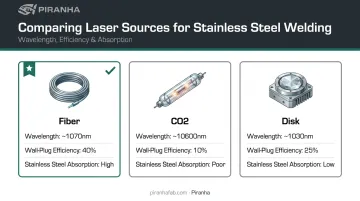
- Fiber lasers run at a 1070 nm wavelength with roughly 30% wall-plug efficiency, absorbing efficiently into stainless steel. Lower running costs make fiber the default on most industrial floors, including Piranha's handheld laser welding systems.
- CO2 lasers work well on non-metals but absorb poorly into stainless steel, limiting their use in modern metal fabrication.
- Disk lasers produce a similar near-1-micron output and remain a capable option, though fiber's flexible delivery and lower ownership costs give it the edge for stainless steel work.
Benefits of Laser Welding Stainless Steel
Shops that move from arc welding to laser welding on stainless steel see measurable gains across five areas.
Higher throughput. IPG Photonics reports its LightWELD handheld system runs up to 4X faster than TIG welding. Piranha's own MA1 Series handheld laser welders show a comparable pattern, running roughly 4x faster than traditional MIG/TIG on mild steel joints. That same cycle-time advantage carries over to stainless steel, where tighter heat control makes the speed gain even more valuable.
Minimal distortion and heat-affected zone. This matters most on thin-gauge sheet, including 16-gauge enclosure panels, trailer skins, and switchgear housings that warp easily under sustained arc heat. A concentrated beam keeps the surrounding material cool enough to hold its shape and dimensions.
Reduced post-weld finishing. Little to no spatter or slag means less grinding and polishing. That's a real advantage on spec-driven work like NEMA and UL-compliant enclosures, where surface finish and dimensional tolerance aren't optional.
Automation and repeatability. Laser welding integrates cleanly into robotic cells. Once you dial in parameters, the process repeats the identical weld thousands of times without drift — a big deal for shops running digitally controlled production lines.
Lower consumable costs. Most stainless steel joints run autogenously, meaning no filler wire or electrodes. That cuts material spend and removes the cleanup that comes with spatter-heavy MIG passes.
Together, these five factors are why more fabrication shops now run laser welding as a standard part of their stainless steel production line.
Laser Welding vs. TIG/MIG Welding for Stainless Steel
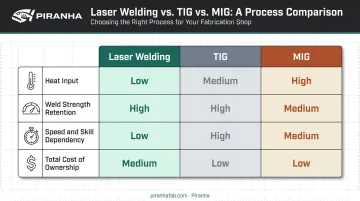
Choosing between laser and arc welding comes down to four practical comparisons.
Heat input. Laser welding uses a fraction of the heat input required by TIG or MIG. Lower heat input means less sugaring, less warping, and fewer parts that need to be clamped, cooled, and re-checked before they'll sit flat.
Weld strength. Cold-worked stainless steel loses hardness when heat anneals its microstructure. Laser welding's narrow, deep penetration and short thermal cycle limit that softening more than TIG's broader heat spread, producing finer weld structure with less thermal distortion. Exact strength retention still varies by grade and joint design.
Speed and skill dependency. TIG quality depends heavily on operator hand skill and travel consistency, and it's the slowest of the three. MIG runs faster but generates more spatter and a wider HAZ. Laser welding offers both speed and consistency, since the parameters (not the operator's steadiness) control the result.
Total cost of ownership. Laser welding equipment costs more upfront. That gap closes over time through reduced labor hours, less rework, and lower material waste, especially on repeat production runs. Handheld laser welding systems, like the ones Piranha offers, keep that entry cost lower than a full automated laser cell while still delivering the same weld quality.
When traditional welding still makes sense:
- Low-volume jobs where the equipment investment won't pay back quickly
- Tight budgets where a TIG setup already exists and works
- Simple joints where speed and distortion control aren't critical
For everything else, including repeat runs, thin-gauge enclosures, and spec-driven joints, laser welding tends to deliver the clearer return.
Key Parameters for Successful Stainless Steel Welds
Getting a clean stainless steel laser weld comes down to three variables: power, speed, and gas.
Material thickness. It determines how much power and travel speed you need for a clean weld. Handheld and industrial fiber laser welders commonly handle stainless steel up to about 6mm (1/4") with full penetration. Thicker stock needs either higher power or a slower travel speed to maintain a stable weld pool all the way through.
Shielding gas selection. Gas choice affects porosity as penetration increases.
| Gas | Best For | Trade-off |
|---|---|---|
| Argon | Stable, high-quality welds at shallow-to-moderate depth | Porosity risk rises as penetration increases |
| Nitrogen | Reducing porosity at greater penetration and higher speeds | Requires purity control for critical components |
AMADA Weld Tech's laser welding testing found that below roughly 0.04 inches of weld depth, gas type barely matters. Past that point, nitrogen consistently produced less porosity than argon in their stainless steel test welds.
Common defects and their causes:
- Porosity: contamination, gas turbulence, or unstable keyhole behavior during the weld
- Cracking: excessive thermal cycling or crack-sensitive stainless chemistry
- Distortion: mismatched power-to-speed ratio or inconsistent fit-up gaps
Clean edges and matched parameters prevent most of this before it starts, which is exactly why upstream cutting quality matters so much.
From Cutting to Welding: Building a Complete Stainless Steel Fabrication Workflow
Weld quality doesn't start at the welder. It starts at the cut.
Clean, burr-free, dimensionally accurate cut edges reduce fit-up gaps and lower the risk of porosity or inconsistent penetration once the part reaches the weld station. A part cut with rough edges or dimensional drift forces the welder to compensate, and that compensation shows up as rework.
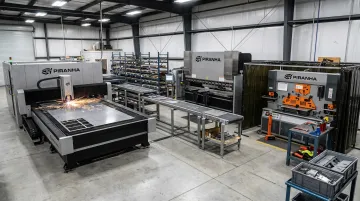
Piranha's fiber laser cutting systems exist precisely to solve that upstream problem. They deliver the clean, repeatable cut edges stainless steel fabricators need before a joint ever sees a beam or an arc. Pair that with press brakes and ironworkers for forming and punching, and a shop covers the full sequence: cut, form, punch, and weld, without handing parts off between vendors.
This full-line approach matters most to Piranha's core customer base:
- Switchgear builders who need tight tolerances on enclosure seams
- Electrical enclosure fabricators working to NEMA and UL specs
- Trailer OEMs producing high volumes of thin-gauge panels
- Structural steel shops running mixed-thickness jobs
For shops investing across their whole stainless steel line, single-vendor simplicity carries real, measurable value:
- One quote instead of coordinating bids from multiple vendors
- One install team instead of scheduling separate installation contracts
- One parts catalog instead of tracking parts across several suppliers
Frequently Asked Questions
Can you laser weld stainless steel?
Yes. Stainless steel is considered one of the easier metals to laser weld, thanks to its lower thermal conductivity and stable weld pool behavior compared to metals like aluminum.
What kind of welder is best for stainless steel?
Fiber laser welders, whether handheld (including Piranha's own systems) or fully automated, are the best choice for speed, precision, and minimal distortion. TIG still works well for low-volume or highly specialized jobs.
How thick of stainless steel can you weld with a laser welder?
Most handheld laser welders handle up to roughly 6mm (1/4") with full penetration. Higher-power industrial systems can weld thicker material at appropriately adjusted travel speeds.
What shielding gas is best for laser welding stainless steel?
Argon is the most common choice for stable, high-quality welds. Nitrogen becomes the better option as weld depth and travel speed increase, since it resists porosity better at greater penetration.
Is laser welding stronger than TIG or MIG for stainless steel?
Laser welds often retain more of the base material's original strength, since the lower heat input avoids annealing cold-worked stainless steel back to a softer state. TIG's broader heat spread makes that softening more likely.
Does laser welding stainless steel require filler material?
Most laser welds on stainless steel don't require filler. Some joint designs or gap-filling situations still call for it, but autogenous (filler-free) welding is the norm.