Compressed air plasma marking skips that stop entirely. It uses the same plasma torch and the same air supply already running your cutter to etch part numbers, layout lines, and traceability codes directly onto the metal — before or after the cut, on the same table.
This guide covers what compressed air plasma marking actually is, how the process works, how it stacks up against argon and nitrogen marking, and where fabrication shops put it to use.
Key Takeaways
- Etches metal instead of cutting, using your existing torch at lower amperage and higher speed.
- Requires no extra gas cylinders, marking machines, or secondary handling steps.
- Produces a darker, coarser mark than argon or nitrogen, but needs no extra gas supply.
- Ranges from light surface discoloration to permanent grooves based on amperage and speed.
What Is Compressed Air Plasma Marking?
Compressed air plasma marking is a variation of standard plasma marking. Instead of running argon or nitrogen through the torch, the machine uses compressed air (the same gas already powering the plasma cutting process) as both the plasma and shield gas.
It runs on the same torch, power source, and controls used for cutting. The only real difference is the settings: lower amperage and faster travel speed constrict the arc's energy so it marks the surface instead of piercing it.
You'll see the terms marking, etching, and scribing used interchangeably here, and that's fine. Equipment manufacturers treat them as different names for the same surface-level operation: adding part names, geometry references, or bend lines with a low-power arc.
Why air appeals to fabrication shops:
- No additional gas cylinders or supply lines to install
- No separate marking machine to purchase or maintain
- One gas type to stock, monitor, and purge for both jobs
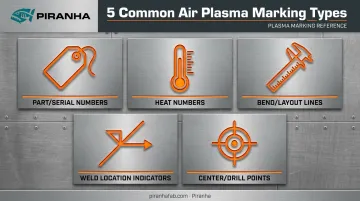
Common Marks Made With Air Plasma
Shops running air plasma marking typically use it for:
- Part and serial numbers
- Heat numbers for material traceability
- Bend and layout lines
- Weld location indicators
- Center and drill points
How Does Compressed Air Plasma Marking Work?
The physics are the same as plasma cutting, just dialed back. Compressed air gets forced through the torch nozzle, and an electric arc ionizes it into plasma, a superheated, electrically conductive gas capable of melting metal on contact.
During cutting, that energy blows molten metal completely through the plate. During marking, reducing the amperage and speeding up the torch travel constricts the arc's energy so it only affects the surface.
Light Marks vs. Deep Grooves
The outcome depends entirely on your settings:
| Setting combination | Result |
|---|---|
| Low amperage, high speed | Light surface discoloration: good for temporary IDs |
| Higher amperage, slower speed | Deeper, more durable groove: stays visible after painting |
Hypertherm's documentation for its Powermax45 XP marking system puts a light score around 10 amps and a heavier score in the 15-25 amp range. Broader industry practice covers roughly 5 to 30 amps, depending on the material and how deep the mark needs to be.
Standoff distance matters too. A torch held closer to the work produces a wider, deeper mark, while backing it off narrows and shallows the mark. Travel speed works the same way: slower speeds add depth, faster speeds lighten the touch.
One Job File, Two Operations
On a CNC-controlled plasma table, marking and cutting get programmed into the same job file. The torch traces the part number or layout line first, then switches settings and cuts the part free — all in one pass, without repositioning the material or swapping consumables.
Compressed Air vs. Argon and Nitrogen for Marking
Not every shop marks with air. Argon and nitrogen have long been the go-to choices where mark quality matters more than convenience.
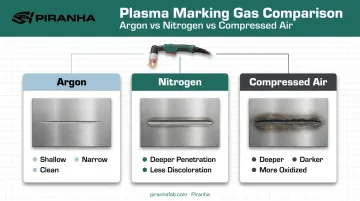
Argon produces a shallower, narrower, and noticeably cleaner mark than air. Its lower energy content makes it well-suited for controlled surface marking without much oxidation. Nitrogen, as a higher-energy diatomic gas, gets picked when a deeper mark is needed without the heavy discoloration that air produces.
Compressed air, by contrast, oxidizes the surface more aggressively. Expect a darker, coarser mark with some dross — but you're not paying for or managing a separate bottled gas.
| Gas | Mark characteristics | Best for |
|---|---|---|
| Argon | Shallow, narrow, clean | Precision aesthetics, minimal oxidation |
| Nitrogen | Deeper penetration | Marks that need to stand out physically |
| Compressed air | Deeper, darker, more oxidized | Cost-driven shops already cutting with air |
When Air Marking Makes Sense
Air is the practical choice when:
- Covers marks that will be painted over anyway, so oxidation doesn't matter
- Skips fine aesthetic detail as a requirement
- Prioritizes simplicity and cost over precision needs
The operational upside is real: running one gas for both cutting and marking means no extra cylinders to stock, no gas switching mid-job, and no purge cycle between operations.
Applications of Compressed Air Plasma Marking
Air plasma marking earns its place in two broad categories: traceability and process guidance.
Traceability and identification marks show up constantly in:
- Structural fabrication, where material identification has to stay visible until members are assembled
- Trailer and truck body manufacturing, tracking parts through multi-stage builds
- Switchgear and electrical enclosure production, where part numbers prevent mix-ups on the line
The American Institute of Steel Construction requires visible material identification through assembly, but full heat-number traceability isn't mandatory unless the contract documents call for it. Shops mark for traceability because it's efficient, not because every job legally requires it.
Process guidance marks cut down on layout errors downstream:
- Bend lines that tell the press brake operator exactly where to fold
- Weld location marks that speed up fit-up
- Drill and center points that eliminate manual layout work
Trailer OEMs, truck body shops, and structural steel fabricators lean on air marking specifically because it's already built into equipment they own. No new investment is required, just a settings change.
Getting Started: Equipment for Cutting and Marking in One Operation
Most CNC plasma and combination punch/plasma systems already have what's needed to mark parts. There's typically no new hardware to buy — just amperage and speed adjustments, plus updated CNC settings for the job at hand.
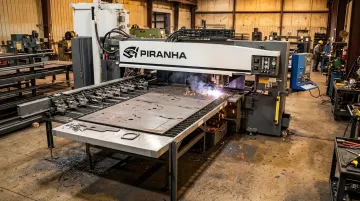
That's the appeal of Piranha's combination punch/plasma machines. Models like the 4400 MAX and the W.A. Whitney-branded 3400 XP handle hydraulic punching and plasma cutting in a single working envelope. That setup means marking, cutting, and punching all happen without moving the part between stations.
What to look for when setting up cutting-and-marking workflows:
- CNC controls that let you program marking and cutting into a single job file
- A control system that switches between modes without a manual consumable change
- A plasma platform, such as the Hypertherm XPR systems powering Piranha's ArcMax X Series tables, built to support both functions
Some combination machines also offer inkjet marking as an alternative for high-volume identification, useful when a lighter, non-etched mark fits the application better. Either way, the goal is the same: fewer secondary steps and parts that stay identifiable from raw plate to finished piece.
Frequently Asked Questions
How does plasma etching work?
Plasma etching uses the same arc as plasma cutting, but at reduced amperage and higher travel speed. Instead of piercing the metal, the constricted arc discolors or lightly grooves the surface.
What is plasma cutting called?
Plasma cutting is formally known as plasma arc cutting (PAC). When the same equipment marks instead of severs metal, it's called plasma marking, etching, or scribing.
What gas is best for plasma marking: air, argon, or nitrogen?
Argon and nitrogen produce cleaner, more controlled marks with less oxidation. Compressed air is more economical and practical for shops that already cut with it.
Can any plasma cutting machine perform marking?
Most modern CNC plasma systems can mark using their existing torch and consumables. High-precision and combination punch/plasma systems make switching between cutting and marking modes even easier.
Is compressed air plasma marking permanent?
Marks made at sufficient amperage and appropriate travel speed are permanent and wear-resistant. Depth and durability still vary depending on the settings used.
Does compressed air plasma marking work on all metal types?
It works on any electrically conductive metal, including carbon steel, stainless steel, and aluminum. Mark appearance and depth vary depending on the specific material's properties.