For a fabrication shop, that translates into sick days, ruined lenses, clogged nozzles, and possibly an OSHA citation if extraction isn't up to par.
Here's the direct answer: laser cutting galvanized steel is safe when you use proper fume extraction, correct machine settings, and the right PPE. Skip any of those, and you're gambling with worker health and consumable life. This guide walks through exactly what "proper" looks like.
Key Takeaways
- Zinc vaporizes at 907°C, hundreds of degrees before steel melts, overwhelming standard ventilation
- OSHA's permissible exposure limit for zinc oxide fume is 5 mg/m³ as an 8-hour average
- Mild-steel laser parameters don't work safely on galvanized coil — focus, gas, and speed need adjustment
- Dedicated fume extraction is required, not optional, for compliant galvanized production
- Enclosed, automation-ready laser systems reduce both fume exposure and consumable damage
Understanding the Risks: Why Galvanized Steel Behaves Differently Under a Laser
Galvanized steel behaves differently than bare steel once it hits the cutting bed. The zinc coating changes the entire physics of the cut.
The Temperature Gap That Causes the Problem
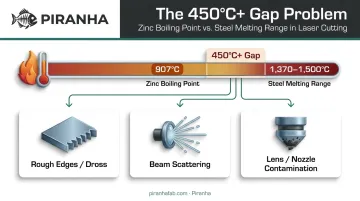
Zinc boils at approximately 907°C. Structural steel doesn't even start melting until somewhere between 1,370°C and 1,500°C. That's a gap of 450°C or more.
What does that mean in practice? The zinc coating flashes into vapor well before the underlying steel is anywhere close to cutting temperature. It's less like slicing through a coated sheet and more like triggering a small, contained explosion at the surface before the real cutting even begins.
That vapor "explosion" causes three problems:
- Rough edges and dross: the violent vaporization disrupts the clean melt pool a laser normally produces
- Beam scattering: the escaping vapor forms a plasma cloud that interferes with beam delivery mid-cut
- Fast lens and nozzle contamination: zinc oxide particulate settles on optics far quicker than it does when cutting bare steel
Metal Fume Fever: Cause, Symptoms, Recovery
Beyond damaging equipment, the fumes create a serious health hazard. Inhaling zinc oxide particulate causes metal fume fever, a flu-like illness that shows up hours after exposure.
Common symptoms include:
- Chills and fever
- Nausea
- Chest tightness and shortness of breath
- Metallic taste and headache
- General muscle aches
Symptoms typically start 4-12 hours after exposure and resolve within 24-48 hours in a zinc-free environment. That sounds mild, but historical high-exposure cases documented pneumonia and roughly four-day recovery windows. Short recovery time doesn't mean the exposure was harmless.
OSHA's Permissible Exposure Limit
This isn't a gray area. OSHA sets the permissible exposure limit for zinc oxide fume at 5 mg/m³ as an 8-hour time-weighted average, per 1910.1000 Table Z-1. A controlled 1996 exposure study found that ten of twelve subjects developed mild fever after just two hours at 2.5-5 mg/m³ concentrations.
A box fan and a propped-open bay door don't come close to meeting that standard. You need measured, filtered extraction at the source, not general dilution ventilation.
The real risk comes from inadequate fume control, unmonitored equipment, or running mild-steel settings on coated material, not from laser cutting itself.
Safety Guidelines for Laser Cutting Galvanized Steel
Safety on galvanized runs comes down to three things working together, not any single fix:
- Engineering controls: extraction systems sized and filtered for zinc oxide particulate
- Correct machine configuration: parameters adjusted specifically for coated material
- Operator discipline: following procedures even when a cut "looks fine"
This isn't a set-it-and-forget-it situation. Extraction filters, nozzles, and lenses all need continual inspection during galvanized production, not just at machine setup.
General Safety Precautions
Baseline protection starts before the first cut:
- Respiratory protection as indicated by your workplace risk assessment
- Laser-safety eyewear rated for your machine's specific wavelength
- Gloves for handling sharp, coated sheet stock
- Enclosure doors closed with interlocks engaged before cutting begins
- Clear egress paths maintained around the machine at all times
- Dedicated fume extraction zoned directly to the cutting head
Galvanized sheet also has handling quirks bare steel doesn't. Edges can be sharper due to coating buildup, and the zinc layer flakes easily if sheets are dragged or stacked carelessly, which can damage protection before the part even reaches the laser.
Safety During Setup and Parameter Configuration
Running mild-steel parameters on galvanized coil is a common shortcut that backfires. It produces excess fume and spatter because the machine isn't accounting for that early zinc vaporization.
Adjustments that matter:
- Negative focus offset to compensate for the coating's vapor barrier
- Adjusted gas pressure tuned for the coated surface, not bare metal
- Matched cutting speed slower than typical mild-steel settings in many cases
Assist gas choice also affects both cut quality and fume behavior:
| Assist Gas | Trade-off |
|---|---|
| Nitrogen | Clean, oxide-free edge; requires high pressure |
| Oxygen | Faster on thick plate; increases edge burn and fume |
| Compressed air | Cost-effective middle ground; moderate oxidation |
Set clear stop conditions before you start: don't proceed if the extraction system isn't verified running, if coating thickness or type is unknown, or if the protective lens shows any visible contamination.
Safety While Cutting and Warning Signs
Once cutting begins, keep an eye out for:
- Visible smoke escaping the enclosure: extraction is failing
- Unusual popping sounds: zinc pocket explosions in the coating
- White dust settling on rails or bellows: a sign fume capture isn't keeping up
Watch for behavioral shortcuts too. Bypassing enclosure interlocks to "get a better look" at the cut, skipping nozzle and lens checks between jobs, and ignoring the extractor's filter replacement schedule are the habits that turn a manageable hazard into an incident.
Common Safety Mistakes to Avoid
Most galvanized-related problems trace back to one of these:
- Treating galvanized like mild or stainless steel — reusing the same parameters, gas, and extraction settings without adjustment
- Relying on general shop ventilation instead of dedicated, filtered extraction rated for zinc oxide particulate
- Ignoring early warning signs : yellow or white dust on machine components and a lingering metallic smell both signal that extraction is underperforming
Catching these early is far cheaper than dealing with a damaged lens, a failed inspection, or a sick operator.
Choosing the Right Equipment for Safer Galvanized Steel Cutting
Machine design has a direct effect on how much risk your shop carries. Fully enclosed cutting areas with zoned extraction, stable beam delivery, and consumables built for the job all reduce both fume exposure and unplanned downtime.
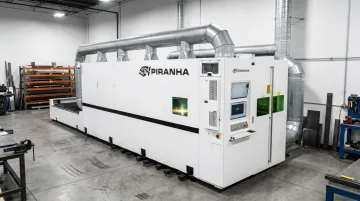
Piranha's fiber laser lineup (including the Flex Series and SP510) is built around full machine enclosures with integrated extraction rather than extraction bolted on as an afterthought. The Flex Series uses a multi-zone fume extraction system paired with replaceable heat shields, so capture happens at the cutting zone instead of relying on the room's general airflow.
A few specifics worth knowing:
- Automation-ready systems: Piranha's fiber lasers are designed to pair with material loading/unloading now or as production scales, without swapping machines
- U.S.-based applications support: available before and after the sale to help dial in settings for demanding materials
- Same-day parts shipping from Belvidere, IL: consumables like nozzles and lenses wear faster on galvanized runs, so downtime waiting on parts is costly
If galvanized production is a growing part of your workload, the machine's extraction design should be part of the buying conversation, not an afterthought you add later.
Conclusion
Laser cutting galvanized steel is safe and genuinely productive when fume extraction, correct parameters, and consistent maintenance are treated as one connected process, not three separate checkboxes. Skip one, and the others can't compensate.
Build galvanized-specific checks into your routine operations, and choose equipment partners who back their machines with real operational guidance and hands-on support.
Frequently Asked Questions
Can a laser cutter cut galvanized steel?
Yes, fiber lasers routinely cut galvanized sheet without issue. Success depends on proper fume extraction and galvanized-specific settings, not the laser type alone.
How thick of steel can a laser cutter cut?
Capacity ranges from thin gauge sheet on lower-power lasers to over an inch on higher-power systems, depending on the machine. This applies to both bare and galvanized steel, though galvanized requires extra process control at any thickness.
What material cannot be laser cut?
PVC and vinyl are off-limits due to toxic chlorine gas release, along with materials like PTFE and beryllium oxide. Galvanized steel isn't on that list when handled with proper extraction and settings.
Is it safe to breathe fumes from laser cutting galvanized steel?
Unfiltered zinc oxide fume is hazardous and causes metal fume fever. Proper enclosure and extraction keep breathing-zone exposure within OSHA's permissible limits.
What PPE is needed when laser cutting galvanized steel?
Baseline protection includes laser-rated eyewear matched to your machine's wavelength, handling gloves, and respiratory protection where a workplace risk assessment indicates it's needed.
Does laser cutting remove the zinc coating, and does that affect corrosion resistance?
Yes, the coating is removed along the cut edge (the kerf). Where corrosion resistance matters, cold galvanizing compound or zinc-rich paint restores edge protection, following repair guidance like AISC's hot-dip galvanizing specification.