Introduction
Walk into almost any modern fabrication shop today, and you'll find a fiber laser humming away where a CO2 system or plasma table used to sit. Fiber lasers have become the default choice for cutting sheet metal, trailer components, and structural steel parts across North America.
Part of the shift comes down to efficiency. Standard high-power fiber lasers now reach up to 40% electrical-to-optical efficiency, with premium models exceeding 50%, a massive gain over older gas-based systems.
Many shop owners buy a fiber laser without fully understanding what happens inside the machine. That gap shows up later, in wrong power selection, sloppy parameter settings, or confusion when troubleshooting a bad cut.
This guide breaks the process into plain steps, from beam generation to the finished part.
Key Takeaways
- Fiber lasers generate a high-density beam through a doped optical fiber, melting metal along a CNC path
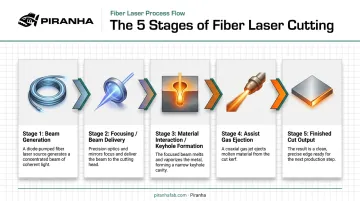
- The cutting process moves through five stages: generation, focusing, material interaction, gas assist, and ejection
- Reflective metals like aluminum, brass, and copper cut cleaner with fiber lasers than CO2 lasers
- Cutting depth scales with wattage, letting industrial machines reach 1–2 inches depending on material
What Is a Fiber Laser Cutting Machine?
A fiber laser cutting machine is a CNC-controlled tool that uses a fiber-optic-amplified laser beam, rather than a gas or crystal medium, to thermally cut metal sheets, plates, and tubes with tight precision.
Fabrication shops adopted fiber technology because CO2, plasma, and mechanical cutting all had gaps: CO2 struggled with reflective metals, plasma left wider kerfs and rougher edges, and mechanical cutting wore down tooling fast. Fiber lasers closed those gaps while reducing maintenance downtime.
What a fiber laser is not:
- Not a CO2 or Nd:YAG laser system
- Skips the mirror alignment required inside a gas resonator
- Eliminates lamp replacement needed in older solid-state lasers
That last point matters more than it sounds. A 2014 industry comparison found fiber lasers running at roughly 30% efficiency against 10% for CO2 systems of that era — and current fiber sources have only widened that gap. Fewer moving parts, less electricity wasted as heat, and no gas consumables translate into lower cost per part over the life of the machine.
Types of Fiber Laser Cutting Machines
Two main configurations dominate the market. Flatbed/sheet cutters process flat sheet and plate stock, the most common setup in general fabrication. Tube cutters handle round, square, and rectangular tube using a rotary chuck axis.
The underlying laser-generation principle doesn't change between the two, only the material-handling axis does.
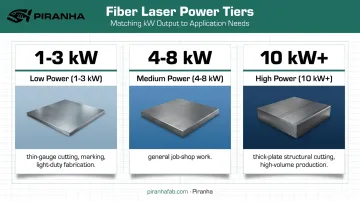
Power tiers matter more for application fit:
- Low power (1–3 kW): thin-gauge cutting, marking, light-duty fabrication
- Medium power (4–8 kW): general job-shop work across common material thicknesses
- High power (10 kW+): thick-plate structural cutting, high-volume production
Machine configuration (moving material, hybrid, or flying optics) affects cutting speed. But the core beam-generation process stays identical regardless of configuration.
How Does a Fiber Laser Cutting Machine Work?
The cutting process runs through a defined sequence every single time: laser generation, beam delivery and focusing, material interaction with assist gas, and material ejection. Understanding each stage explains why certain settings work and others produce bad edges.
Initiation: Generating the Laser Beam
The process starts at the fiber laser source, not the cutting head. Diode-pumped light seeds into a rare-earth-doped optical fiber, where it amplifies as it travels through the fiber core.
This is a common misconception worth clearing up: the beam is generated in the source cabinet, then delivered to the head through an optical cable. The cutting head itself doesn't create anything.
Beam initiation is fully automated. Once a G-code program loads, the CNC controller triggers the source: no manual ignition, no warm-up ritual like older gas lasers required.
That said, one bottleneck trips up a lot of operators: insufficient warm-up or a chiller that hasn't reached target temperature before initiation. Start a job too early, and you'll get inconsistent beam power right at the start of the cut, usually showing up as an incomplete pierce or a rough lead-in.
Core Operation: Beam Delivery, Focusing, and Material Interaction
Once amplified, the beam travels through the optical cable to the cutting head. Inside the head, collimating and focusing lenses (or mirrors, at higher power) concentrate the beam into a tiny, high-energy spot, often smaller than a human hair.
When that focused spot hits the metal surface, it heats the material past its melting or vaporization point almost instantly. This creates a keyhole that deepens as the CNC gantry moves the head along the X and Y axes, with the Z axis adjusting focal height.
Three variables control the outcome at this stage:
- Focal position: where the beam waist sits relative to the material surface
- Spot size: smaller spots concentrate more energy but narrow the process window
- Travel speed: too fast starves the cut; too slow widens the kerf and increases heat input
Get any one of these wrong, and you'll see it in the kerf width or edge finish before you see it anywhere else.
Cutting head design matters here too. Piranha's fiber laser cutters use automation-ready cutting heads, which means a shop can add robotic loading and unloading later without swapping out the core machine, a detail that saves real money when production scales up.
Regulation and Control: Assist Gas, Height Sensing, and Cooling
Melting metal is only half the job. Something has to blow the molten material out of the kerf, and that's where assist gas comes in.
Nozzle-delivered gas (oxygen, nitrogen, or compressed air) works alongside the beam in two ways:
Mechanically, it blows molten material out of the cut path. Chemically, oxygen accelerates the exothermic reaction for faster cutting in mild steel, while nitrogen produces a clean, oxide-free edge on stainless.
While that's happening, a capacitive height-sensing system continuously reads the distance between the nozzle and the material. As the head crosses a warped sheet or slightly uneven plate, the sensor adjusts nozzle height in real time to keep the focus consistent.
Cooling runs in the background the whole time. A water chiller isn't optional equipment: it's mandatory. Photoelectric conversion inside the laser source is never 100% efficient, and the leftover heat has to go somewhere. Without adequate cooling, that residual heat degrades the laser source and damages optics from reflected thermal load.
Skip or shortcut this stage, and you'll see it show up as:
- Dross buildup on the bottom edge
- Inconsistent kerf width across a cut
- Lens damage from reflected heat
Output / Result: The Finished Cut
The end result of all this: a narrow, clean kerf with a minimal heat-affected zone, produced without the mechanical tool wear you'd see in blade or plasma cutting.
That output quality feeds directly into downstream steps. Clean edges move straight to bending, welding, or assembly without secondary deburring, a real time savings on high-volume runs.
Precision at this stage isn't just cosmetic. It shows up in:
- Reduced scrap rates from consistent part-to-part tolerances
- Predictable fit-up during welding and assembly
- Repeatable accuracy needed for NEMA and UL-compliant enclosure work
What Can (and Can't) a Fiber Laser Cut?
Cutting depth ties directly to laser power. As a reference point, TRUMPF's 3 kW fiber systems max out around 20 mm in mild steel, 16 mm in stainless, and 16 mm in aluminum, while 24 kW configurations push to roughly 60 mm in mild steel and stainless.
Piranha's own PlateLASER platform Fiber's shorter wavelength, in the 1-micron range, gets absorbed by metal far more efficiently than the roughly 10-micron CO2 wavelength. Metal simply reflects less of it, and that difference plays out like this:
| Fiber Laser Strengths | Fiber Laser Limitations |
|---|---|
| Copper, brass, and aluminum, metals that historically gave CO2 systems fits | Non-metals like wood, acrylic, or fabric, which absorb CO2's longer wavelength but barely absorb fiber's shorter one |
| Galvanized steel and other reflective materials | Plate beyond a couple of inches, where cut quality and speed both suffer |
For shops that need to handle both thin reflective sheet metal and heavy plate beyond fiber's practical ceiling, Piranha's combination punch/plasma machines and standalone plasma systems fill that gap. They cover both material types without forcing a laser to do a job it wasn't built for.
Where Fiber Laser Cutting Machines Are Used
Fiber laser cutting usually sits as the first operation in a fabrication workflow, right after material receiving. Raw sheet or plate goes in; cut blanks and profiles come out, ready for bending, punching, or welding.
The environments where fiber lasers perform best share a common thread — high repeatability, tight tolerances, and volume:
- High-volume sheet metal production runs
- Precision electrical enclosure fabrication
- Structural component cutting with strict tolerance requirements
Specific industries have built entire production lines around this capability. Trailer and truck-body manufacturing, power and transformer production, and electrical enclosure fabrication all rely on fiber laser cutting as a core process step. These are the same segments Piranha's trailer and truck-body OEM customers depend on for daily production output.
Conclusion
Fiber laser cutting is a controlled sequence — beam generation, focused delivery, assist-gas-driven material removal, and precise ejection — that repeats thousands of times a second across a single cut.
Understanding that sequence changes how you make decisions. Picking the right wattage means matching it to your actual material mix, not chasing the biggest number on a spec sheet. It also means choosing automation-ready equipment now, even if you don't need robotic loading today. Piranha designs its fiber laser line around exactly that kind of scalability, so growth doesn't mean starting over with a new machine.
Frequently Asked Questions
How does a fiber laser cutting machine work?
A fiber laser generates a beam in a doped optical fiber and delivers it through a cable to a focusing cutting head. As the CNC gantry moves the head along the cut path, assist gas blows the molten metal out of the kerf.
How deep can a fiber laser cut?
Cutting depth scales with wattage. A 3 kW system typically handles up to roughly 20 mm in mild steel, while 12–24 kW systems can reach 40–60 mm depending on the material.
What can a fiber laser not cut?
Non-metal materials like wood, acrylic, and fabric don't absorb fiber's wavelength well, so CO2 lasers handle those better. Extremely thick plate beyond a couple of inches is often better suited to plasma cutting.
How much does a fiber laser cutting machine cost?
Pricing varies by wattage, table size, and automation features — entry-level configurations start well under $150,000, while high-power systems with automation run higher. Factor in ROI from labor savings and reduced downtime, not just sticker price.
Is fiber laser cutting more accurate than CO2 cutting?
Fiber offers a smaller focus spot and better performance on reflective metals like aluminum and brass. CO2 can still hold an edge on very thick material, above 12 mm, where its edge quality remains competitive.
How much maintenance does a fiber laser cutting machine need?
Fiber lasers have far fewer moving parts than CO2 systems: no mirror realignment, gas resonator, or lamp replacement. Routine maintenance shifts to CNC motion components, optics, nozzles, and cooling systems instead.