The global laser cutting machine market hit $6.85 billion in 2025 and keeps climbing. That kind of growth tells you shops are betting heavily on this technology. Waterjet isn't disappearing either, especially for jobs a laser simply can't touch.
Picking the wrong machine doesn't just hurt your budget on day one. It affects your hourly operating costs, how much downtime you eat during maintenance, and how fast the equipment pays for itself.
This guide breaks down real purchase price ranges, hourly operating costs, and the other cost drivers that matter, so you can figure out which machine actually fits your shop's job mix.
TL;DR
- Fiber lasers beat waterjets on both upfront price and hourly cutting cost.
- Waterjet is the only option for thick plate, mixed materials, or heat-sensitive alloys.
- Purchase price varies widely by power, bed size, and automation level.
- Total cost of ownership, not sticker price, decides the real winner.
- Match the technology to material type, volume, and tolerance needs, not price alone.
Waterjet vs Laser: Quick Comparison
Here's how the two technologies stack up across the factors that actually hit your bottom line:
| Cost Factor | Waterjet | Fiber Laser |
|---|---|---|
| Purchase price | $100,000-$400,000 | $134,900-$282,000+ |
| Operating cost/hour | $23-$58 | $13-$20 |
| Main consumable | Garnet abrasive | Assist gas |
| Achievable tolerance | ±0.005 in | ±0.005 in |
| Max practical thickness | Up to 8 in (nearly any material) | ~40-60mm steel (power-dependent) |
Purchase Price
Industrial CNC waterjets typically run $100,000 to $400,000 depending on bed size, pump pressure, and the number of cutting heads.
Piranha's own fiber laser lineup starts at $134,900 for a compact 3kW SP404 and climbs past $282,000 for a full industrial Flex Series machine with dual-pallet shuttle automation. Power level (3kW to 20kW), bed size, and automation options drive most of that spread.
Operating Cost Per Hour
Waterjet's biggest recurring expense is garnet abrasive, running $18 to $36 per hour on top of $5-$22/hour in wear parts. Garnet alone can eat up to 75% of total hourly cost. All-in, that puts total operating costs at roughly $23-$58/hour, depending on garnet grade and cutting parameters.
Fiber laser runs leaner, generally $13-$20/hour, since assist gas and electricity make up most of the bill.
Maintenance & Tooling Costs
- Waterjet: Sapphire/ruby orifices last around 80 hours; diamond orifices can hit 1,000+ hours. Pump seals need swapping roughly every 500 hours, cylinders every 5,000.
- Laser: Nozzles get inspected and replaced as they wear, with no fixed universal interval. Gas contract terms and purity matter more than any single part cost.
Cutting Speed & Precision
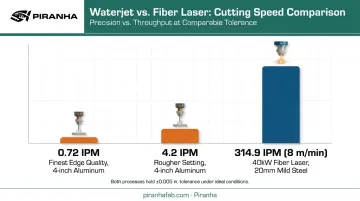
Waterjet speed drops sharply as thickness or edge quality demands increase, from about 0.72 IPM on 4-inch aluminum at the finest edge quality up to 4.2 IPM at a rougher setting. A 40kW fiber laser, by comparison, cuts 20mm mild steel at roughly 8 m/min. Both processes can hold tolerances around ±0.005 in under the right conditions.
Material Versatility
Waterjet cuts nearly anything from 1/16 to 8 inches thick with zero heat-affected zone. Laser performs best on sheet steel, stainless, and aluminum, with thickness capped by power output, typically 40-60mm on higher-power systems.
What Is a Waterjet Cutting Machine?
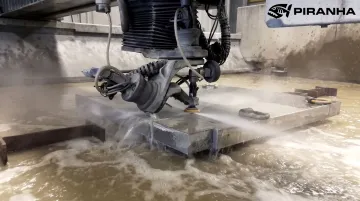
A waterjet uses ultra-high-pressure water, up to 94,000 PSI, forced through a jeweled orifice to erode material. It's a cold-cutting process. No heat means no warping, no metallurgical change, and no heat-affected zone to grind out afterward.
That last point matters more than it sounds. Fabricators cutting thick plate for aerospace often need heat-cut edges completely reground before the part passes inspection. Waterjet skips that step entirely, cutting secondary finishing work out of the workflow.
There are two flavors:
- Pure waterjet uses water alone, suited to soft, knife-cuttable materials like foam or rubber.
- Abrasive waterjet adds garnet to the stream, opening the door to metal, stone, glass, and composites.
Use Cases of Waterjet
Waterjet earns its place in a shop when the job involves thick plate, heat-sensitive alloys, or mixed-material stacks a laser can't handle in one pass.
Industries where it dominates:
- Aerospace components requiring cold-cut precision without edge distortion
- Stone, tile, and glass fabrication
- Gasket and composite material cutting
Flow International reports abrasive waterjet handles stainless steel and nearly any other material from 1/16 to 8 inches thick, holding part tolerances of 0.003-0.005 inches. That range covers jobs no fiber laser on the market today can touch economically.
What Is a Laser Cutting Machine?
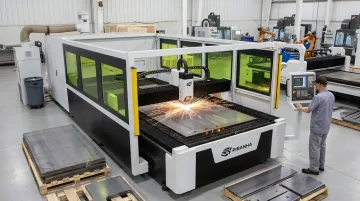
Fiber laser cutting directs a high-intensity beam through fiber-optic cable to melt and vaporize a cut path. It's become the default choice for modern metal fabrication because it's fast, precise, and cheap to run compared to older technologies.
Three variants exist: CO2, fiber, and diode. Fiber has taken over most metal cutting applications. Bystronic reports fiber delivers up to 5X faster cutting below half an inch and roughly half the operating cost compared to legacy CO2 machines.
That fiber advantage extends into the equipment itself. Piranha's fiber laser systems, including the compact SP404 and the industrial Flex Series, ship automation-ready from the factory, so a shop can start with a base configuration and bolt on material loading and unloading later without replacing the core machine.
Select models also ship in-stock for faster delivery, which matters when a production ramp can't wait months for a build slot.
Use Cases of Laser
Laser fits naturally into high-volume sheet metal production where tight tolerances and clean edges are non-negotiable.
Industries where fiber laser dominates:
- Trailer and truck body manufacturing
- Structural steel fabrication
- Electrical enclosures and switchgear production
Pennsylvania fabricator Raytec put that dominance to work, adding 15- and 20kW fiber lasers to serve building-products and job-shop customers. The move let it grow throughput without adding headcount, with some months posting 40% year-over-year growth. That's the kind of scaling laser makes possible on standard gauge metal.
Waterjet vs Laser: Which Costs More?
There's no single "cheaper" machine. Total cost of ownership depends on five factors:
- Purchase price
- Hourly operating cost
- Material thickness and type
- Production volume
- Tolerance requirements
For standard sheet metal, laser usually wins on both speed and operating cost. Waterjet costs more per part in that same lane, but it's the only realistic option once you hit extreme thickness, mixed materials, or parts that can't tolerate any heat distortion.
Choose laser if:
- Prioritize throughput on standard gauge steel, stainless, or aluminum
- Need tight tolerances and clean edges more than broad material range
- Want lower operating costs per hour
Choose waterjet if:
- Regularly cut plate beyond laser's power-limited thickness ceiling
- Mix soft and hard materials in the same job
- Can't tolerate any heat distortion in the finished part
A Simple ROI Framework
Break-even time = machine price ÷ (monthly output value − monthly operating cost)
Run this with your own numbers: quoted machine price, expected parts output per month, and hourly operating cost multiplied by expected run hours. It won't give you a perfect answer, but it gets you close enough to compare options honestly.
Real-World Example
Goshen Engineering, a fabricator serving power-distribution and data-center equipment markets, hit a wall with its waterjet setup. Heavy operator involvement turned it into a bottleneck as demand grew, with certain jobs eating 50 to 60 hours a week.
The fix: a Salvagnini fiber laser with automated loading and sorting. That same weekly workload dropped to one or two days. A 10-person fabrication team now supports 40-50 assembly employees, and unattended operation stretches production hours well beyond a single shift.
That's the kind of throughput shift a fiber laser can deliver once volume and part mix justify the switch. If you're weighing a similar move, talk to Piranha's fabrication experts about whether a fiber laser fits your shop's production needs.
Conclusion
There's no universal cheaper machine here. The right answer depends on material thickness, production volume, and precision needs specific to your job mix. Trying to force one technology to cover every job on your floor usually costs more than buying the right tool for each lane.
For standard metal fabrication, laser tends to deliver lower operating costs and faster ROI — Piranha's fiber laser systems are built for that exact production profile. For specialty thick-plate or heat-sensitive work, waterjet remains necessary, cost premium and all. Match the machine to the work, not the other way around.
Frequently Asked Questions
How much does a laser cutting machine cost?
Entry-level fiber lasers start around $134,900 for a compact 3kW system, while full industrial configurations with automation can exceed $282,000. Power level, bed size, and automation add-ons drive most of the price variation.
How much does a waterjet cutting machine cost?
Industrial CNC waterjet systems generally range from $100,000 to $400,000. Cost mainly depends on pump pressure, bed size, and the number of cutting heads.
Is laser cutting cheaper than waterjet cutting?
For standard metal thicknesses, yes. Laser generally runs $13-$20 per hour compared to $15-$30 for waterjet. Waterjet costs more but handles jobs, like thick plate or mixed materials, that laser physically can't cut.
Which costs more to operate, a laser cutter or a waterjet cutter?
Waterjet typically costs more per hour, mainly due to garnet abrasive, which can account for up to 75% of its hourly operating cost. Laser's main expense is assist gas and electricity.
Can a laser cutter cut the same materials as a waterjet?
No. Laser is limited by power on thick plate and struggles with heat-sensitive materials. Waterjet cuts nearly anything from 1/16 to 8 inches thick, including stone, glass, and composites, with no heat-affected zone.
Which machine offers a faster return on investment?
Laser usually delivers faster ROI on high-volume standard metal fabrication thanks to speed and lower operating costs. Waterjet's ROI depends heavily on how much specialty, thick, or heat-sensitive work your shop consistently has on the books.