The choice matters more than most owners realize. Pick wrong, and you're stuck with slower throughput, more rework, or a machine that can't handle your actual production mix. The laser welding equipment market alone is projected to grow from $1.42 billion in 2025 to $2.4 billion by 2033, according to Grand View Research, reflecting how many shops are adding laser capability rather than replacing arc welding outright.
This guide breaks down cost, strength, speed, and use cases so you can decide which method — or combination — actually fits your operation.
Key Takeaways
- MIG welding remains the low-cost entry point for thick materials and loose fit-up tolerances
- Laser welding delivers deeper penetration, smaller heat-affected zones, and faster cycles on thin-to-medium gauge
- Base your decision on thickness, fit-up precision, labor availability, and volume—not trends
- More shops are running both processes side by side instead of picking one winner
Laser Welding vs MIG Welding: Quick Comparison
Here's the short version before we dig into specifics:
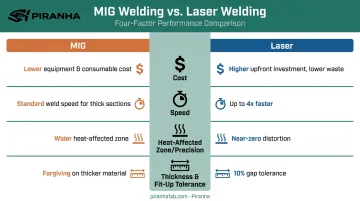
| Factor | MIG Welding | Laser Welding |
|---|---|---|
| Upfront cost | Moderate | Higher |
| Ongoing cost | Wire and gas consumables | Minimal consumables, but requires precise fixturing |
| Speed | Moderate, slower on thick joints | Up to 4x faster on thin-to-medium material |
| Heat-affected zone | Larger, more distortion | Minimal, near-zero distortion |
| Fit-up tolerance | Forgiving | Tight, precise fit-up required |
| Thickness range | Up to roughly 1/2 in. with multi-pass or FCAW | Best on thin-to-moderate gauge |
Cost
MIG systems require a moderate initial investment, but wire and shielding gas add up as consumable costs over time. Laser welders cost more to buy, and the American Welding Society lists high acquisition and maintenance cost among the process's real limitations.
The trade-off: fewer consumables and less rework can offset that capital cost over time, though the payback depends entirely on your part mix and utilization.
Speed & Efficiency
MIG's filler-wire feed and multi-pass requirements slow things down on thicker jobs. Laser welding runs faster on repeatable thin-gauge work, up to 4x faster than MIG, depending on the system and application.
Precision & Heat-Affected Zone (HAZ)
MIG spreads heat broadly, which increases distortion, spatter, and post-weld cleanup. A concentrated laser beam does the opposite, shrinking the HAZ and cutting grinding time dramatically.
Material Thickness & Fit-Up Tolerance
MIG forgives wider gaps and handles thicker sections, particularly when paired with flux-cored (FCAW) fill passes.
That tolerance shrinks dramatically with laser welding: a typical allowable gap runs around 10% of the thinnest material or under 50% of the beam diameter, according to a technical guide from The Fabricator. That means your upstream cutting process has to be dead-on accurate.
What is MIG Welding?
MIG, or Gas Metal Arc Welding (GMAW), uses a continuously fed wire electrode and shielding gas to lay down a weld bead. It's the workhorse process in trailer, truck body, and structural steel fabrication, and for good reason.
Why shops rely on it:
- Easier to train new welders on, cutting ramp-up time for growing shops
- Continuous wire feed keeps throughput steady on thick materials
- Forgiving of gap variation, so part fit-up doesn't need to be perfect
Shops working outdoors or in the field often switch to flux-cored arc welding (FCAW), a MIG variant that skips external shielding gas (useful when wind or ventilation makes gas shielding impractical).
Use Cases of MIG Welding
MIG typically handles structural frames, thick-gauge assemblies, and repair or maintenance work — the jobs where joint tolerance matters less than raw deposition rate. Industries where it remains standard include:
- Trailer OEMs building heavy chassis and frame rails
- Construction and structural steel fabrication
- Shipbuilding, particularly on thick hull and deck sections
- Heavy equipment manufacturing
On thick-plate work, MIG (often paired with FCAW fill passes) still delivers. Pipeline crews complete root, fill, and cap passes on inch-thick pipe up to four feet in diameter in about five and a half hours, with repair rates under 1%, according to a Miller Electric case study.
That's the kind of reliability that keeps MIG on the floor even as laser adoption grows.
What is Laser Welding?
Laser welding uses a concentrated beam of light to melt and fuse metal, either with or without filler wire. Manufacturers are adopting it fast because it solves problems MIG can't: tight tolerances, minimal distortion, and cycle times that shrink dramatically on the right parts.
The operational payoff:
- Deep, narrow penetration reduces the need for multiple passes
- Minimal distortion means less time spent straightening or clamping parts afterward
- Faster cycles translate directly into higher first-pass yield
Two modes matter here. Conduction-mode welding suits thin materials, producing shallow, wide welds. Keyhole welding vaporizes a narrow channel through the material for deep, narrow penetration, better suited to thicker sections.
Shops can also choose the delivery method: handheld units for flexible, one-off work, or robotic and automated systems for repeatable, high-volume runs.
Use Cases of Laser Welding
Laser welding fits precision joints, thin-gauge assemblies, and high-repeatability production. It's gaining ground fast in:
- Automotive body panels and structural components
- Aerospace assemblies requiring tight tolerances
- Electronics enclosures and battery packs
- Trailer and truck body sheet metal, particularly on side panels and roof sheets
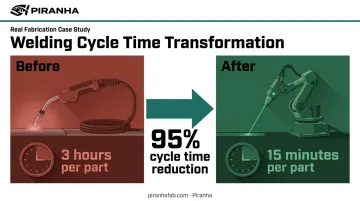
One documented example: Great Lakes Stainless was producing curved stainless escalator-platform components through a manual workflow that included MIG welding, averaging roughly three hours per part. Working with Serra Laser Center, they moved to a FANUC cobot paired with an IPG LightWELD system.
Production time dropped to about 15 minutes per part, a 95% reduction, according to FANUC America. That's a full workflow change, not a controlled MIG-versus-laser test — automation plus laser welding compresses cycle time hard on the right parts.
Quality holds up too. Independent metallurgical inspection of handheld-laser-welded stainless samples found no cracking, porosity, or incomplete fusion across dozens of cross-sections, meeting AWS D17.1 Class A standards.
Laser Welding vs MIG Welding: Which Is Better for Your Shop?
There's no universal answer here. The right call depends on five factors:
- Material thickness range you run most often
- Joint fit-up tolerance your parts can realistically hold
- Production volume and how repeatable your jobs are
- Skilled labor availability for training and staffing
- Capital budget for upfront equipment versus long-term operating savings
Choose MIG if:
- Your shop primarily works thick structural materials
- Fit-up tolerances vary from part to part
- You need a lower-cost entry point into welding capacity
Choose laser welding if:
- Precision, speed, and minimal distortion are priorities
- You're running thin-to-medium gauge work at volume
- First-pass yield and reduced post-weld cleanup matter to your bottom line
Here's the part shops often miss: laser welding's tight fit-up requirement means your upstream cutting has to be just as precise as the weld itself. A part that's off by even a fraction of an inch can blow past the beam-diameter gap tolerance and ruin the joint before the welder even fires.
That's why shops investing in laser welding typically pair it with precision fiber laser cutting equipment, such as Piranha's Flex Series and SP404 fiber lasers. Clean, accurate blanks support strong, consistent laser welds from the start.
If your shop is weighing a combined welding and cutting equipment investment, it's worth running the numbers on both ends of the workflow together rather than in isolation. Piranha's fabrication experts can walk through your part mix, volume, and budget to help build a production line that scales instead of bottlenecking at the weld station. Reach out at 800-338-5471 or through the Build and Price tool to start that conversation.
Conclusion
There's no single winner in the MIG versus laser welding debate. MIG remains the practical, forgiving choice for thick, high-tolerance work. Laser welding wins where speed, precision, and minimal distortion matter most. Many shops, understandably, run both.
The real decision point is which process fits the parts you're actually running today, and tomorrow. Get that match right, and you'll see it show up directly in downtime, labor cost, and throughput. Pair that welding investment with Piranha's precision cutting systems, and those gains compound across the entire shop floor.
Frequently Asked Questions
Is laser welding as good as MIG welding?
Laser welding often produces stronger, cleaner welds with less distortion on thin-to-medium materials. MIG remains better suited for thick sections and joints with looser fit-up tolerances.
Do laser welders need gas?
Most laser welders use shielding gas, typically argon or helium, to protect the weld pool from contamination, similar to MIG welding.
How thick will a laser welder weld?
Handheld laser welders typically handle full-penetration welds up to around 6mm effectively, depending on the system. Thicker sections usually require multi-pass or hybrid laser-arc techniques.
Is laser welding more expensive than MIG welding?
Laser welding carries a higher upfront equipment cost, but it often reduces long-term operating costs through faster cycle times and less rework, depending on your application.
Can laser welding replace MIG welding entirely in a fabrication shop?
No, laser welding isn't a full replacement for MIG. Most shops run both, applying each method where it performs best based on material thickness and volume.
What thickness range is MIG welding best suited for?
MIG welding is effective up to about 1/2 inch in a single pass, often using flux-cored fill passes for thicker joints. Beyond that, shops typically move to multiple passes or alternative methods.