Introduction
Laser welding with filler wire feeds a metal wire into the weld pool to reinforce the fusion created by the laser beam. It suits particular joint designs and material combinations. It isn't a default upgrade for every laser weld.
This matters most for metal fabrication shops, trailer and truck body manufacturers, and structural fabricators. Weld integrity, dissimilar metal joints, and NEMA/UL-driven tolerances leave little room for guesswork.
Even so, many shops know laser welding exists but don't understand when filler wire actually belongs in the process versus autogenous (no-filler) welding. This article breaks down the mechanics and real-world applications, then flags where filler wire hits its limits — so you know exactly when to reach for wire and when to leave it out.
Key Takeaways
- Filler wire bridges gaps and joins dissimilar metals — but most laser welds don't need it
- Autogenous welding is the default when fit-up is tight and materials are compatible
- Wire feed rate, delivery angle, and spot size vs. wire diameter set weld quality
- Adding wire "by default" typically slows production by 10-20% without improving results
What Is Laser Welding with Filler Wire?
Laser welding with filler wire uses a focused laser beam to melt a metal wire positioned near the weld joint. The molten wire merges with the melted base metal, filling the seam and building a stronger, more controlled weld bead.
The goal is straightforward: a metallurgically sound, gap-free weld with predictable geometry, even when the base materials or joint fit-up aren't perfect.
Autogenous Welding Is the Default, Not Filler
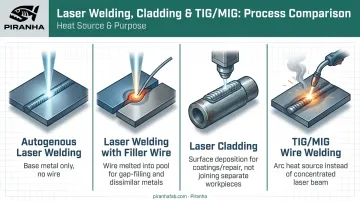
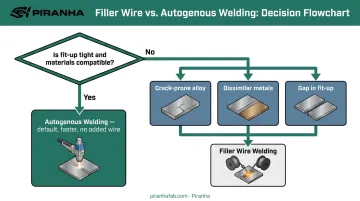
Most laser welding is autogenous, meaning only the base metal melts and fuses, with nothing added. Filler wire is the exception, brought in for specific problems:
- Gaps left by imperfect joint fit-up
- Crack-prone alloys that need extra material for strength
- Dissimilar metals that require a compatible bridging filler
That distinction gets confused constantly on shop floors. Autogenous welding stays the standard whenever the fit-up is tight and the materials are compatible without reinforcement.
Not the Same as Laser Cladding
Laser welding with filler wire also isn't the same thing as laser cladding or additive deposition. Cladding feeds wire or powder onto a surface to build up material, typically for coatings or repair. TWI defines laser cladding as depositing a metallurgically bonded layer on a substrate, not joining two separate workpieces.
Laser wire welding shares a conceptual cousin in TIG and MIG wire feeding. The difference is the heat source: a concentrated laser beam instead of an electric arc. That concentration is what gives laser welding its narrower heat-affected zone and tighter control, filler wire or not.
Why Filler Wire Is Used in Metal Fabrication
Filler wire earns its place in a weld procedure for four specific reasons. None of them are cosmetic.
Bridging joint fit-up gaps. Stamped, cut, or formed parts rarely present a perfect edge-to-edge fit. A peer-reviewed trial successfully bridged a 1.0 mm gap in a 2.0 mm butt joint using wire-fed laser welding, a result far beyond what autogenous welding tolerates on its own. That figure is study-specific, not a shop-floor guarantee, but it shows the mechanism at work.
Preventing solidification cracking. Certain aluminum alloys crack as they cool unless the wire chemistry adjusts the freezing behavior. Higher-silicon wires like ER4043/4047 are the common fix for crack-prone 6xxx-series aluminum.
Joining dissimilar metals. Different melting points and thermal expansion rates make autogenous welding unreliable across material boundaries. Filler wire chemistry can bridge that gap, both literally and metallurgically.
Controlling weld profile. Wire lets operators dial in crown height, bead width, and undercut elimination to hit mechanical strength and fatigue-life targets.
Skip filler wire where it's actually needed, and the failure modes show up fast: gaps, porosity, hot cracking, or undercut that compromises structural integrity in load-bearing assemblies. None of this is regulatory. There's no code that mandates filler wire — it's an operational call based on material, joint design, and application.
How Laser Welding with Filler Wire Works
At a high level: wire is positioned near the laser's focal point, the beam melts both wire and base metal simultaneously, and the combined molten pool solidifies into a reinforced seam.
Getting there requires three inputs working together:
- Cleaned, aligned workpieces with consistent joint geometry
- A compatible filler wire — stainless steel, aluminum, titanium, or nickel alloy, matched to the base metal
- A wire feeder synchronized precisely to the laser head
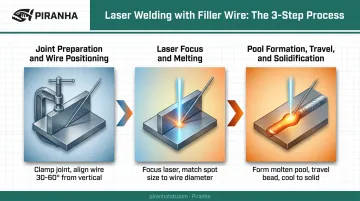
Step 1: Joint Preparation and Wire Positioning
Parts get cleaned, aligned, and clamped before the wire ever enters the picture. The wire feeds in at a set angle toward the beam centerline — typically 30 to 60 degrees from vertical, with 45 degrees as the standard setup, according to an SME technical review of high-power fiber laser welding with filler material.
Step 2: Laser Focus and Melting
The laser spot size needs to closely match the wire diameter. Too small a spot melts the wire unevenly, which invites porosity. Too large, and energy gets wasted heating the surrounding pool instead of the wire tip.
Step 3: Pool Formation, Travel, and Solidification
Beam and wire feed move together along the seam at a synchronized rate. The trailing molten pool cools and solidifies into the finished weld. Get the feed-to-travel ratio wrong, and the result is humping or porosity instead of a clean bead.
That same SME source is worth flagging directly: adding filler wire generally causes a 10-20% decrease in welding speed at a given laser power, because some beam energy has to melt the wire instead of only fusing the joint. That tradeoff shouldn't rule out wire when the application calls for it, but it's a cost worth planning into your production schedule.
Wire Feeding Techniques, Configurations, and Applications
Not every filler-wire setup looks the same. Material, joint geometry, and production volume all push toward different configurations.
Cold Wire vs. Hot Wire Feeding
Cold wire feeding sends unheated wire directly into the pool. It's the standard approach for filling hot cracks in aluminum, where composition control matters more than deposition speed.
Hot wire feeding preheats the wire with a separate power supply before it reaches the pool. This reduces the laser energy needed to melt the filler, which helps on thicker sections or wider gaps where deposition rate becomes the bottleneck.
Single vs. Dual Wire Configurations
| Configuration | Best fit | Tradeoff |
|---|---|---|
| Single wire | Routine joints, tight budgets, standard alloys | Lower deposition, simpler setup |
| Dual wire | Dissimilar metals, thick sections, chemistry blending | Higher skill requirement, more setup complexity |
Dual-wire feeding earns its complexity in dissimilar-metal work. One study joining SA508 ferritic steel to 316L stainless steel used two wire chemistries at a 3:1 ratio to hit roughly 571 MPa tensile strength, adjusting the blend to balance strength against impact toughness. That's chemistry control, not just faster deposition.
Where the Process Shows Up in Fabrication Workflows
Filler-wire laser welding turns up consistently in:
- Trailer and truck body panel joints
- Structural steel assemblies
- Switchgear and electrical enclosure fabrication
- Repair welding on dissimilar or high-value alloys
Shops running fiber laser cutting equipment (including Piranha's fiber laser line) often pair that cutting precision with downstream laser welding. Tighter, more repeatable cut edges feed directly into a more consistent weld setup, since fit-up quality is half the battle before the wire even engages.
Key Factors, Common Issues, and When Filler Wire May Not Be Necessary
Weld quality with filler wire comes down to a handful of controllable variables, and knowing when to skip the wire altogether.
Key Parameters That Determine Weld Quality
- Wire feed rate relative to welding speed. Underfeed leaves gaps unfilled; overfeed demands more melting energy and distorts bead geometry.
- Delivery angle and alignment. Even small deviations from the beam centerline reduce melting efficiency and consistency.
- Laser spot size matched to wire diameter. Mismatches here are one of the most common causes of irregular melting.
- Shielding gas selection. Argon or helium is standard; avoid nitrogen with titanium, since TWI's welding guidance shows oxygen and nitrogen absorption above roughly 400°C embrittles the metal, so shield the pool and root carefully.
Common Misconceptions and When Not to Use Filler Wire
Filler wire doesn't automatically mean a "better" weld. Most laser welding applications run autogenous, and adding wire when fit-up is already tight just adds cost and time without improving the result.
Two things worth separating clearly: filler wire is added material that changes joint chemistry and fills volume, while shielding gas is process protection that prevents oxidation. The two get conflated often, but they solve different problems.
For thin, well-fitted, single-material joints, autogenous welding already meets mechanical requirements. Adding wire "by default" rather than by need slows production without moving the needle on weld quality. Know your fit-up tolerance and your alloy's cracking behavior first: that's what should decide the call, not habit.
Frequently Asked Questions
Do laser welders use filler wire?
Laser welders can operate with or without filler wire. Piranha's handheld laser welding systems handle most joints autogenously, adding filler wire only when gap-filling, dissimilar metal joining, or crack prevention calls for it.
What type of wire is used for laser welding?
Wire selection typically matches the base metal family (stainless steel, aluminum, titanium, or nickel alloys) with specific alloy wires chosen to address cracking or fit-up issues.
Can you laser weld without filler wire?
Yes. This is called autogenous welding, and it's the default method whenever joint fit-up is tight and materials are compatible without added reinforcement.
What is the difference between laser welding and laser wire welding?
Laser wire welding is a subset of laser welding that specifically incorporates a wire filler material. General laser welding may or may not use filler at all.
How does filler wire affect weld quality?
Correctly fed filler wire improves gap tolerance, reduces cracking, and shapes the final weld geometry. Poorly controlled feed rate or angle introduces porosity or humping instead.
What thickness of material requires filler wire in laser welding?
There's no fixed threshold. Filler wire becomes more relevant as material thickness increases or joint fit-up worsens, since thicker sections often need reinforced geometry and better gap tolerance.