A fiber laser is the only practical shop-floor tool that handles anodized aluminum without leaving dross, discoloration, or a wrecked edge. But it's not a "set it and forget it" job. Results shift dramatically depending on anodize thickness, coating type, assist gas, and how your parameters are dialed in. Cutting anodized stock is not the same exercise as cutting bare aluminum, even at the same base thickness.
This guide walks through the exact steps, the prep work that matters, the parameters that make or break edge quality, common mistakes, and when a different cutting method might actually serve you better.
TL;DR
- Fiber lasers are required: their ~1070nm wavelength couples into aluminum better than a CO2 laser's 10.6-micron beam.
- The anodized layer (Al2O3) melts at a much higher temperature than the base aluminum, so parameters need adjusting beyond standard settings.
- High-pressure nitrogen assist gas is non-negotiable for flushing molten metal and oxide before it resolidifies as dross.
- Test coupons on scrap anodized stock are mandatory before running a production batch; skipping this step is the top cause of failed cuts.
How to Laser Cut Anodized Aluminum on a Fiber Laser
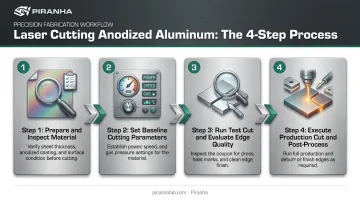
Step 1: Prepare and Inspect the Material
Start by confirming what you're actually cutting. Type II conventional anodizing typically runs 0.07–1.0 mil thick, while Type III hardcoat can run anywhere from 0.5 mil up to 4.5 mil or more, per MIL-PRF-8625 design guidance. That thickness difference directly affects how much energy is needed to punch through the surface before the beam even reaches the base metal.
Before loading the sheet:
- Wipe down oils, dust, and handling residue. Contamination on the surface disrupts beam coupling.
- Make sure the sheet sits flat and fully supported on the cutting bed slats. Warped or tented stock throws off focus consistency across the cut.
- Cross-check the alloy grade and anodize spec against your machine's parameter library. No match? Run a fresh test coupon instead of guessing.
Step 2: Set Baseline Cutting Parameters
Power needs to clear two hurdles here, not one: the oxide layer's higher melting point, then the base aluminum underneath. Set power high enough to overcome both, and program a negative focal point (below the surface) to help push molten material through the full thickness of the sheet.
Nozzle standoff matters too. A tighter standoff paired with the right focus setting helps maintain consistent energy density as the beam travels through the anodized layer and into the metal.
For assist gas, configure high-pressure nitrogen. Published references for high-pressure gas-assist laser cutting commonly cite inlet pressures in the 300–400 PSI range, though exact requirements vary by nozzle, thickness, and machine. Always confirm against your OEM's cut chart rather than a generic number.
Nitrogen's inert, purely mechanical flushing action clears both molten aluminum and oxide particles without adding further oxidation to the edge.
Step 3: Run a Test Cut and Evaluate Edge Quality
Cut a scrap coupon from the same anodize spec before touching the production sheet. Skipping this step under time pressure is exactly what causes the most scrapped material.
Inspect the test edge for:
- Dross clinging to the bottom edge
- Discoloration or a visible heat-affected zone around the kerf
- Incomplete penetration through the anodized layer
- Inconsistent kerf width from top to bottom
Adjust power, speed, or focus in small increments based on what the coupon shows. Don't chase multiple variables at once — change one, re-cut, and compare.
Step 4: Execute the Full Production Cut and Post-Process
Once the coupon checks out, load the finalized program. Position pierce points and lead-ins in scrap areas away from critical edges — anodized finishes show pierce marks more visibly than bare aluminum.
Watch the cut as it runs. Irregular sparking or sudden flare-ups usually signal anodize thickness inconsistency across the sheet, which happens more often than most shops expect on production-run stock.
Aluminum dross is typically soft enough that light post-cut cleanup handles it without secondary finishing operations: a deburring pass or light brushing is usually all that's needed.
Key Parameters That Affect Results When Cutting Anodized Aluminum
Anodized aluminum adds a second variable on top of standard aluminum cutting physics: the oxide coating itself. That means parameter control matters more here than on almost any other reflective metal job.
Laser Power Relative to Anodize Thickness
The oxide layer melts at a far higher temperature than the base metal underneath it. Aluminum oxide melts around 2030°C, compared to roughly 660°C for pure aluminum, according to NIST and PubChem thermodynamic data. That gap is why underpowered cuts leave residue bonded to the edge — the beam severs the aluminum but never fully clears the coating.
Too little power leaves dross and unfinished edges, especially on Type III hardcoat. Too much power widens the kerf and lets discoloration bleed into the surrounding anodized finish.
Assist Gas Type and Pressure
Nitrogen's high-velocity, inert flow mechanically ejects molten aluminum and refractory oxide fragments before they resolidify. Oxygen, by contrast, reacts with the melt and drives edge discoloration.
Insufficient pressure leaves stalactite-like dross on the underside of the cut, while correct pressure produces a clean, dross-free edge with minimal secondary cleanup.
Focal Point Position
Correct focus placement determines how efficiently energy couples into the material right at the surface, exactly where the anodized layer sits. A surface-level focus lets the beam diverge as it travels deeper, which can leave oxide to freeze into dross at the bottom edge before the gas clears it.
Misplaced focus shows up as poor piercing and inconsistent kerf width from top to bottom.
Cutting Speed
Speed has to balance two opposing forces: the initial resistance of the anodized surface, and aluminum's high thermal conductivity, which constantly pulls heat away from the cut zone.
Cutting too fast leaves oxide and metal incompletely severed, while cutting too slow lets heat build up, causing discoloration and a wider heat-affected zone.
Is Your Shop Ready to Laser Cut Anodized Aluminum?
When This Method Makes Sense
Fiber laser cutting fits best for spec-driven parts, such as electrical enclosures, switchgear panels, and nameplates, where clean, repeatable edges matter and NEMA or UL compliance is on the line.
It becomes less practical for:
- Very thick Type III hardcoat plate that exceeds your machine's rated power for the thickness
- Ultra-thin anodized foil, which is prone to warping and heat distortion before the cut even completes
- Mixed-alloy or multi-coating batches, since inconsistent anodize thickness across parts causes uneven cut quality
What You Need Before Starting
Equipment:
- A high-pressure, nitrogen-capable assist gas system
- A nozzle and lens rated for reflective-metal cutting to reduce back-reflection risk
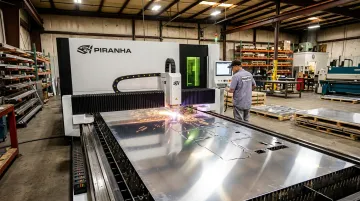
When sourcing this equipment, Piranha's fiber laser line, including the SP404 and PlateLASER series, is built for cutting reflective metals like aluminum. These units are generally kept in stock at the Belvidere, IL facility, so you're not stuck waiting months on a lead time to add this capability. Piranha's current in-stock equipment page shows what's available for near-term delivery.
Materials/Inputs:
- Verified anodize thickness and alloy documentation
- Flat, clean stock free of coating defects
- Test cuts on scrap to confirm settings before running production parts
Skill/Safety:
- Operator training on Class 4 laser hazards
- Fume extraction rated for oxide particulates
- A Class D extinguisher on hand, since OSHA's 29 CFR 1910.157 requires one within 75 feet wherever combustible metal dust is generated at least every two weeks
Common Mistakes and Troubleshooting When Cutting Anodized Aluminum
The same handful of mistakes show up again and again on shop floors:
- Reusing bare-aluminum parameters without accounting for the anodized layer's higher melting point
- Using oxygen instead of nitrogen as assist gas, which drives excess oxidation and visible edge discoloration
- Ignoring anodize thickness variation across a batch, leading to inconsistent cut quality from piece to piece
Quick Troubleshooting Reference
| Symptom | Likely Cause | What to Check |
|---|---|---|
| Dross or oxide residue on the bottom edge | Insufficient nitrogen pressure or incorrect focal depth | Increase gas pressure and confirm the focus point sits below the material surface, not at or above it |
| Discoloration or burn marks around the cut | Excess heat input from slow travel speed or excessive power | Increase cutting speed or dial back power, then re-run a test coupon before returning to production stock |
Alternatives to Fiber Laser Cutting for Anodized Aluminum
Fiber laser isn't always the right call. Thickness, budget, and finish requirements can point toward a different method.
| Method | Best For | Trade-Off |
|---|---|---|
| CNC Routing/Machining | Very thick anodized plate; preserving finish beyond the cut line | Slower cycle times, tooling wear |
| Waterjet Cutting | Heat-sensitive parts needing zero HAZ or discoloration | Slower processing, higher per-part cost |
| Plasma Cutting | Very thick plate where laser power becomes cost-prohibitive | Wider kerf, rougher edge — unsuitable for fine detail |
Piranha manufactures both fiber laser and plasma systems, so moving to plasma doesn't mean switching vendors. A widely cited trade comparison from The Fabricator found laser fastest on thin aluminum stock, plasma the lowest-cost option on thicker plate, and waterjet the clear winner when a heat-affected zone isn't acceptable.
Conclusion
Fiber lasers cut anodized aluminum cleanly when power, gas pressure, and focus match the oxide layer's higher melting point. Bare aluminum settings borrowed from a different job won't work here. Most failed cuts trace back to one of two things: skipping the test coupon, or reusing parameters that never accounted for the anodized coating in the first place.
Getting these settings right matters most when the machine itself can hold them consistently. Shops evaluating new equipment for this kind of work can explore Piranha's in-stock fiber laser systems, built for cutting reflective metals with automation-ready configurations for shops planning to scale.
Frequently Asked Questions
Can you cut aluminum with a fiber laser?
Yes. Fiber lasers are the standard tool for cutting both bare and anodized aluminum because their wavelength is well absorbed by the metal, unlike CO2 lasers.
What materials can a fiber laser not cut?
Fiber lasers struggle with transparent materials like glass and clear acrylic, and they're ineffective on non-conductive, organic materials such as wood or most plastics.
How thick can aluminum be laser cut?
Thickness capacity scales with laser power — a few millimeters on lower-power machines, up to 20mm or more on high-power industrial systems like a 12kW PlateLASER.
Do you need to strip anodizing before laser cutting?
No. Fiber lasers can cut directly through the anodized layer and base metal in one pass when parameters are correctly tuned for the coating.
Does anodized aluminum cut differently than bare aluminum?
Yes. The oxide coating's higher melting point means anodized stock typically needs slightly adjusted power or speed compared to bare aluminum of the same thickness.
What assist gas works best for cutting anodized aluminum?
High-pressure nitrogen is preferred. Its inert, purely mechanical flushing action clears molten aluminum and oxide residue without adding further oxidation to the edge.