Introduction
Trailer OEMs, power and transformer manufacturers, and switchgear builders are all feeling the same squeeze right now. Customers want tighter tolerances, and turnaround windows keep shrinking.
NEMA and UL-driven specs leave zero room for a sloppy edge that needs a second pass with a grinder.
That pressure is pushing more fabrication shops to take a hard look at high-definition (HD) plasma.
On paper, HD plasma can look like an upsell. A conventional plasma unit runs $15,000 to $20,000. An HD system can run three to four times that. But the value doesn't show up on a spec sheet. It shows up in your daily production numbers.
This article breaks down what HD plasma actually delivers on the shop floor. It also compares the real cost of HD, conventional, and air plasma once you factor in labor and rework, and shows when the investment pays off.
TL;DR
- HD plasma constricts the arc for a narrower kerf and cleaner, near dross-free edges
- Expect $50,000-$65,000 for an HD cutting unit alone, versus $15,000-$20,000+ for conventional systems
- Bolt-ready, weld-ready parts cut down on secondary finishing on NEMA/UL-driven jobs
- Some HD consumables log 1,000+ starts under optimized conditions, outpacing budget air-plasma systems
What Is High-Definition Plasma Cutting
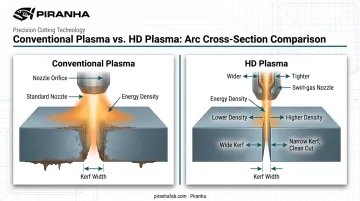
HD plasma is a constricted-arc process. A specialized nozzle narrows and focuses the plasma stream, which raises energy density and arc stability compared to conventional or air plasma. The result: a narrower kerf and a cleaner, more repeatable cut.
You'll find it running on:
- Automated CNC cutting tables
- Combination punch/plasma machines
- Beam lines processing mild steel, stainless steel, and aluminum
Most HD systems handle material up to roughly 2 inches (50 mm) for mild steel and aluminum, with some platforms rated even thicker for stainless. Hypertherm's XPR300, one of the more widely deployed HD platforms, lists a 3-inch (75 mm) production cut on stainless steel.
None of that matters much unless it changes what happens next in your shop. The real payoff is weld-ready, bolt-ready parts that skip the grinding station entirely.
Key Advantages of High-Definition Plasma Cutting
Forget the abstract cut-quality claims for a second. What matters to a shop floor manager is rework rate, cycle time, and cost-per-part. HD plasma's advantages line up against those three metrics directly.
Precision and Cut Quality
A constricted arc and a smaller nozzle orifice produce a narrower kerf than conventional plasma. Cut edges come out closer to dross-free, and tolerances hold steady from the first part to the thousandth.
Industry benchmarks for mechanized plasma generally land in the ±0.015 to 0.020 inch range, with results depending on your machine's motion platform, torch height control, material, and thickness. That's still a meaningful jump over the wider variance you get on conventional or air plasma setups.
Tighter tolerances translate to less grinding before parts reach the weld station. Fewer QC rejects. Faster flow from cutting table to assembly.
This matters most on bolt-ready and compliance-driven parts, where hole accuracy and edge consistency aren't optional. Piranha builds its Combination Punch-Plasma machines around exactly this kind of repeatable output.
One customer, Wilco Machine & Fab., reported punched hole tolerances within 0.001 inch after installing a Whitney 3400 XP combination unit. The upgrade eliminated two secondary processes, machining and drilling, that used to happen after the initial cut.
KPIs impacted: rework rate, finishing labor hours, scrap rate, tolerance compliance.
Cutting Speed and Throughput
HD plasma's higher energy density lets you run faster travel speeds without sacrificing edge quality, especially on thin-to-mid gauge material and parts with tight curves or intricate geometry.
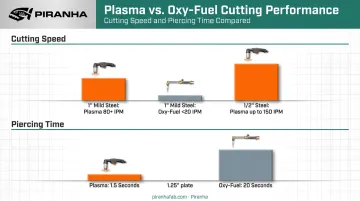
For context on how far plasma has pulled ahead of older cutting methods, a comparative analysis from The Fabricator found high-precision plasma cutting 1-inch mild steel above 80 inches per minute, versus under 20 IPM for oxy-fuel. Plasma cut half-inch steel as fast as 150 IPM.
Piercing times told a similar story: roughly 1.5 seconds for plasma against 20 seconds for oxy-fuel on 1.25-inch plate.
That speed advantage compounds across a shift:
- More parts cut per hour
- Shorter queue times ahead of welding
- Better on-time delivery performance on high-mix production runs
Trailer, truck-body, and structural steel OEMs running high-volume programs feel this most, since every minute of cycle time gets multiplied across hundreds of parts.
KPIs impacted: parts per hour, cycle time, on-time delivery rate.
Consumable Life and Total Operating Cost
Nozzle and torch engineering on HD systems is built for longevity, not just peak performance on day one. Better gas control and arc stability mean less electrode and nozzle wear over time.
Hypertherm reports that some modern automated plasma systems can push past 1,000 starts before consumables need replacing, though actual life depends heavily on amperage, pierce height, duty cycle, and how well the torch is maintained. Compare that to budget air-plasma units, where some cheaper systems burn through consumables in as few as 120-250 starts.
Run the math over a year of production and the gap in consumable spend adds up fast:
- Fewer changeouts mean less unplanned downtime
- More consistent part-to-part quality across a production run
- Lower cost-per-part once amortized across the machine's service life
This matters most in multi-shift, high-mix shops where the machine is already running near capacity. Every consumable swap is time the torch isn't cutting.
KPIs impacted: consumable spend, machine uptime, cost-per-part.
Is High-Definition Plasma Worth the Extra Cost? A Price Breakdown
Here's what you're actually comparing, unit-only pricing, no cutting table or machine included:
| System Type | Typical Price Range (Unit Only) |
|---|---|
| Air plasma | $200 - $8,000 |
| Conventional plasma | $15,000 - $20,000+ |
| HD/X-Definition plasma | $50,000 - $65,000 |
Source: Hypertherm's plasma pricing breakdown.
Sticker price alone tells you almost nothing useful. The real comparison has to include finishing labor, rework, downtime, and consumable spend stacked up across the machine's working life.
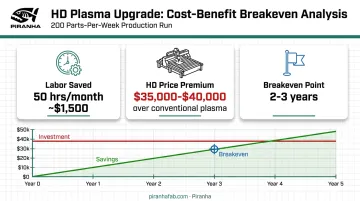
Run a rough breakeven scenario for your own shop. Assume grinding and rework labor costs $30 per hour, and conventional plasma parts need 15 extra minutes of finishing per part that HD plasma eliminates.
On a run of 200 parts per week, the math looks like this:
- Labor saved: 50 hours per month, roughly $1,500
- HD price premium: $35,000–$40,000 over conventional plasma
- Breakeven point: two to three years, before counting faster cycle times or reduced scrap
That math holds up in the field, too. Hypertherm's customer, R.M.P. Products, switched from drilling bolt holes to cutting them on an XPR300 and reported processing 3x faster as a result. Hypertherm characterizes payback in a 24/7 operation as close to immediate.
There's a smarter way to spread that capital cost, too. Pairing HD plasma with a combination punch/plasma machine, like the lines Piranha builds, puts punching and cutting into one footprint instead of buying two separate machines. You get more function per dollar spent, and one machine to maintain instead of two.
What Happens When Shops Settle for Standard Plasma
Standard plasma isn't a dead end. Plenty of shops run it well. But settling for it on parts that demand tight tolerances creates predictable problems downstream:
- Rough, dross-covered edges require extra grinding before parts can move to welding, slowing the whole flow from cutting table to assembly line.
- Frequent consumable changeouts on lower-cost systems increase unplanned downtime and introduce part-to-part inconsistency across a run.
- Inconsistent tolerances create QC failures and rework risk, particularly on spec-driven contracts where NEMA/UL compliance or a trailer OEM's RFQ terms leave no room for variance.
None of these are catastrophic on their own. But they compound. A shop cutting 500 parts a week that needs even five extra minutes of grinding per part burns over 40 labor hours weekly. Those are hours that could go toward production instead of cleanup work.
How to Maximize ROI From Your HD Plasma Investment
Buying the machine is the easy part. Getting the full return requires a few deliberate decisions upfront.
Match capacity to your actual material mix. Don't buy a system rated for 2-inch plate if you're running 3/8-inch sheet all day, and don't undersize a unit if thick-gauge structural work is a regular part of your book.
Invest in the supporting systems, not just the torch. Cut quality depends on nesting software, table motion accuracy, and torch height control just as much as the plasma source itself. A top-tier torch on a shaky table still produces inconsistent parts.
Build in preventive maintenance. Consumable life and cut consistency both drop fast when torches run past their service intervals.
Pick a single vendor for the long haul. A slow-to-service system quickly becomes a maintenance burden. Piranha's U.S.-based support covers its plasma, combination punch/plasma, and ironworker lines, so a shop isn't juggling multiple vendors for one production cell.
Frequently Asked Questions
What is a high-definition plasma cutter?
It's a plasma cutting system that constricts the arc through a specialized nozzle, producing a narrower kerf, cleaner edges, and tighter, more repeatable tolerances than conventional or air plasma.
How thick can a high-definition plasma cutter cut?
Most HD systems handle material up to roughly 2 inches (50 mm) for mild steel and aluminum while maintaining strong edge quality, with some platforms rated for thicker stainless steel cuts.
Which is better for a high-definition plasma cutter: high-frequency or non-high-frequency?
Fabricators generally prefer non-high-frequency (blow-back/contact) start on automated CNC systems. It generates far less electromagnetic interference, meaning more reliable arc starts around sensitive CNC controls.
How much does a high-definition plasma cutting system cost?
Expect $50,000-$65,000 for the HD cutting unit alone, separate from the cutting table or machine it's installed on.
Is HD plasma cutting better than laser cutting?
HD plasma typically costs less upfront and handles thicker material more efficiently. Fiber laser offers finer precision on thinner gauges. The right choice depends on your material mix and part specs.
What materials can HD plasma cut?
Mild steel, stainless steel, and aluminum all cut cleanly with HD plasma. Oxy-fuel, by comparison, is limited to carbon steel and wrought iron.