That growth brings a real problem: too many choices and not enough clarity. Many first-time buyers struggle to tell a genuinely rigid machine from a bolted-together kit dressed up with marketing photos.
The right table changes the math. It improves cut accuracy, cuts material waste, and shortens the learning curve compared to freehand cutting. This guide breaks down what actually matters in a beginner-friendly plasma table and compares the top options for 2026.
TL;DR
- Entry-level CNC plasma tables run $13,000 to $35,000, combining an air plasma cutter, CNC control, and CAD/CAM software.
- Prioritize torch height control, a welded steel frame, and non-proprietary CAD/CAM support before comparing brands.
- Top 2026 picks: Arclight Dynamics (a Piranha company), ShopSabre, Techno CNC, Cyrious, and Langmuir Systems.
- Table size, material thickness, and shop space matter more than brand name alone.
Overview of Entry-Level CNC Plasma Tables in the Metal Fabrication Industry
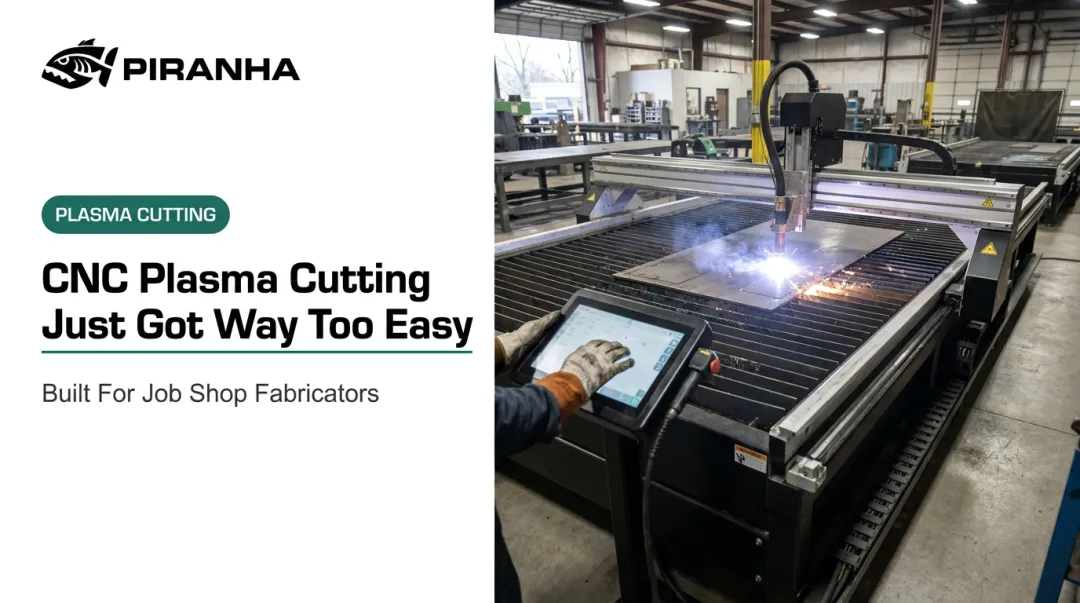
An entry-level CNC plasma table pairs an air plasma cutter with a motion-controlled gantry, built for lower production volumes and smaller budgets than industrial systems. Instead of a hand torch and a straightedge, an operator loads a G-code file and lets the machine do the cutting.
This segment has grown steadily. Hypertherm has noted that the entry-level plasma table market expanded "rather dramatically" over roughly 15 years, driven by hobbyists, professional artists, hot-rod builders, welding job shops, and construction companies picking up tables that can be assembled with common tools.
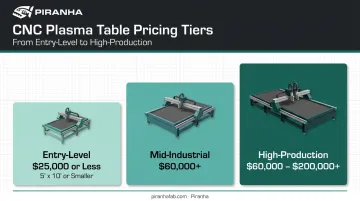
Pricing has followed a similar path. The Fabricator groups light-duty and artisan tables with cutting surfaces of 5x10 ft or smaller into a $25,000-or-less category, distinct from the $60,000-plus mid-industrial and $60,000-$200,000+ high-production tiers.
The best options in that entry tier balance three things:
- Affordability that fits a startup or hobby budget
- Precision good enough for repeatable, sellable work
- Room to scale as a shop's production needs grow
Top Entry-Level CNC Plasma Table Options for 2026
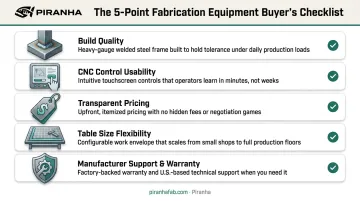
This list was built around real-world buying criteria: build quality, control system usability, table size options, price transparency, and manufacturer support. Here's how the leading entry-level tables stack up.
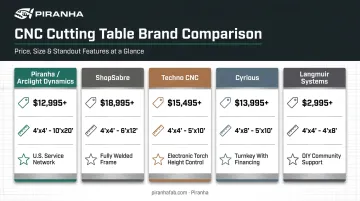
Piranha / Arclight Dynamics – Arc Pro Series & Piranha C-Series
Arclight Dynamics is a Piranha Fabrication Company, which means it's backed by Piranha's manufacturing heritage in U.S. metal fabrication equipment dating back to 1974. That matters more than it sounds. A lot of entry-level plasma brands are three-person operations; Piranha isn't.
The Arc Pro Series is built around a welded steel frame with ARC CNC or FlashCut CNC control, and it carries a multi-year motion control warranty that tends to run longer than typical entry-level competitors. For shops that want integrated downdraft smoke and dust control without paying industrial prices, the Piranha C-Series is worth a look.
| Feature | Details |
|---|---|
| Starting Price | From roughly $13,495 for compact sizes (4x4/5x5), scaling with table size and plasma package |
| Table Sizes | 4x4, 5x5, 4x8, 5x10 |
| Key Differentiator | Backed by Piranha's U.S. service network and a one-source ecosystem for future upgrades (ironworkers, press brakes) |
ShopSabre – SideKick CNC Plasma
ShopSabre is a Minnesota-based, American-made manufacturer that builds fully welded frames instead of bolt-together aluminum designs. That construction choice shows up directly in cut repeatability over time.
The SideKick line appeals to educational institutions, automotive shops, and small manufacturers that want industrial-grade motion control without an industrial price tag.
| Feature | Details |
|---|---|
| Starting Price | Approximately $18,195 |
| Table Sizes | SideKick 4, 8, 10, and 12 |
| Key Differentiator | Fully assembled, ready-to-run with closed-loop brushless motors; optional light-duty router upgrade |
Techno CNC – Phoenix & Venus Series
Techno CNC covers both ends of the entry-level spectrum. The Venus is a compact tabletop system suited to classrooms and makerspaces, while the Phoenix is a production-ready table for shops planning to cut daily.
Both use a PC-based WinCNC controller, and Phoenix adds real-time electronic torch height control with a helical rack-and-pinion drive, a precision feature that's genuinely rare at this price point.
| Feature | Details |
|---|---|
| Starting Price | Venus from roughly $16,400; Phoenix is quote-based (previously listed near $23,500) |
| Table Sizes | Venus: 20"x30" tabletop; Phoenix: 4x4, 4x8, 5x10 |
| Key Differentiator | Scalable from a tabletop learning tool to advanced production cutting |
Cyrious Plasma Tables
Cyrious, based in Texas, focuses squarely on small businesses and startup fabricators. Every table ships as a turnkey, fully welded steel unit, assembled, calibrated, tested, and loaded with software before it leaves the shop.
Financing is a bigger part of the pitch here than with most competitors: Cyrious works with several leasing and payment partners specifically to help first-time buyers get a table on the floor faster.
| Feature | Details |
|---|---|
| Starting Price | $13,995–$17,995 |
| Table Sizes | 4x4, 4x8, 5x10 |
| Key Differentiator | Turnkey build with pre-shipment testing, remote setup help, and a two-year warranty |
Langmuir Systems – Crossfire Series
Langmuir Systems owns the true hobbyist/DIY corner of this market. The Crossfire base kit starts at $1,995, though that price excludes the plasma cutter and computer, and the real all-in cost lands considerably higher once you add both.
What sets Langmuir apart is the community, not just the hardware. A large online forum, FireShare project library, and detailed setup guides mean a first-time buyer isn't cutting alone.
| Feature | Details |
|---|---|
| Starting Price | $1,995 base kit (plasma cutter and computer sold separately) |
| Table Sizes | Compact beds sized for garage and small workshop footprints |
| Key Differentiator | Strong DIY community support and the lowest barrier to entry |
Key Features to Look for in Your First CNC Plasma Table
Picking a table by price tag alone is how buyers end up disappointed six months in. These five features determine whether a machine actually performs.
Torch Height Control (THC)
THC uses arc-voltage feedback to hold a consistent torch-to-work distance as the plate height varies. Skip it and you'll pay for it in cut quality — excessive standoff widens the kerf and increases angularity and dross, while too little height can damage consumables during piercing. Some manufacturers strip THC out to hit a lower price point. Don't buy that table.
Control System & Plasma Compatibility
Look for a controller that supports non-proprietary CAD/CAM software, such as SheetCAM, Fusion 360, or ProNest LT. Proprietary-only systems lock you into one software ecosystem, which becomes a real limitation once your design needs get more complex.
That compatibility only helps if the plasma cutter itself won't damage the control system. Blowback-start plasma cutters generate far less electromagnetic interference than high-frequency start systems, and that matters because PC-based controllers are sensitive electronics. Some manufacturers explicitly prohibit HF-start cutters because the arc can permanently damage the control board.
Shop Space, Power & Air Requirements
Before locking in a size, measure:
- Account for total shop footprint, including clearance on all sides
- Reserve material loading side and staging space
- Plan growth room if you expect to move up from 4x4 to 4x8 or 5x10
Compressed air needs vary by cutter, generally landing between 4.5 and 7.5 CFM depending on amperage. Beginners often overlook electrical supply requirements too: confirm voltage and phase before the table arrives, not after.
How We Chose the Best Entry-Level Options
Every table on this list was evaluated against five criteria:
- Build quality: welded steel frame versus bolted aluminum construction
- CNC control usability: how quickly a beginner can get from design to cut
- Transparent pricing: published starting prices versus quote-only walls
- Table size flexibility: room to grow from a starter size to production capacity
- Manufacturer support and warranty terms: real coverage, not fine-print exclusions
The most common buyer mistake we see: choosing solely on lowest sticker price. That approach ignores consumable costs, software licensing fees, and whether the table can actually be upgraded as production volume increases. A $2,000 kit that needs a $1,500 plasma cutter and $600 in annual consumables isn't automatically the cheaper option.
Conclusion
There's no single "best" entry-level CNC plasma table. The right one depends on matching table size, control system, and support network to where your shop is actually headed, not which brand shows up first in a search result.
Before you buy, weigh total cost of ownership against the upfront sticker price. That means factoring in:
- Consumables
- Software licensing
- Warranty coverage
A table that's $2,000 cheaper up front can easily cost more over three years if support is thin or upgrades aren't possible.
If you're evaluating options built to grow with your shop, Piranha's Arclight Dynamics entry-level plasma tables are worth a look. They come backed by U.S.-based support and a clear path into more advanced fabrication equipment when you're ready for it.
Frequently Asked Questions
What is considered an entry-level CNC plasma table?
Entry-level tables use air plasma systems, smaller cutting beds (4x4 to 5x10 ft), and simplified CNC controls built for lower-volume cutting compared to industrial-grade machines.
How much does an entry-level CNC plasma table cost in 2026?
Prices generally start in the low-to-mid five figures depending on table size, control system, and included plasma cutter. Confirm current pricing directly with manufacturers, since several publish quote-only pricing.
What table size is best for a beginner?
4x4 and 4x8 tables suit most beginners' budgets and shop space while still handling standard steel plate sizes. Choose 5x10 if you're anticipating growth within the first year or two.
Do I need torch height control on an entry-level machine?
Yes. THC directly affects cut quality, edge angularity, and consumable lifespan. THC is essential, not optional, regardless of budget.
Can an entry-level CNC plasma table handle thicker steel as my business grows?
Cutting capacity depends on the plasma cutter's amperage rating. Many entry-level tables allow you to upgrade to a higher-amperage plasma system later without replacing the whole machine.
What's the difference between air plasma and industrial plasma systems for beginners?
Air plasma systems are more economical and sufficient for thinner materials and lower-volume cutting. Industrial systems handle thicker plate and higher duty cycles, but at a much higher cost.