Introduction
More metal shops are researching CNC router and plasma table combo machines. The pitch sounds simple: one gantry, one bed, cut steel and cut wood without buying two separate machines.
The appeal makes sense. Less floor space. One capital expense instead of two. But fabricators considering this route need to understand what they're trading before they sign a purchase order.
This guide breaks down how router/plasma combos actually work and why routing and plasma cutting are mechanically different processes. We'll show where those differences start to matter for your shop.
We'll also cover realistic pricing and explain when a purpose-built industrial system — like Piranha's combination punch/plasma line — makes more sense for production shops than a retrofitted combo.
Key Takeaways
- Router/plasma combos add wood, plastic, and composite capability, but require conflicting drive systems
- Plasma cutting needs smooth, fast motion; routing needs high torque and rigid clamping, often compromising both
- Entry-level plasma tables start around $18,000-$21,000, with router attachments adding further cost
- Production metal fabricators typically get better repeatability from dedicated, purpose-built combination equipment
What Is a CNC Router and Plasma Table Combo Machine?
A CNC router and plasma table combo is a plasma cutting table built or retrofitted with a router head or spindle that shares the same gantry and bed. Instead of buying a separate router, the shop mounts a router attachment onto its existing plasma system.
Mechanically, this usually means swapping tool heads. Premier Plasma CNC's router kit, for example, includes a router mount, rear mounting plate, and dust-collector mount. The manufacturer states that switching between plasma cutting and routing takes about three minutes on compatible tables.
Why shops consider this setup:
- Expands a metal-cutting plasma table into a machine that also engraves, contours, or cuts non-metal stock
- Handles wood, plastic, foam, and composites without a second machine on the floor
- Lets both processes run on the same workpiece without repositioning it
- Adds carving and milling alongside cutting, as Boss Tables' router accessory demonstrates on wood, plastic, composites, and certain metals
That's a real capability gain. The question is what it costs the machine in the process.
CNC Router vs. Plasma Cutter: What's the Real Difference?
This is one of the first questions buyers ask before they invest in a combo unit, and for good reason. Routers and plasma cutters don't just cut differently: they operate on entirely different physical principles.
How CNC Routers Cut
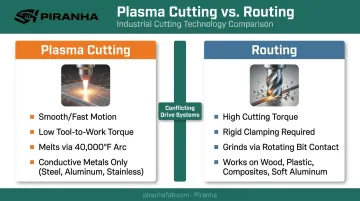
A router uses a rotating spindle and cutting bit that physically grinds away material through direct contact. This requires:
- High tool-to-work torque to force the bit through the material
- Rigid clamping to resist the lateral cutting force
- Slower travel speeds compared to plasma cutting
Routers typically handle wood, plastics, foam, composites, and soft aluminum. Industrial-grade spindles run in the 24,000-32,000 RPM range with up to 13.3 horsepower, reflecting just how much mechanical force is involved.
How Plasma Cutters Cut
Plasma cutting works completely differently. Electrical energy ionizes a gas into a plasma arc, and that superheated, electrically conductive channel melts the metal while compressed air blows the molten material out of the cut. Hypertherm reports plasma arc temperatures approaching 40,000°F — hot enough to cut through steel in seconds.
The catch: plasma only works on electrically conductive materials. Carbon steel, stainless steel, aluminum, copper, and brass are fair game. Wood and plastic are not, because plasma cutting depends entirely on conductivity to sustain the arc.
The core distinction: routers physically grind through contact and torque, while plasma cutters melt through heat and conductivity. This engineering gap explains why a single gantry must serve two fundamentally different mechanical demands.
The Pros and Cons of Combining a Router and Plasma Table
Why Fabricators Consider a Combo System
For the right shop, a combo makes sense:
- Cuts metal and non-metal materials without moving the workpiece to a second machine
- Saves floor space and upfront capital for shops with mixed, lower-volume needs
- Adds engraving, contouring, and detail work that plasma alone can't produce
Sign shops and small job shops doing occasional metal work alongside wood or acrylic signage are the clearest fit here.
Where Combo Systems Fall Short
The engineering conflict is real, and it's not a minor footnote. Hypertherm's own technical team has written directly about this: plasma cutting needs even, fast, smooth motion with relatively little tool-to-work torque, while routing demands high cutting torque and workholding that can resist lateral force.
Those are two different drive systems, motors, and Z-axis designs, not two settings on the same machine.
According to Hypertherm, combining both processes on one gantry usually means one side gets compromised, sometimes both. Their stated recommendation is running separate systems for better performance and less machine wear.
Other trade-offs to weigh:
- More downtime for tool changes, even at a quoted three minutes per swap
- Added maintenance complexity from a drive system doing double duty
- Shorter component life when parts are forced to handle mismatched loads
For shops running high-volume, precision metal fabrication (NEMA/UL enclosure work, structural steel, trailer components), that compromise is a real risk to cut quality and repeatability. Weigh that trade-off carefully before committing to a single-gantry design.
How Much Does a CNC Plasma Table Cost?
Pricing varies by machine class, and adding a router accessory pushes the number higher still.
| Machine Class | Published Price Range | Notes |
|---|---|---|
| Entry-level / light industrial | $18,195 – $25,800 | ShopSabre SideKick starts at $18,195; Boss MVP ranges $21,100–$25,800 by bed size |
| Industrial | Starting around $32,995 | ShopSabre ShopMaster line |
| Heavy industrial | Quote-based | Pricing depends heavily on configuration |
ShopSabre lists its SideKick model starting at $18,195, positioning it for entry-level through medium production work, prototyping, and sign making.
Piranha's own combination punch-plasma systems follow a different approach, with pricing configured to order through an account-gated quote reflecting bed size, power, and automation needs.
What actually drives the price:
- Cutting bed size (Boss's own MVP line jumps from $21,100 at 4x4 feet to $25,800 at 6x12 feet)
- Amperage and power supply — a 65-amp system costs far less than a 300-amp HD plasma source
- CNC controls and CAD/CAM software
- Torch height control (THC) — standard on higher-end tables, an add-on elsewhere
- Dust and fume extraction setup
The sticker price is only part of the equation. Total cost of ownership includes consumables, scheduled maintenance, training, and downtime risk. This is exactly where combo machines can carry hidden long-term costs — a router attachment that adds capability on paper can also add wear, service calls, and lost cutting time that never show up on the initial quote.
Combo Table vs. Dedicated Industrial Systems: What's Right for Your Shop?
The right answer depends entirely on your production mix.
Router/plasma combos tend to work well for:
- Sign shops and small fabrication operations
- Low-volume, mixed-material work where changeover time isn't a bottleneck
- Shops that don't need tight tolerance repeatability on the metal side
When Dedicated Metal Equipment Makes Sense
Production-focused metal fabricators, including trailer OEMs, structural steel fabricators, and switchgear or electrical enclosure builders, usually need something built for the job, not adapted to it.
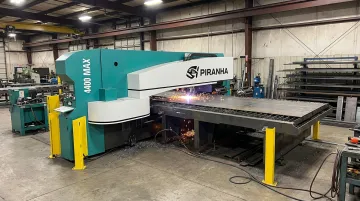
This is the gap Piranha's combination punch/plasma machines are designed to fill. Instead of forcing a plasma gantry to also handle router torque, these machines are engineered from the ground up for metal fabrication workflows, punching and plasma cutting in one platform with no compromise between two incompatible processes.
The 4400 MAX, for example, pairs 100 tons of hydraulic punching force with an optional Hypertherm oxygen plasma system across a 96" x 160" working envelope, built specifically to punch and cut steel, not to switch personalities between metal and wood.
The Single-Vendor Advantage
Buying a combo router/plasma unit often means piecing together components from different suppliers: the plasma system, the router head, the mounting hardware. Piranha's approach is one quote, one install team, one parts catalog, backed by U.S.-based service support across all 50 states.
Fewer vendors means fewer places for accountability to fall through the cracks when something needs servicing.
Piranha also builds its systems with room to grow. Shops can add automation and capability as production scales, rather than replacing the entire machine once volume outpaces what a retrofitted combo was ever designed to handle.
Before committing capital, evaluate:
- What percentage of your actual work is metal versus non-metal
- Whether tolerance and repeatability requirements justify dedicated equipment
- The true total cost of ownership between one combo unit and two purpose-built machines
Talk to an equipment specialist who can walk through both scenarios with your actual production numbers, not just a sales brochure.
Frequently Asked Questions
What is the difference between CNC router and plasma cutter?
A router uses a rotating bit for mechanical, contact-based cutting suited to wood, plastic, and composites. A plasma cutter uses a superheated ionized gas arc to melt and cut electrically conductive metals like steel and aluminum.
How much does a CNC plasma cutter cost?
Costs vary widely by machine class, from roughly $18,000 for entry-level tables to $30,000-plus for industrial systems. Power/amperage, bed size, torch height control, and router attachments all add to the final price.
Can a CNC plasma table cut wood or plastic without a router attachment?
No. Plasma cutting requires an electrically conductive material to sustain the arc, so a standard plasma table cannot cut wood, plastic, or composites without adding a separate router head.
Is a combo router/plasma table a good fit for a metal fabrication shop?
Combo systems generally suit low-volume, mixed-material shops. Production metal fabricators typically get better precision, uptime, and ROI from dedicated or purpose-built combination punch/plasma equipment.
Do combo CNC machines require more maintenance than standalone systems?
Yes, often. Forcing one drive system to handle two mechanically different processes (high-torque routing and smooth-glide plasma cutting) increases wear and maintenance frequency compared to single-process machines.
What materials can a CNC router and plasma table combo actually cut?
The plasma side cuts conductive metals such as steel, aluminum, and stainless. The router side handles wood, plastic, foam, and some composites, but switching between the two typically requires swapping the tool head first.