This guide is written for metal fabricators, trailer and truck body OEMs, power and transformer manufacturers, and job shops taking on titanium work for the first time. Getting the settings right matters here more than with mild steel. Titanium runs anywhere from $8 to $25+ per pound depending on grade, so a scrapped sheet is a real hit to the bottom line, not just a scheduling headache.
Titanium has a reputation for being finicky to cut. In practice, it behaves a lot like stainless steel once you dial in the right parameters. This article walks through how the process works, what actually affects cut quality, and when laser cutting isn't the right call at all.
Key Takeaways
- Titanium cuts similarly to stainless steel, but gas choice (nitrogen vs. argon) affects edge quality and cost
- Fiber lasers cut titanium efficiently up to about 4mm before other methods make more sense
- Grain orientation impacts bending accuracy, so plan sheet nesting accordingly
- Proper machine setup (tech tables, gas ports, focal control) prevents most common cutting defects
- Thin, simple shapes don't always need a laser; let thickness and budget drive the decision
What Is Laser Cutting for Titanium Sheets, and Why Is It Used?
Laser cutting titanium sheet works by directing a high-density laser beam onto the material's surface. The beam heats a narrow path to melting or vaporization temperature.
Titanium melts at roughly 1,668°C, well above steel's melting point, so the process demands consistent energy delivery. An assist gas then blows the molten material out of the kerf, leaving a clean, dimensionally accurate cut.
The goal is straightforward: precise cuts with minimal thermal distortion and no mechanical stress on the material. That last part matters a lot with titanium. Unlike sawing or milling, laser cutting doesn't generate chips, doesn't wear down cutting tools, and doesn't risk the work-hardening that makes machining titanium such a slog for shop floors.
Why Fabricators Choose Laser Over Other Methods
Laser cutting delivers the tight tolerances and repeatability that aerospace, chemical-processing, and NEMA/UL-compliant electrical enclosure work demand. TRUMPF reports a bidirectional positioning error as low as 0.05mm on select fiber laser models, based on ISO 230-2:2014 testing standards. That level of repeatability is hard to match with mechanical cutting on an alloy as expensive as titanium.
That precision, though, depends on tight process control. Skip it, and the risks show up fast:
- Rough or bronzed edges that fail spec
- Warping from uneven heat input
- Wasted sheet on material that's too costly to scrap casually
Despite those risks, laser cutting remains the standard choice across several titanium-heavy industries. Common applications include:
- Aerospace structural parts and turbine components
- Chemical-processing tanks and piping
- Transformer and switchgear enclosures
- Trailer and truck body panels where strength-to-weight ratio counts
No single regulation mandates laser cutting for titanium. It's simply become the operational default because it balances precision against cost better than most alternatives.
How the Titanium Laser Cutting Process Works
At a high level, the laser beam focuses through a nozzle onto the titanium surface, rapidly heating it while assist gas clears molten material from the kerf. The setup requires four things working together: the titanium sheet itself, a fiber laser (the standard choice for this application), an assist gas supply, and manufacturer-supplied tech tables calibrated for titanium's thickness and grade.
Energy absorption causes localized melting. Gas pressure and flow eject that molten titanium to form the cut line. Laser power, cutting speed, focal position, and gas type all get tuned together, often referencing pre-set tech tables similar to those used for stainless steel.
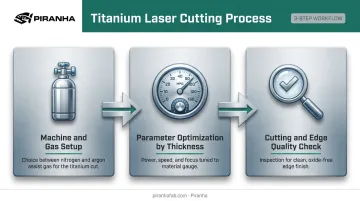
Step 1: Machine and Gas Setup
Fabricators typically choose between two assist gases:
- Nitrogen for cost-efficient cuts, with a slight bronzing on the edge
- Argon for a smoother, higher-quality finish, at a higher gas cost
Automation-ready fiber laser platforms with configurable assist-gas control, like Piranha's fiber laser systems, simplify switching between gases when a shop runs mixed-material jobs on the same machine.
Step 2: Parameter Optimization by Thickness
Thinner titanium sheet can often start from a stainless-steel nitrogen tech table as a close approximation and be fine-tuned from there. MetalForming Magazine notes that thicker sheet may need an oxygen-assisted approach to achieve a clean cut, though oxygen introduces its own reaction heat and oxide-formation tradeoffs worth testing before a full production run.
Step 3: Cutting and Edge Quality Check
The laser executes the programmed path while power, speed, and focus stay synchronized throughout the cut. Once finished, edge quality gets inspected for smoothness and discoloration before parts move to bending or welding. This inspection step matters more with titanium than with mild steel because bending an improperly cut edge can crack the part outright.
Key Factors That Affect Titanium Laser Cutting Quality
Several variables determine whether a titanium cut comes out clean or comes out scrap:
- Assist gas selection. Nitrogen is economical with slight bronzing; argon costs more but produces a cleaner edge for cosmetic-critical parts.
- Material thickness and power. Thicker titanium needs more laser power and tighter parameter control to avoid incomplete cuts or an oversized heat-affected zone.
- Sheet size and grain orientation. Titanium's pronounced shape memory means grain direction affects bending strength and crack resistance, so cutting parts in a consistent orientation across a sheet protects downstream forming accuracy.
- Machine and vendor dependencies. Consistent results depend on accurate tech tables, gas-switching capability, and vendor support that responds quickly when parameters need troubleshooting across multiple machines.
- Energy and operating cost. Cutting speed and gas choice, particularly argon, drive per-part energy and consumable cost more than they drive maintenance cost.
- Compliance and finish requirements. NEMA/UL-driven or aerospace-spec parts often demand tighter edge-quality controls than general fabrication jobs.
Common Issues, Misconceptions, and When Laser Cutting May Not Be Ideal
A few myths tend to follow titanium into the shop, and they're worth clearing up.
Myth: Titanium requires exotic, one-off cutting settings. Most parameters closely mirror stainless-steel tech tables with modest adjustments for gas type and power. You're not starting from zero.
Myth: A bronzed edge always means a bad cut. A slight bronze tint is a normal nitrogen-assist byproduct, not a defect, unless the application specifically calls for an argon-level finish.
Confusion: Slower cutting equals better quality. It doesn't. Slower speeds often just burn more energy without improving the cut. Speed needs to match the tech table for that thickness and gas, not get dialed down out of caution.
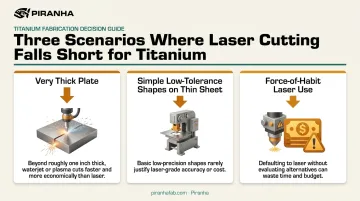
Laser cutting also isn't always the right tool for the job:
- Very thick titanium plate slows the process down significantly; waterjet or plasma often make more sense past a certain thickness
- Simple, low-tolerance shapes on thin sheet may cut more cost-effectively on other equipment
- Force-of-habit laser use wastes time and money when a shop defaults to the laser without a real precision need
Fume extraction and operator training are non-negotiable. NIOSH sets recommended exposure limits for fine and ultrafine titanium dioxide particulate, and titanium dust is classified as combustible under certain conditions. Proper ventilation is required equipment for running the process safely.
Conclusion
Laser cutting titanium sheet is a controllable, well-understood process once assist gas, thickness, and parameters are matched to the material.
Getting these variables right protects both part quality and the cost of a material that doesn't forgive careless settings, especially in precision-driven work like power and transformer manufacturing, switchgear fabrication, or trailer production.
Success comes down to matching the right machine, gas setup, and process knowledge to the job at hand. Shops new to titanium work often move faster with an equipment partner who can walk through real cutting scenarios rather than just handing over a spec sheet.
Piranha's applications team and U.S.-based Field Service Engineers work through exactly these kinds of setup questions with fabricators before and after a machine hits the shop floor.
Frequently Asked Questions
Which materials should you never cut with a laser cutter?
Materials like PVC and other chlorine-containing plastics should never go through a laser cutter, since they release toxic chlorine gas when heated. Titanium itself is safe to laser cut with proper fume extraction in place.
What is the best tool material for cutting titanium?
There isn't one — laser cutting is non-contact and doesn't use a physical tool at all. That's exactly why it avoids the carbide and diamond tool wear problems common when sawing or milling titanium.
How difficult is it to cut titanium?
Titanium is comparable in cutting difficulty to stainless steel when using a fiber laser. It demands closer attention to assist gas selection and material utilization simply because the material costs so much more.
What assist gas works best for laser cutting titanium sheet?
Nitrogen is the cost-effective default and produces a slight bronze tint on the edge. Argon costs more but delivers a cleaner, brighter finish, worth it when the application demands a cosmetic or spec-driven edge quality.
How thick of a titanium sheet can a fiber laser cut?
Most fiber lasers cut titanium efficiently up to roughly 4mm before surface quality and cutting speed start to suffer. Beyond that, waterjet or plasma cutting often become more practical options.
Does laser cutting titanium produce hazardous fumes?
Yes. Titanium cutting can generate fine particulates and fumes, including combustible dust under certain conditions. Proper extraction and ventilation systems are necessary to keep operators safe.