Introduction
Scroll through any online marketplace and you'll find "internally heated industrial laser welding tools" for $20 to $50, promising to weld metal, strip rust, and repair anything from circuit boards to car panels. The catch? Most buyers can't tell if they're looking at real laser equipment or a rebranded soldering iron.
That confusion costs money. A shop that expects laser-grade penetration from a $35 heat tool will end up with a failed joint, a wasted afternoon, and no real answer about what went wrong.
This review breaks down what these tools actually are, whether they can weld anything structural, and how to spot genuine industrial laser welding equipment before you spend a dime.
Key Takeaways
- "Internally heated laser welding tools" are soldering guns, not real lasers.
- Genuine handheld laser welders start around $17,990 and require documented specs.
- Missing laser source, wavelength, or safety certification is an instant red flag.
- Structural welds on steel or aluminum need real laser power, not a hot tip.
What Exactly Are "Internally Heated" Laser Welding Tools?
Here's the problem: "internally heated industrial laser welding tool" isn't a recognized equipment category. It's marketing copy attached to a product that has nothing to do with lasers.
The core distinction is simple:
- Internally heated tool: A resistive heating element inside the tip generates heat, then transfers it to the workpiece through direct contact — the same principle as a soldering iron.
- True laser welder: A laser source generates a focused optical beam that melts base metal at the point of contact, with no physical touching required.
Buyers looking for real equipment typically search "handheld laser welder," "fiber laser welder," or "portable laser welding machine" instead. That search leads to a very different price tag. Established brands like IPG and Miller list entry-level 1 kW handheld systems starting around $17,990 for the IPG LightWELD 1000, with complete packages running toward $35,000.
Piranha's own handheld laser welding systems compete in this same real-equipment category, built around genuine fiber laser sources instead of resistive heating elements.
That gap between the $30 heated tool and an $18,000 laser system separates two completely different product categories, not a discounted deal.
The First Red Flag
Check the listing for three things before anything else:
- Laser source type (fiber, Nd:YAG, diode)
- Wavelength in nanometers
- Rated power output in watts
No laser source, no wavelength, no rated power means no laser. It's that straightforward. If a listing skips all three, it's describing a heating element with laser branding slapped on top.
This distinction carries real financial weight. A shop that buys the wrong tool loses the purchase price, sure, but the bigger cost is downstream: false expectations about weld quality on a job that actually needs to hold up.
The Real Catch: Heating Element vs. True Laser Beam
A genuine industrial laser welding system isn't one part. It's an integrated system with several required components:
- Laser source — the actual beam generator (fiber, disk, or Nd:YAG)
- Power supply — matched to the laser's rated output
- Cooling system — air or water-cooled, sized to the duty cycle
- Optics and welding head — focuses and directs the beam precisely
- Control software — manages parameters like speed, power, and pulse
- Safety interlocks — shut down the beam if enclosures are breached
- Shielding gas delivery — protects the weld pool from oxidation
A $30 heated tool has exactly one of those: a heating element. Everything else is missing.
Heated Tool vs. Real Laser Welder
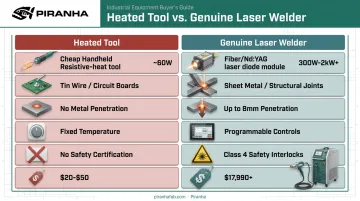
| Feature | Low-Cost Heated Tool | Genuine Industrial Laser Welder |
|---|---|---|
| Heat Source | Resistive element, ~60W | Fiber/Nd:YAG laser, 300W–2kW+ |
| Typical Use | Tin wire, circuit boards | Sheet metal, structural joints |
| Metal Penetration | None on structural metals | Up to ~8mm on steel (2kW) |
| Process Control | Fixed temperature only | Programmable power, speed, pulse |
| Safety Level | None documented | Class 4 interlocks, enclosures |
| Price Range | $20–$50 | $17,990–$40,000+ |
Reading Through the Marketing Language
Listings often lean on phrases like "heat fusion" or "constant temperature rapid heating." These describe how the tip gets hot, not how a laser melts metal. It's technical-sounding language borrowed to imply capability the product doesn't have.
Real-world examples show this pattern clearly. One current listing markets a "60W, 480°C" tool as an "Internal Heat Electric Welding Tool" for circuit board and tin-wire repair. Another lists its item type as "Soldering Gun" despite using "Laser Welding" in the title.
The Safety Gap Nobody Mentions
Genuine laser welding equipment operates as Class 4 laser hardware. OSHA requires controlled areas, nondefeatable door interlocks, emergency disconnects, and wavelength-specific protective eyewear for open Class 4 operation, plus DANGER-format warning signs at every entrance.
A legitimate listing mentions this. A heated-tool listing never does, because there's no laser to protect against. That silence is itself a warning sign.
This same "fake laser" branding pattern shows up in laser cutting and laser cleaning categories too — buyers should apply the same scrutiny there.
Can These Tools Actually Weld Metal? Material and Thickness Limits
Internally heated tools can join thin plastics or low-melting solder wire. They cannot produce a structural weld on steel, stainless, aluminum, copper, or titanium. There's no mechanism for it: contact heat alone can't create the fusion penetration a structural joint requires.
Genuine laser systems scale thickness capacity with power output. Published industry guidance breaks down roughly like this:
| Laser Power Band | Typical Max Thickness | Example |
|---|---|---|
| 300–500W | Up to ~1mm | Thin gauge sheet, precision repair |
| 500–1,500W | Up to ~4mm | 1kW handheld units, ⅛" sheet steel |
| 1,500–3,000W | Up to ~7–8mm | 2kW systems on steel/stainless |
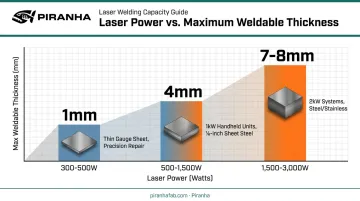
These ranges come from manufacturer and industry guidance, and actual results depend heavily on material grade, joint design, travel speed, and shielding gas quality. Wattage alone doesn't guarantee the result — a shop still needs matched optics and process control to hit these numbers consistently. Piranha's handheld laser welding systems, for example, are built within these same documented power-to-thickness ranges rather than sold on promises contact heat alone can't back up.
Why Aluminum and Copper Are Especially Hard
These two metals punish underpowered or poorly controlled systems:
- Aluminum is highly reflective, meaning much of the laser energy bounces off rather than absorbing into the metal.
- Copper reflects even more strongly near the 1,000nm wavelength range used by most industrial fiber lasers.
- Both conduct heat rapidly, pulling energy away from the weld zone before it can fuse properly.
A 2kW handheld system that welds 8mm on carbon steel might only manage around 3mm on copper. Same machine, very different result. A heating element has zero chance here. There's no reflectivity problem to solve because there's no beam to reflect.
How to Spot a Genuine Industrial Laser Welding Tool Before You Buy
Before spending real money, demand documentation. Specifically:
- Laser source type — fiber, Nd:YAG, disk
- Rated power — average watts, and peak watts if pulsed
- Wavelength — needed to match protective eyewear
- Cooling method — air-cooled or water-cooled, with capacity specs
- Duty cycle — continuous rating or pulse width/frequency
- Safety certification — laser class, interlock design, CDRH accession number
A Quick Due-Diligence Checklist
Run any listing through these five questions:
- Does it document a real laser source with a stated wavelength?
- Is there actual welding sample data on the metal you need to join?
- Is the system rated for your target material — steel, aluminum, copper?
- Does the seller provide safety documentation matching Class 4 requirements?
- Is the price point realistic for laser hardware, not heat-tool pricing?
If any answer is no, walk away. Once a listing passes this checklist, compare it against what a real system includes.
What a Real System Should Include
A legitimate handheld or portable industrial laser welder provides:
- Stable, programmable power output
- Matched welding head and optics for the rated power
- Shielding gas support at the weld point
- Optional wire feed for filler material
- Safety interlocks tied to enclosure access
- Full parameter control (speed, power, pulse settings)
Support Matters as Much as Hardware
Hardware alone doesn't guarantee a legitimate purchase. Manufacturer backing separates real industrial suppliers from anonymous marketplace sellers. That means:
- Training on parameter setup for specific materials
- Maintenance programs and documented service history
- Warranty coverage with clear terms
- Technical support that answers the phone
Piranha's handheld laser welders, for instance, ship with documented specs, training, and U.S.-based support.Genuine industrial systems run thousands to tens of thousands of dollars depending on power and features. That price reflects the laser source, optics, cooling system, and safety engineering — none of which exist in a sub-$100 listing. There's no version of a real laser welder that costs $35.
Why Sourcing From an Established Industrial Equipment Manufacturer Matters
The internally heated "laser welder" trend illustrates a broader lesson: unverified low-cost sellers rarely offer the engineering rigor or accountability that established manufacturers do.
Piranha builds fiber laser cutting systems with documented specifications and automation-ready design, meaning shops can add material loading and unloading later without replacing the core machine. That matters for fabricators planning to scale production over time rather than buying twice.
When evaluating any laser-based investment, prioritize manufacturers with:
- A verifiable track record and published specifications
- U.S.-based technical support that's actually reachable by phone
- Same-day parts shipping from a domestic facility (Piranha ships from Belvidere, IL)
- Decades of manufacturing history, spanning 140+ years and including the W.A. Whitney and Bertsch brands
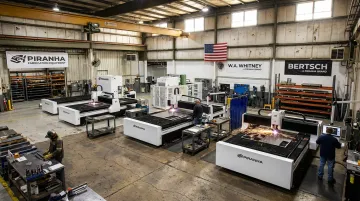
That kind of backing is the difference between a machine you can rely on for a real production job and a marketplace gamble with laser branding.
Frequently Asked Questions
How much does an internally heated industrial laser welder cost?
The heated tools themselves run $20 to $50 on marketplaces. Genuine industrial laser welding systems cost thousands to tens of thousands of dollars, depending on power, cooling, and controls.
Do internally heated industrial laser welders work?
They can heat or soften soft materials like solder wire or thin plastic. They cannot perform true structural metal welding, since they have no laser source to melt base metal.
What is the maximum metal thickness an internally heated industrial laser welder can weld?
These heated tools have no meaningful structural welding thickness capacity. Real laser welders scale thickness capability with laser power, reaching roughly 1mm at low power up to 7–8mm at 2kW.
What is the difference between a laser welder and a heat fusion tool?
A laser welder uses a focused optical beam to melt base metal without contact. A heat fusion tool transfers heat through direct physical contact with a heated tip, similar to a soldering iron.
Is it safe to use a low-cost "laser welding" tool at home?
These tools typically lack any laser safety enclosure or certification because they contain no actual laser. Buyers should be cautious of both safety claims and performance claims on these listings.
What should I look for before buying an industrial laser welding machine?
Demand a documented laser source, rated power, wavelength, and safety certification, plus real welding sample data on your target metal. Manufacturer support for training and maintenance matters just as much as the hardware specs.