Picking the wrong one doesn't just cost you money upfront. It affects cut speed, part quality, and your shop's ability to hit delivery deadlines or NEMA/UL spec requirements on enclosure work.
This guide breaks laser and plasma down side-by-side across speed, material capability, and cost, so you can match the technology to your actual production mix instead of guessing.
Key Takeaways
- Laser cutting delivers tighter tolerances and faster cuts below 1 inch
- Plasma cutting handles thick plate more efficiently and costs less upfront
- Plasma overtakes fiber lasers in speed around the 5/8-inch mark
- Base your decision on thickness split and volume, not brand loyalty
Laser Cutting vs Plasma Cutting: Quick Comparison
Piranha manufactures both fiber laser and CNC plasma cutting systems, so this comparison reflects real shop-floor trade-offs rather than a sales pitch for either technology.
| Factor | Laser | Plasma |
|---|---|---|
| Capital cost | Higher upfront investment | Lower upfront investment |
| Best thickness range | Thin-to-mid gauge (up to ~1.5") | Mid-to-thick plate (up to several inches) |
| Speed advantage | Faster below ~5/8" | Faster above ~5/8" |
| Cut quality | Narrower kerf, tighter tolerance | Wider kerf, slight bevel |
| Maintenance | Precision optics, chiller upkeep | Simple nozzle/electrode swaps |
Cost
Fiber lasers carry the bigger price tag. Published entry-level fiber laser systems start around $71,995, while comparable CNC plasma tables from the same manufacturer start closer to $32,995.
That gap widens at higher power. A complete high-definition plasma table, like a Hypertherm XPR300 setup, typically runs $175,000 to $225,000 installed. A comparable fiber laser can cost three to four times more, depending on wattage.
Plasma offers a lower barrier to entry with faster payback on thick-plate work, while laser carries a higher sticker price but often delivers faster ROI on high-volume thin-gauge production.
Materials & Thickness
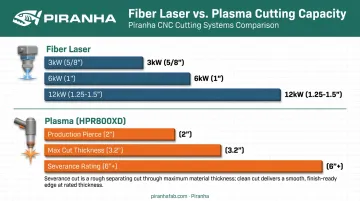
Laser thickness ceilings scale directly with power. A 3 kW fiber laser tops out around 5/8 inch on mild steel, a 6 kW unit reaches roughly 1 inch, and 12 kW systems push toward 1.25 to 1.5 inches depending on the alloy.
Plasma keeps going well past that. High-definition systems like Hypertherm's HPR800XD push further:
- Production pierce rating of 2 inches on mild steel
- Maximum cut thickness of 3.2 inches
- Severance ratings on stainless and aluminum exceeding 6 inches
Severance isn't the same as a clean, weld-ready cut, though, so match the spec to your actual quality needs.
Speed
Below roughly 5/8 inch (16mm), laser wins on raw travel speed. Above that threshold, plasma pulls ahead, and the gap grows as plate gets thicker.
In one documented benchmark, a 170A plasma system cut 10mm mild steel roughly twice as fast as a 4kW fiber laser running oxygen assist gas. Thickness, laser power, and gas type all shift where the crossover actually lands for your shop.
Cut Quality & Precision
Laser edges come off the machine nearly weld-ready:
- Kerf width around 0.008 to 0.020 inch
- Part tolerance near ±0.006 to 0.015 inch
- Minimal heat-affected zone
Plasma kerf runs wider, roughly 0.05 to 0.34 inch depending on amperage and gas configuration, with a slight edge bevel. Modern high-definition plasma using ISO 9013 Range 2 quality narrows that gap considerably on thinner plate.
Maintenance & Operating Cost
Laser systems need more specialized care. Optics, cover slides, ceramic insulators, and chillers all wear over time and require trained hands.
Plasma consumables are simpler. Nozzles and electrodes are the primary wear items, and most in-house maintenance teams handle swaps without outside service calls.
What Is Laser Cutting?
Fiber laser cutting uses a focused, high-intensity beam of light to melt or vaporize metal along a programmed path. For fabricators chasing tight tolerances and repeatable parts, that precision translates directly into fewer rejects and less rework.
The operational payoff shows up in three places:
- Minimal secondary finishing — clean edges mean less grinding before welding or paint
- Reduced material waste — precise beam control allows tighter nesting on the sheet
- Faster changeover — no retooling between job runs, unlike punch-based processes
Modern fiber lasers, including Piranha's line, are built with automation-readiness in mind. That means a shop can add automated load/unload systems as volume grows without swapping out the core machine.
Power Classes Matter
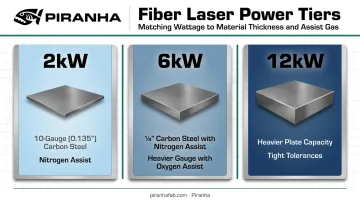
Fiber lasers come in low, medium, and high-power classes, and the class you buy determines your practical thickness ceiling:
- 2 kW systems handle roughly 10-gauge (0.135") carbon steel with nitrogen assist
- 6 kW systems push to about ¼ inch with nitrogen, more with oxygen
- 12 kW systems, like Piranha's PlateLASER, target heavier plate while still holding tight tolerances
Undersizing this decision gets expensive: a shop cutting mostly 3/8-inch plate can't rely on a 2kW machine without slowing production, while overspending on 12kW capacity for thin sheet work ties up capital that's better spent on automation or additional tooling.
Use Cases of Laser Cutting
Laser fits best where hole patterns, intricate profiles, or spec compliance matter more than raw thickness. Electrical enclosure fabrication and switchgear building are classic examples, where NEMA and UL requirements demand consistent, repeatable cuts.
Precision sheet metal work for OEMs is another strong fit. One Pennsylvania fabricator running 15kW and 20kW automated fiber lasers on ¼-inch and thinner material reported cutting throughput gains without adding labor, with some months showing 40% year-over-year growth.
That's the kind of advantage thin-gauge shops get from laser speed.
What Is Plasma Cutting?
Plasma cutting uses an ionized, superheated gas jet to melt through electrically conductive metal. It's been the workhorse of heavy fabrication for decades, and for good reason: it's fast on thick material and forgiving on material quality.
The operational advantages stack up on thick plate:
- Lower cost-per-part above roughly 5/8 inch
- Faster cutting speeds than laser once you cross that thickness threshold
- Durability in high-volume, high-duty-cycle shop environments
Piranha's plasma and combination punch/plasma systems are engineered specifically for the thick-plate demands of trailer, truck body, and structural steel fabrication, where parts often get welded afterward and a slight edge bevel simply doesn't matter.
Plasma Variations
Not all plasma is equal. Three main types serve different shop needs:
- Conventional plasma costs the least but cuts the widest kerf and leaves the roughest edge
- High-definition plasma tightens tolerances and improves edge squareness for parts needing closer dimensional control
- Dual-gas systems add shielding gas control for a better finish on specific alloys, at a higher consumable cost
Use Cases of Plasma Cutting
Plasma dominates where thickness matters more than fine detail: structural components, trailer frame parts, and heavy equipment fabrication. Trucking and trailer OEMs, structural steel shops, and foundries rely on it daily.
The economics back this up. Hypertherm models a midsized shop cutting 2,000 half-inch mild steel plates annually and improving nesting utilization by just three percentage points. That single change can save 82 plates a year, worth roughly $77,000. On thick plate, small efficiency gains compound fast.
Laser vs Plasma: Which Is Better?
Neither wins outright. The right call depends on four things:
- Material thickness split, both today and where your work is trending over the next 3-5 years
- Required tolerance and edge quality: do parts need to go straight to weld, or straight to finish?
- Production volume, since high-mix, high-volume thin work favors laser's speed advantage
- Capital budget matters most when cash flow is tight, favoring plasma's lower entry cost
Choose laser if most of your work is thin-to-mid gauge sheet requiring tight tolerances and clean edges with minimal finishing.
Choose plasma if most of your work involves thick plate, budget is the primary constraint, or parts get welded anyway, making a slight edge bevel irrelevant.
Real-World Example: MAC Trailer
MAC Trailer needed a plasma system that could keep pace with their production volume without sacrificing accuracy. They installed a CNC plasma machine processing mostly 3/16- and 1/4-inch aluminum plus mild steel up to 1/2 inch.
According to Messer Cutting Systems' case study on MAC Trailer, the results were measurable:
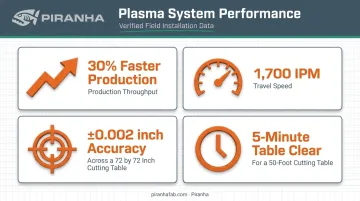
- Production ran about 30% faster than the machine it replaced
- Cutting-head travel speed hit 1,700 inches per minute
- Machine accuracy held to ±0.002 inch across a 72 x 72 inch table
- Clearing a 50-foot table took roughly 5 minutes
Dross and part fit-up both improved, cutting down on secondary finishing time. For a trailer or truck body shop weighing the same decision, the lesson is simple. If your work is mostly mid-thickness plate and welded assemblies, a well-specified plasma system can close the productivity gap without the laser price tag.
Not sure where your material mix lands? Talk to Piranha's fabrication experts about evaluating your production data before committing to either investment.
Conclusion
Neither laser nor plasma is universally better. Laser wins on precision and speed for thinner materials, while plasma wins on cost-efficiency and thick-plate productivity. The right choice depends on your shop's specific material mix and volume, not on which technology sounds more advanced.
What matters in practice is lower cost-per-part, less downtime, and faster ROI. Piranha's product range spans fiber lasers, plasma, and combination punch/plasma systems. Fabricators can start with the right technology today and add capability as production grows, without switching vendors.
Frequently Asked Questions
How much does a plasma cutting machine cost?
Pricing varies by amperage, bed size, and automation, ranging from about $30,000 for entry-level tables to over $200,000 for high-definition systems. Plasma systems still cost less than comparable fiber laser machines.
What is the difference between a plasma cutter and a laser cutter?
Plasma uses ionized gas to cut thicker conductive metals cost-effectively, while laser uses a focused light beam for faster, more precise cuts on thinner materials. The crossover point sits around 5/8 inch of thickness.
Can I make money with a CNC plasma cutter?
Yes. Plasma cutting is a proven revenue generator for job shops due to low operating costs, fast cutting speeds on thick plate, and versatility across parts and industries. Consumable costs stay manageable compared to laser optics.
Is there an American-made plasma cutter available?
Yes. U.S. manufacturers, including Piranha, build plasma cutting systems domestically with U.S.-based service and support, so you're not waiting on overseas parts or support queues.
Which is faster, laser cutting or plasma cutting?
It depends on thickness. Laser is faster on thin materials, generally under 5/8 inch, while plasma pulls ahead on thicker plate.
What materials can each machine cut?
Both can cut conductive metals like steel, stainless, and aluminum. Laser can also handle certain non-metal materials in some configurations, while plasma is limited strictly to electrically conductive metals.