Introduction
Fabrication shops are getting squeezed from every direction. Skilled welders and machinists are retiring faster than shops can replace them. US manufacturing had roughly 409,000 unfilled positions as of August 2025, according to a Deloitte analysis of the sector's labor shortage.
Customers aren't patient about it either. Research cited by The Fabricator found that half of customers value shorter lead times over lower cost.
Automation used to be optional. Now it's how shops stay open.
"Automated manufacturing systems" covers a lot of ground. It ranges from a single automated ironworker running unattended overnight to a fully connected fiber laser cell that loads, cuts, and offloads sheet without an operator touching it.
Many shop owners know they need to automate something. Fewer know where to start.
This guide breaks down what these systems are, the four main types you'll run into, real equipment examples from metal fabrication, and how to choose the right system as your shop grows.
Key Takeaways
- The right automation level depends on your part volume and variety
- Labor shortages and lead-time pressure make automation a survival tool, not an upgrade
- Fixed, programmable, flexible, and integrated automation each solve a different problem
- Automation-ready equipment lets shops add capability without replacing machines
- ROI comes from labor savings, throughput gains, and reliable service, not price alone
What Are Automated Manufacturing Systems?
Automated manufacturing systems are computer-controlled equipment and software that run, schedule, and monitor production tasks with little direct human input.
Instead of an operator manually feeding every part through a machine, a control system directs the equipment. It sets cut paths, punch sequences, or bend programs, and keeps the process running consistently from the first part to the last.
These systems typically handle more than the cutting or forming motion itself. Control platforms can also:
- Set preventive maintenance schedules based on machine hours or cycle counts
- Monitor quality in real time through connected sensors and cameras
- Flag material handling issues before they turn into scrapped parts
- Log production data for traceability and scheduling
Automation Still Needs People
"Fully automated" doesn't mean an empty shop floor. Someone still has to program the job, load raw material, swap tooling, and perform maintenance. What changes is the nature of the work. Operators shift from repetitive manual tasks toward programming, oversight, and troubleshooting.
That shift is happening at scale. Manufacturers worldwide installed 542,000 industrial robots in 2024 alone, including 34,200 in the United States, according to the International Federation of Robotics' 2025 World Robotics report. Robots are just one piece of the automation puzzle, but the number shows how normal this equipment has become.
This ties into the broader Industry 4.0 movement, which links machines, sensors, and software into one data-driven system. A press brake that reports cycle times to a shop's ERP, or a laser table that flags a nesting error before it wastes sheet, is Industry 4.0 in practice.
For fabrication shops, this connectivity is quickly becoming a baseline expectation from OEM customers, not a competitive edge.
Types of Automated Manufacturing Systems
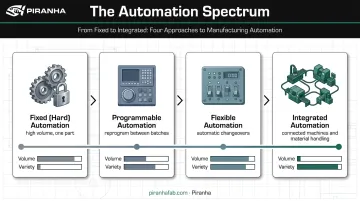
Automation exists on a spectrum, from rigid single-task machines to fully flexible, software-driven systems. The right type depends on your production volume and how much part variety you actually run.
Fixed (Hard) Automation
Built for one job, run at high volume, repeated indefinitely. Reprogramming is costly and slow, sometimes requiring new tooling or a full mechanical changeover.
In metal fab, picture a dedicated punching or shearing line set up to run one part configuration, shift after shift, on a high-volume component like a bracket or bolster plate. It's efficient when the part never changes, and wasteful the moment your product mix does.
Programmable Automation
Equipment here can be reprogrammed between batches, which suits shops running varied part runs instead of one part forever. CNC-controlled fabrication equipment, such as punch presses and press brakes with programmable back gauges, is the classic example.
An operator loads a new program, and the machine executes a different hole pattern or bend sequence on the next batch. This is the tier where most job shops already operate.
Flexible Automation
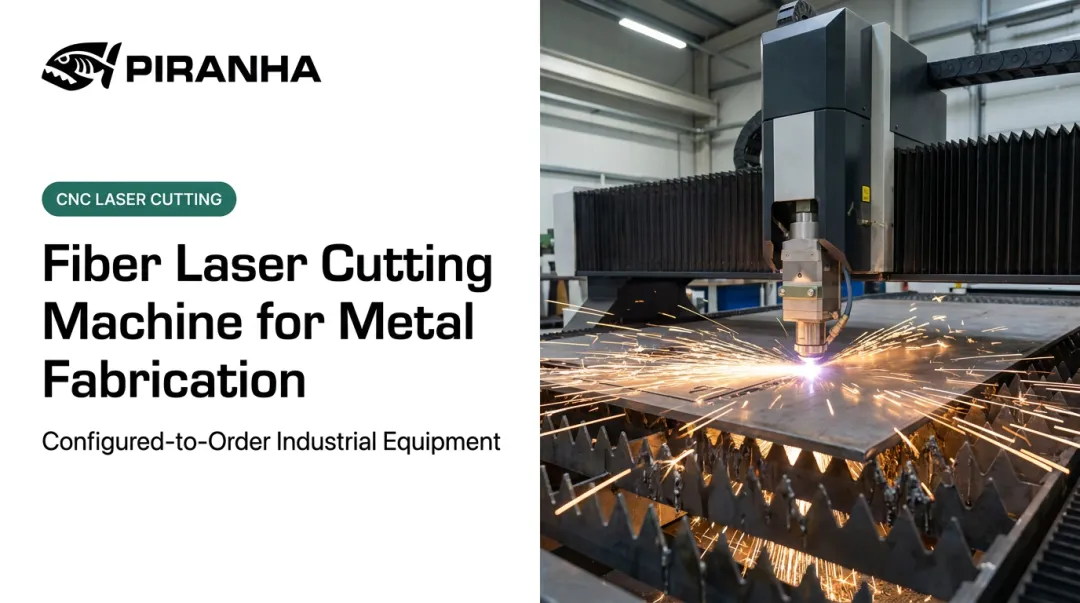
Changeovers happen automatically through software, with little to no downtime between jobs. Piranha's fiber laser and combination punch/plasma systems, built with automation in mind, increasingly operate at this level. A laser table can finish a run of brackets, then switch immediately to a completely different part nested on the next sheet, with no manual retooling in between.
Integrated Automation
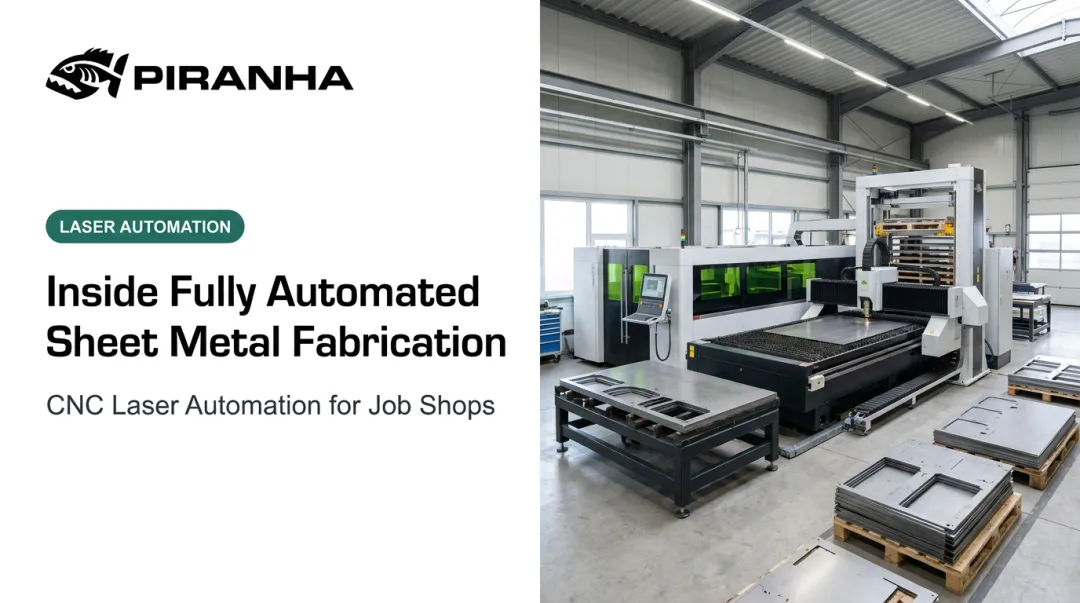
A single control system coordinates multiple machines and material handling together, loading, cutting, and offloading in one connected cell. This is the direction the fabrication industry is heading, as shops link cutting, forming, and material handling equipment into cells that run with minimal supervision across a shift.
Key Benefits of Automating Your Fabrication Shop
Automation pays off in three areas that matter to almost every shop owner: output, safety, and compliance.
More Parts, Consistent Quality
Automated equipment runs at a steady pace, without the slowdown that comes from fatigue or shift changes. Shops that switched from mag-drilling to punching have cut job completion time by as much as 80%, finishing five to six holes in the time it takes to drill one.
The exact multiplier depends on the job, but the pattern holds: automated processes reduce per-part cost by cutting cycle time and scrap.
Fewer Hands Near Dangerous Work
Automation pulls operators away from the riskiest parts of the job, including heavy material handling and repetitive punching near a moving ram. Piranha's ironworkers build in automatic hydraulic clamping and independent dual-operator stations that reduce manual handling needed to keep material positioned during a cut.
Less manual contact with the workpiece means fewer chances for a hand to end up somewhere it shouldn't.
Precision That Holds Up to Spec
Automated hole positioning and cut accuracy matter for more than appearance. They're often the difference between passing and failing inspection. Electrical enclosure fabricators need to hit NEMA and UL dimensional requirements consistently across thousands of parts.
The Whitney 3400 XP, for example, has held finished punched-hole dimensions within 0.001 inches, tight enough to eliminate secondary drilling entirely. That kind of repeatability is hard to guarantee with manual layout, no matter how skilled the operator.
Examples of Automated Manufacturing Equipment in Metal Fabrication
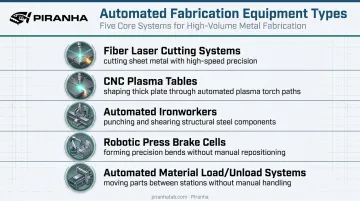
Automated manufacturing equipment is machinery that performs production tasks through pre-programmed instructions, requiring little to no manual input once a job starts. Common examples in metal fabrication include:
- Fiber laser cutting systems - cut sheet and plate from programmed nesting files, often with automated loading and unloading
- CNC plasma tables - follow programmed cut paths on thicker plate where lasers aren't ideal
- Automated ironworkers - handle punching, shearing, and notching with hydraulic clamping and programmable stroke control
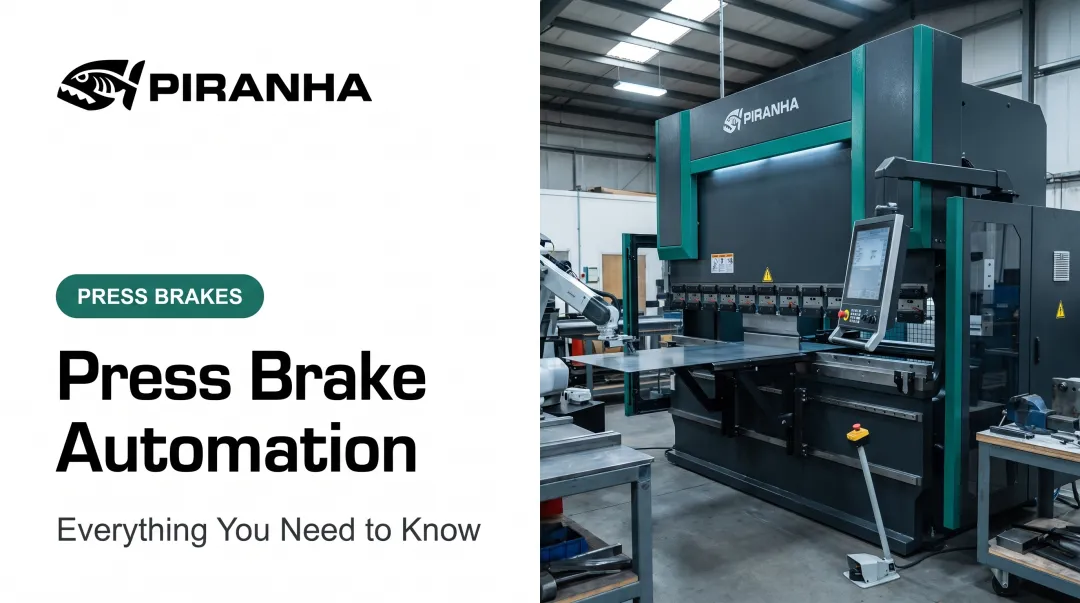
- Robotic press brake cells - use robotic arms to load, bend, and unload parts without an operator standing at the machine
- Automated material load/unload systems - feed raw sheet into a cutter and remove finished parts, extending unattended run time
The core toolset behind all of it includes:
- PLCs for sequencing
- CNC controllers for cut and bend paths
- Robotic arms for material handling
- Sensors and IIoT devices for monitoring
- Automated material handling to tie it together
Built to Grow With Your Shop
Piranha's fiber laser cutters are engineered with automation in mind from the start. Whether a shop needs loading and unloading now or plans to add it once volume justifies the investment, the machines are built to accept that expansion without a full replacement.
There's also a practical case for buying automated equipment from one manufacturer instead of mixing vendors. When your laser, press brake, punch/plasma combo, and ironworker all come from Piranha, you're working with one parts catalog and one support team that already understands how the equipment talks to itself.
Mixing brands means mixing service contracts and troubleshooting calls, exactly the friction automation is supposed to remove.
How to Choose the Right Automated Equipment for Your Shop
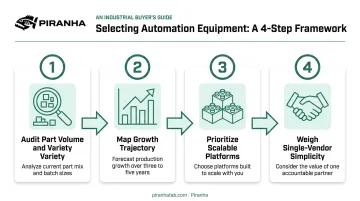
Before signing a purchase order, match the automation type to your actual production mix.
- Audit your part volume and variety - high volume of one part points toward fixed automation; frequent changeovers point toward programmable or flexible systems
- Map your growth trajectory - don't buy for today's workload alone; a shop likely to double laser volume in three years should prioritize equipment that supports adding automation later
- Prioritize scalable platforms - look for automation-ready machines that let your shop add material handling down the road instead of replacing the whole system; Piranha's fiber laser lines are built this way
- Weigh single-vendor simplicity - one quote, one install team, and one parts catalog directly reduce integration headaches and downtime
The Build and Price Your Perfect Piranha Shop tool lets shops configure equipment and pricing directly. It's a practical starting point once you know roughly what automation tier fits your production.
Challenges to Consider Before You Automate
Automation isn't a plug-and-play decision. Three challenges come up in nearly every shop's evaluation.
Upfront investment and ROI timing. Costs vary widely by equipment type and scale, from a single automated ironworker to a fully integrated laser cell. Calculate expected payback through labor savings, throughput gains, and reduced scrap before committing, not just the purchase price.
Workforce transition. Operators shift from manual tasks toward programming and machine oversight. That's a real training investment, and shops that treat it as a one-time event tend to struggle more than those who build ongoing upskilling into the plan.
Ongoing maintenance and downtime risk. Automated equipment that goes down doesn't just stop one task. It can stall an entire cell. Piranha ships parts same-day from its Belvidere, Illinois facility and backs equipment with US-based phone support, which matters when a down machine is costing production hours, not merely repair costs.
Frequently Asked Questions
What are some examples of automated manufacturing?
Common examples include automated laser and plasma cutting, robotic welding, CNC punching, and automated material load/unload systems. In metal fabrication, this also covers automated ironworkers and robotic press brake cells.
What are the top automation tools for automated manufacturing?
The core toolset includes PLCs, CNC controllers, industrial robots, sensors and IIoT devices, and automated material handling systems. Most shops combine several of these rather than relying on just one.
What is automated manufacturing equipment?
It's machinery that completes production tasks based on pre-set programming, with minimal manual input once a job starts. Operators still load material, set up programs, and handle maintenance.
What is the difference between automation and robotics in manufacturing?
Robotics is one form of automation: physical robotic arms or devices that perform tasks. Automation is the broader category, including any technology or control system that reduces manual intervention, robotic or not.
How much does it cost to automate a manufacturing process?
Costs vary widely based on machine type, tooling, and installation, from a single automated machine to a fully integrated cell. Weigh the upfront investment against labor savings, throughput gains, and reduced downtime before committing.
Can small manufacturing shops benefit from automation?
Yes. Scalable equipment lets smaller shops start with one automated machine, like an automation-ready laser cutter, and expand as demand grows rather than overhauling the entire plant at once.