That's a costly habit. The wrong orifice diameter or layer type causes dross buildup, rough kerf edges, gas starvation on thick plate, and lens damage that takes a machine down mid-shift. Every one of those problems hits cost-per-part and throughput directly.
This guide breaks down the nozzle types fiber laser shops actually use, the variables that determine correct selection, and how to build a repeatable process so nozzle choice stops being guesswork.
Key Takeaways
- Nozzles fall into single-layer (nitrogen/air), double-layer (oxygen), and high-power designs for thicker plate
- Correct selection depends on material, gas type, plate thickness, laser power, and cutting head compatibility
- Wrong diameter or type causes gas starvation, dross buildup, or lens damage
- Standoff distance and routine wear checks matter just as much as initial nozzle selection
What is a Fiber Laser Cutting Nozzle?
A fiber laser cutting nozzle is the small consumable threaded onto the tip of the cutting head. It aims the laser beam and assist gas at the same point on the material, using that gas to blow molten metal out of the kerf and shield the lens from spatter.
Manufacturers build two primary nozzle families:
| Nozzle Type | Gas Channel | Typical Gas |
|---|---|---|
| Single-layer | One channel | Nitrogen or air |
| Double-layer | Added inner core | Oxygen |
At higher power levels, application-specific variants such as E-type, Beam, and SP designs handle higher gas flow or beam geometry that standard nozzles can't manage.
Core Components and Functional Anatomy
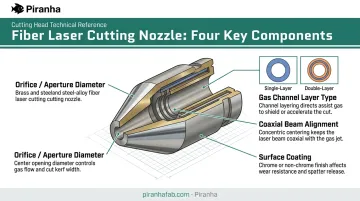
Cut quality comes down to how big the orifice is, how many gas layers the nozzle has, how well it's centered on the beam, and what's coating its surface.
- Orifice/aperture diameter: Controls gas velocity and flow volume. Too small starves the cut of gas; too large drops pressure before it reaches the material.
- Layer type (single vs. double): Single-layer suits nitrogen or air cutting on stainless steel and aluminum; double-layer suits oxygen cutting on carbon steel to sustain the oxidation reaction.
- Coaxial alignment with the beam: Beam and nozzle center must stay concentric within fractions of a millimeter, or the beam strikes the nozzle body and skews the kerf.
- Surface coating (chrome vs. non-chrome): Chrome-plated nozzles resist spatter buildup better than standard finishes, which matters most on jobs with heavy dross or long unattended runs.
Why Fabrication Shops Rely on Correct Nozzle Selection
Nozzle choice isn't cosmetic. It shows up directly in shop-floor numbers:
- Cleaner edges mean less time spent on secondary deburring and rework
- A properly matched nozzle protects the focusing lens from spatter, avoiding a costly replacement
- Correct gas flow reduces nitrogen or oxygen consumption per part
- Fewer mid-shift stoppages for nozzle swaps or lens cleaning keep throughput steady
- Consistent piercing on thick plate avoids failed starts that waste material and cycle time
What to Consider When Choosing the Best Nozzle
Nozzle selection isn't a single-variable decision. It's the intersection of material, gas, plate thickness, laser power, and cutting head. Get one wrong and it undermines the rest. These factors translate technical nozzle specs into numbers that matter on the floor: cut speed, scrap rate, and consumable spend.
Material Type and Assist Gas Pairing
Stainless steel and aluminum cut with nitrogen call for single-layer nozzles. Carbon steel cut with oxygen calls for double-layer nozzles, or E-type/SP designs once power climbs high enough to need extra gas flow.
Get the pairing wrong and the fallout shows up fast. Gas consumption climbs, oxide layers or dross form on the cut edge, and someone on the floor spends extra time grinding parts clean before they ship.
A shop running 3mm stainless with a double-layer oxygen nozzle instead of the correct single-layer nitrogen setup, for example, often sees heavier dross buildup that adds manual deburring time to every part.
Plate Thickness and Nozzle Diameter
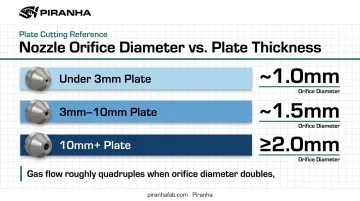
Thicker plates need larger apertures to sustain flow rate and clear molten material from the kerf. Thin sheet needs smaller apertures for precision and a tighter cut line.
HGLaser's published process guide offers a useful, if source-specific, reference range: roughly 1.0 mm for plate under 3 mm, stepping up to 1.5 mm above 3 mm, and 2.0 mm or larger once plate hits 10 mm and beyond. Treat that as a starting point, not gospel. Always confirm against your own cutting head's parameter sheet.
One rule holds across brands: run the smallest orifice that still produces the cut you need. Doubling the diameter roughly quadruples gas flow, so oversizing burns through nitrogen or oxygen fast without improving quality.
Laser Power Level
Higher power shifts nozzle requirements. As wattage climbs, standard double nozzles often give way to high-flow designs built to sustain oxygen delivery at speed. Single nozzles used for nitrogen cutting may need to move to variants suited for thicker stainless plate.
Mismatched nozzle-to-power selection is a common, and often overlooked, cause of unexplained cut-quality drift in shops that recently upgraded to a higher-wattage machine. The laser usually isn't the problem. The nozzle simply wasn't sized for the new power level.
Power-to-thickness guidance illustrates how much this changes: a 6kW laser can typically cut up to ¼-inch carbon steel with nitrogen assist, while a 2kW machine tops out closer to 10-gauge (0.135 inch). Nozzle sizing has to scale right along with that power curve.
Nozzle Type: Single, Double, and High-Power Variants
Single and double nozzles cover most jobs, but "one nozzle fits all" breaks down once gas volume, not beam quality, becomes the limiting factor.
| Nozzle Type | Assist Gas | Typical Material | Best For |
|---|---|---|---|
| Single-layer | Nitrogen or air | Stainless steel, aluminum, copper | Thin-to-mid gauge, clean edges |
| Double-layer | Oxygen | Carbon steel | General-purpose oxidation cutting |
| High-power (E-type, SP, Beam-style) | Oxygen or nitrogen | Carbon steel or thick stainless | Higher wattage, heavier plate |
Shops running mixed material jobs, stainless one day and carbon steel the next, typically stock more than one nozzle family rather than betting on a single universal choice.
Cutting Head Brand Compatibility
An aperture spec like "1.5mm single" isn't a universal part number. Thread patterns, body dimensions, and tolerances differ across cutting head brands, so a nozzle that fits one machine often won't thread onto another, even with an identical diameter listed.
Ordering the wrong part number over this mismatch causes install delays and unplanned downtime while the correct part ships in. Piranha's fiber laser platforms are built around standardized cutting heads, which keeps consumable sourcing simple instead of forcing shops to cross-reference part numbers every time they reorder.
Standoff Distance, Wear, and Maintenance Cadence
Standoff distance, the gap between the nozzle tip and the material, directly affects gas ejection efficiency and how long the nozzle lasts.
Published guidance varies by source. Some cutting head makers recommend roughly 0.3 to 0.8 mm, while The Fabricator's rule of thumb sets standoff at one nozzle diameter. Excess distance weakens molten-metal evacuation and forces higher gas pressure to compensate.
Either way, the fix is the same. Follow your cutting head's parameter sheet rather than a generic number, and inspect nozzles on a routine cadence:
- Check nozzle tips at the start of every shift for deformation, chipping, or clogging
- Replace after any collision, even if the nozzle still looks intact
- Track wear against job type; continuous production wears nozzles faster than mixed job-shop work
Proactive inspection reduces scrap rate and protects the lens sitting a few inches above the nozzle, a part that costs far more to replace.
How Piranha Can Help
Picking the right nozzle matters, but it's only half the equation. The fiber laser platform underneath that nozzle determines how consistently it performs, shift after shift.
Piranha works with fabricators to specify a system built for the materials and thicknesses they actually run, not a generic configuration that leaves nozzle and gas settings as guesswork. That conversation happens before the sale, and the same fabrication expertise stays available after the machine is running.
A few specifics matter when nozzle performance and uptime are on the line:
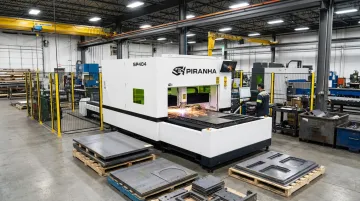
- Automation-ready cutting heads: Piranha's fiber laser lineup (3kW–20kW, SP404/SP510/Flex Series) is built for automation, so material handling can be added later without re-engineering the head.
- In-stock units cut the wait between placing an order and making a first cut.
- Same-day parts shipping from Piranha's Belvidere, IL facility means a worn nozzle or damaged lens doesn't turn into a week of downtime.
- U.S.-based phone support connects shops directly with someone who knows the equipment, not an overseas queue.
Piranha also sells the rest of the fabrication line: press brakes, ironworkers, shears, and plate rolls, all from the same manufacturer. For shops scaling capacity, that means consolidated ordering, parts, and support under one manufacturer instead of five vendors.
Conclusion
No nozzle works for every job. The right choice depends on five factors working together: material, plate thickness, gas, power level, and cutting head.
That match isn't permanent. Add a higher-wattage laser, start running thicker plate, or switch from carbon steel jobs to stainless, and the nozzle that worked last quarter may be the wrong choice now. Revisit selection whenever your material mix or machine changes, not just when something goes wrong.
Pair that correct selection with a routine wear-inspection habit, and cut quality and uptime take care of themselves. Piranha's parts team can help match consumables to your machine.
Frequently Asked Questions
What is the difference between a single nozzle and a double nozzle fiber laser?
Single-layer nozzles use one gas channel and pair with nitrogen or air for stainless steel, aluminum, and copper. Double-layer nozzles add an inner core and pair with oxygen for cutting carbon steel.
How thick will a 1500-watt fiber laser cut?
Stable cutting thickness depends heavily on material, gas, and edge-quality requirements, so there's no single reliable number. Check your machine's parameter sheet for the thickness range rated for stable, repeatable cuts rather than maximum severance.
How often should laser cutting nozzles be replaced?
It depends on production intensity. TRUMPF notes that a typical nozzle lasts roughly two to three shifts under normal use, though condition matters more than a fixed schedule. Inspect regularly and replace as needed.
What causes premature nozzle wear or damage?
Incorrect standoff distance, beam misalignment, gas pressure errors, and spatter contamination are the leading causes. A collision with the workpiece from running too close is one of the fastest ways to damage a nozzle.
Can the same nozzle be used across different cutting head brands?
No. Nozzles with identical aperture specs aren't interchangeable across brands like Precitec, WSX, Raytools, or BLT, because thread patterns and body dimensions differ even when the diameter matches.
How do I know which nozzle diameter to use for my material thickness?
Diameter should scale up with plate thickness and match your assist gas type. Always verify against your specific cutting head's parameter sheet rather than relying on a generic rule.